
Schengen Area Explained: Countries & Travel
 Written by
Janine El-Saghir
Janine El Saghir is an editor at How-to-Germany.com, where she specializes in the practical aspects of daily life and integration for expatriates. With years of...
Written by
Janine El-Saghir
Janine El Saghir is an editor at How-to-Germany.com, where she specializes in the practical aspects of daily life and integration for expatriates. With years of...
 Reviewed by
Erkan Boga
Erkan Boga is the founder and CEO of qmedia GmbH, the publishing house behind How-to-Germany.com. He established the platform with the clear vision of creating...
Reviewed by
Erkan Boga
Erkan Boga is the founder and CEO of qmedia GmbH, the publishing house behind How-to-Germany.com. He established the platform with the clear vision of creating...
 Edited by
Sadie Voss
Content Lead & Editor
Sadie Voss is the Lead Editor for How-to-Germany.com. As an expat who carved her own way into Berlin from the United States, Sadie is deeply...
Edited by
Sadie Voss
Content Lead & Editor
Sadie Voss is the Lead Editor for How-to-Germany.com. As an expat who carved her own way into Berlin from the United States, Sadie is deeply...
- Since 1985/1990, the Schengen area has developed into the largest free travel area in the world.
- The Schengen Agreement, initially signed by five European countries in 1985, provided for the gradual removal of border controls between the Schengen member states.
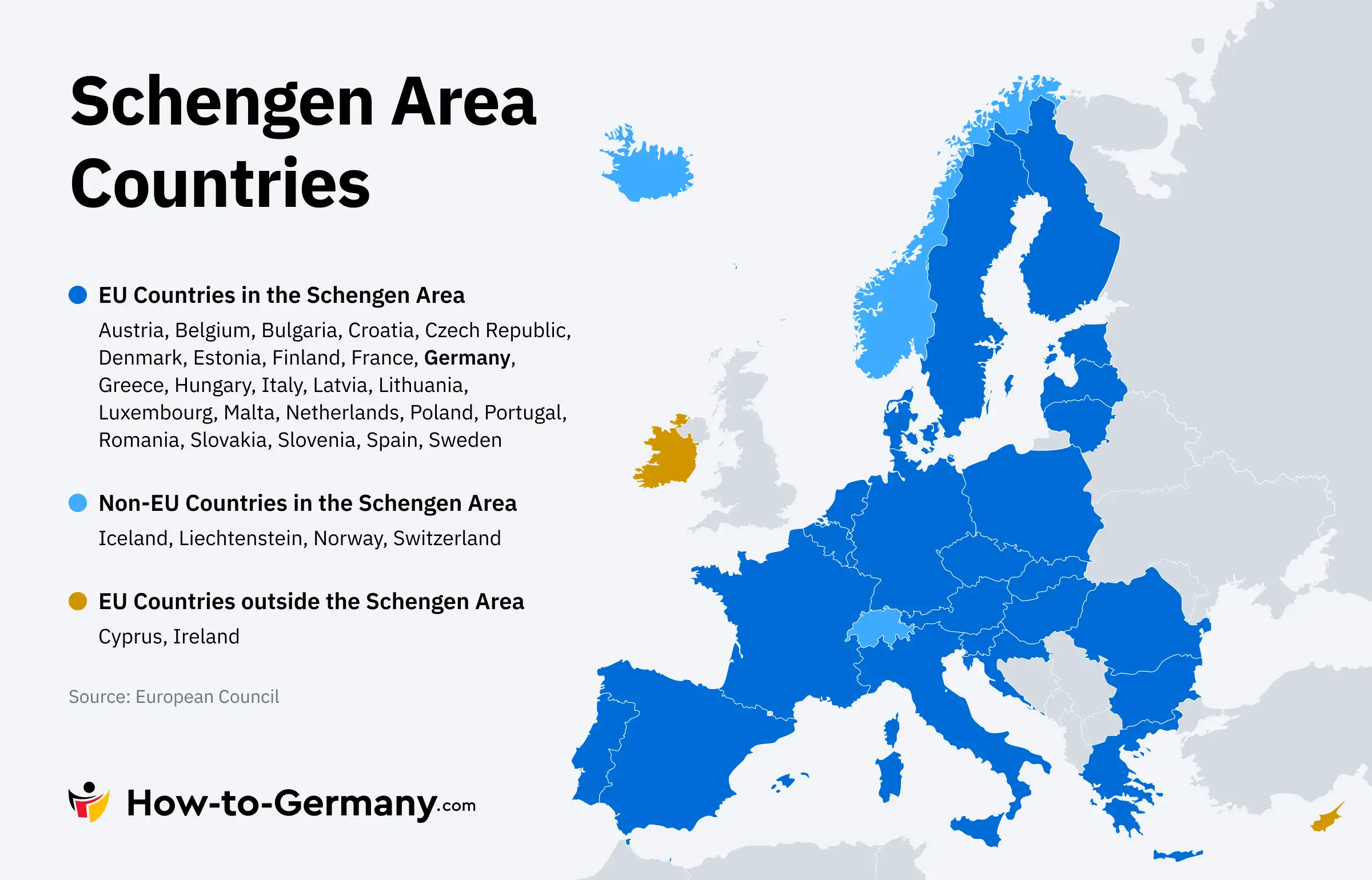
- Today, there are 29 Schengen countries. These include all member states of the European Union and several other countries, except Ireland and Cyprus.
- The centerpiece of the Schengen Agreement is the Schengen Borders Code. This code, which is a set of regulations, governs border formalities within the Schengen area and at its external borders. It outlines the procedures for border checks, visa requirements, and the conditions under which temporary border controls can be implemented.
- Citizens of Schengen countries travel visa-free and largely without border controls within the entire Schengen area. They also benefit from extensive freedom of establishment.
- The issuance of airport-transit and short-stay visas for the Schengen area is uniformly regulated. Expats who have obtained a valid Schengen C visa can generally travel throughout the Schengen zone within the conditions and permitted duration of that visa. National D visas and residence permits are separate documents for long-term stays, although they generally also permit short visits to other Schengen countries.
The Schengen Agreement and the Schengen Area
The Schengen area consists of 29 countries whose residents can travel visa-free and without routine border controls across Schengen member states. Its significance is fundamental to the idea and practice of the European Union: citizens of Schengen countries can move around in most of Europe as if it were a single country. There are also very liberal regulations regarding their residence in another Schengen country.
International travelers and expats also benefit from the freedom to travel within the Schengen zone. According to our German visa guide, a short-stay Schengen C visa is generally valid for the country it was applied to and all Schengen states, subject to the visa’s validity and permitted duration of stay. A German national D visa or residence permit is legally distinct from a Schengen C visa but generally also allows short visits to other Schengen countries for up to 90 days within any 180-day period.
The abolition of internal border controls in the Schengen area is accompanied by the goal of reliably protecting Europe’s external borders. The cornerstone for creating the world’s largest free travel area was laid in 1985 with the Schengen Agreement.
The Schengen Agreement
The Schengen Agreement was initiated by Germany and France in 1984. It was signed on June 14, 1985, initially by the initiators and by Belgium, Luxembourg, and the Netherlands. The Luxembourg village, where representatives of the participating countries met for this purpose, gave the Schengen process its name.
The Schengen Convention was signed in 1990 and entered into force in 1993. Its practical implementation, including the abolition of internal border checks between the first participating countries, began on March 26, 1995. In the following decades, the group of Schengen member states gradually expanded. The Schengen Agreement and all the regulations based on it are also referred to as the Schengen acquis.
From the outset, the fundamental objectives of the Schengen Agreement were:
- Abolition of internal border controls between member states
- Uniform procedures for issuing visas based on Schengen visa German requirements
- Establishment of the SIS database (SIS — Schengen Information System)
- Close cooperation between officials of various internal departments and the immigration authorities
Today, more than 400 million people live within the Schengen area. For the member states, it is not least an important economic factor. Because of international law and national regulations based on it, Schengen enables uncomplicated economic relations, barrier-free cross-border work, and cultural exchange. Tourism also benefits from this within the Schengen area and in the global dimension.
Schengen member states
Today, the Schengen Area includes all European Union countries except Ireland and Cyprus. Schengen member states outside the EU are Iceland, Norway, Liechtenstein, and Switzerland.
Bulgaria and Romania are the newest Schengen member states. Internal air and sea border controls were lifted on March 31, 2024, followed by internal land-border controls on January 1, 2025. Both countries now participate fully in the Schengen area.
Special regulations for individual countries
Ireland, the United Kingdom, and Cyprus are non-Schengen countries and do not issue Schengen visas. The United Kingdom also left the European Union in 2020. International expats may need to apply for a separate visa for each country, and a visa issued by one of these countries does not automatically entitle them to enter the Schengen area or vice versa.
However, citizens of the Schengen member states do not require a visa for short visits to Ireland, Great Britain, or Cyprus. For the United Kingdom, they need an electronic travel authorisation (ETA) before the trip unless they already have permission to live, work, or study there. Cyprus is in the process of creating the structural conditions for full Schengen membership.
Great Britain and Ireland form the Common Travel Area, which primarily gives British and Irish citizens rights to travel, live, and work across both countries. Third-country nationals and other expats living in either country do not automatically receive the same freedom of movement and must comply with the separate immigration and entry rules applicable to their nationality and residence status.
The 4 European microstates (Andorra, San Marino, Monaco, Vatican) are also non-Schengen countries. They have freedom of movement without border controls with their immediate neighbors.
Overseas territories
The Schengen member states Denmark, France, the Netherlands, and Norway have overseas territories that belong to their national territory but are not part of the Schengen zone.
The British overseas territory of Gibraltar belongs neither to the EU nor the Schengen area.
Other European countries
All other countries that geographically belong in whole or in part to Europe — for example, the Balkan countries except the EU member states Croatia and Slovenia or Turkey — do not belong to the Schengen area.
Common Schengen Information Systems
Border controls, visa issuance, and cooperation between authorities are uniformly regulated in and between the Schengen member states.
The basis for freedom of movement within the Schengen area is largely the Schengen Borders Code, which defines the absence of internal border controls as the normal state of affairs. However, the Schengen states are entitled to introduce temporary border controls if they can claim national security interests.
In addition, these countries operate joint border and security systems, including the VIS (Visa Information System), SIS (Schengen Information System), and EES (Entry/Exit System).
The Entry/Exit System became fully operational on April 10, 2026 across the external borders of the Schengen Area. It electronically registers the entry, exit, and refusal-of-entry data of covered non-EU nationals traveling for short stays.
EES records information from the traveler’s passport together with biometric data, including a facial image and fingerprints where required. It digitally calculates the duration of an authorized stay and helps authorities identify overstayers and document fraud.
For travelers covered by EES, electronic registration has replaced routine physical entry and exit stamps. Manual passport stamping may still be used as a fallback during a technical failure or where another specific exception applies. Holders of residence permits, national long-stay visas, and certain other exempt travelers are generally not registered in EES.
ETIAS has not started yet, and the EU has not set a start date: the official ETIAS portal (checked on October 7, 2026) says the date will be announced several months before the launch, and the earlier target of late 2026 is no longer listed there. Once introduced, eligible visa-exempt travelers will need an ETIAS travel authorization before a short trip to participating European countries. ETIAS is not a visa and is not yet accepting applications; the EU will announce the specific start date before launch. Current information is available from the official EU ETIAS portal.
Visa Information System
The VIS is designed to optimize the exchange of information between Schengen member states regarding granting visas and the decision on asylum applications. The system has the following functions:
- facilitating border controls at the external Schengen borders (if necessary, also internally in the case of justified national interests)
- facilitating the granting of visas for the Schengen area
- Combating illegal entry
- Support in deciding which Schengen state is responsible for examining asylum applications
Schengen Information System
The SIS explicitly fulfills security functions. Among other things, it supports:
- Cross-border police cooperation between the Schengen states
- Cooperation between their law enforcement agencies, judicial cooperation
- Cooperation in vehicle registration
Schengen visa — visa types and visa requirements
The Schengen member states have established a uniform procedure for issuing airport-transit A visas and short-stay Schengen C visas. When you apply for a short-stay Schengen visa at the embassy of a Schengen country, your application is assessed according to the common criteria established by the Schengen Visa Code.
A Schengen C visa is normally issued as a sticker that is affixed to your passport. It allows you to visit all 29 Schengen countries, subject to the visa’s validity and permitted duration of stay. If you have a German Schengen C visa, you can travel throughout the entire Schengen area, usually without routine internal border controls.
At the external Schengen border, travelers covered by EES now undergo electronic entry registration rather than routine passport stamping. Border authorities check the traveler’s passport and visa and may collect or verify a facial image and fingerprints. A valid visa does not create an automatic right of entry, and temporary internal border checks may also take place.
A short-stay Schengen C visa is intended for tourism, business visits, family visits, medical treatment, cultural events, and other short visits. It permits a maximum stay of 90 days within any 180-day period and does not generally authorize paid employment or long-term study.
A short-stay Schengen C visa permits travel for no more than 90 days within a 180-day period. It may be issued for tourism, business visits, family visits, medical treatment, or short study visits, but it does not authorize paid employment or long-term study.
A national D visa is issued by an individual country under its national immigration law for stays such as employment, study, vocational training, or family reunification. It is not a long-term Schengen visa and is not issued under the unified Schengen Visa Code.
A national D visa or residence permit issued by one Schengen country generally allows travel to other Schengen countries for short stays of up to 90 days within a 180-day period. It does not automatically authorize long-term study, employment, or residence in another country.
For example, a student holding a valid German national D visa or German residence permit can normally visit France for tourism or another short-stay purpose for up to 90 days within any 180-day period. This right comes from the German D visa or residence permit, not from a “German Schengen visa.”
Anyone planning to work or study for more than 90 days will normally need a national D visa or residence permit from the specific country where the activity will take place.
Under the student-mobility rules established by Directive (EU) 2016/801, a student who holds a valid study residence permit or long-stay study visa issued by one participating EU country may, under certain conditions, study in another participating EU country for up to 360 days. This is not a right granted by a short-stay Schengen C visa. It generally requires the student to participate in an EU or multilateral mobility program, or an agreement between higher-education institutions, and a formal notification procedure must be completed before the mobility period. These rules do not apply in Ireland or Denmark and do not extend to non-EU Schengen countries such as Norway or Switzerland.
Schengen visa types
Visas for Germany are issued for various purposes, which you must state in your visa application and interview. However, a visa for Germany is not always a Schengen visa.
Schengen visas are limited to airport-transit A visas and short-stay C visas. German national D visas form a legally separate category governed primarily by German immigration law. The available visa purposes are therefore divided between German short stay visas and German national long-stay visas:
- Tourist visas and German airport transit visas
- German cultural events visas and visas for visiting family members or friends
- German business visas
- German medical treatment visas
- National work visas, including German freelance visas
- National German job-seeker visas
- National student visas, including full-time study, study preparation, and German language course visas
- National visas for vocational training and German internship visas
- National visas for family reasons, including German spouse visas and family reunification
Schengen C visas are issued for a single entry, as a double-entry or multiple entry visa.
Short- and long-term Schengen visas
Despite the commonly used wording, only airport-transit A visas and short-stay C visas are Schengen visas governed by the Schengen Visa Code. National D visas are separate national visas for longer stays, although they generally provide limited mobility rights within the Schengen Area.
Short-stay Schengen visas and national long-stay visas differ in terms of their legal basis, purpose, and period of validity:
- C visas are Schengen short-stay visas issued for a maximum of 90 days within 180 days according to the German 90/180 day rule calculator tool. You can get this visa for tourist trips, visits to family and friends, business trips, medical treatment, or short study visits. It does not authorize paid employment or long-term study.
- National D visas (German long stay visas) are issued under national law for a planned stay of more than 90 days. They are not long-term Schengen visas. A residence permit may also be required after entry, depending on the duration and purpose of the stay. The validity of D visas and national residence permits depends on the purpose of your stay. For example, student or work permits may allow a stay of several years. Although a national D visa generally allows short visits within the wider Schengen area, it is legally distinct from a Schengen C visa.
European embassies usually issue a Schengen C visa for the period you have applied for. However, a shorter period of validity is also possible. After your permitted stay has expired, you must leave the Schengen area unless a lawful extension or another valid residence status applies.
However, not all visas are extendable. According to the Schengen Visa Code, a C visa can normally be extended only in limited exceptional circumstances. For D visas and residence permits, the available extension options depend on the visa type and national immigration law.
Schengen visa process and visa requirements
You apply for a Schengen visa at the embassy or consulate of the Schengen country that is your main destination. You’ll normally need to schedule an appointment to submit your visa documents and biometric information. Depending on the country, the application may be handled by an embassy, consulate, or authorized external service provider.
The basic requirements for a Schengen visa are:
| Requirement | Description | Example / Details | Notes |
|---|---|---|---|
| Financial Means | Proof of sufficient funds. | Bank statements, income proof, or sponsor declaration of commitment. | Must cover entire stay. |
| Health Insurance | Valid Schengen travel insurance adhering to German visa insurance standards. | Coverage for medical emergencies during stay. | Mandatory for visa approval. |
| Passport | Valid passport required. | Must meet German visa passport requirement rules and German visa photo requirements. | Core document for application. |
| Proof of Return Intention | Required for many visa types. | Employment, studies, or family ties in home country. | Shows intent to leave Schengen area. |
| Visa Fee Payment | Proof of payment required. | Receipt showing payment of the applicable fee. See our guide to German visa fees. | Core document for application. |
Depending on the type of visa you are applying for, you will need further documents for the visa application, some of which may require official certification. You can find information on the website of the embassy, consulate, or authorized application center where you are applying.
If a Schengen visa is refused
If a German Schengen visa application is rejected, the applicant receives a refusal notice stating the reasons and available legal remedies. Since July 1, 2025, German missions no longer accept remonstrations against visa refusals. Applicants may submit a new application with corrected or additional evidence, or seek judicial review in accordance with the instructions and deadline stated in the refusal notice. Further information is available from the German Federal Foreign Office.
Conclusion
The Schengen Area represents a groundbreaking achievement in European and global mobility, enabling seamless travel across 29 European countries. By eliminating routine internal border controls and harmonizing short-stay visa regulations, it offers substantial freedom of movement for residents and international travelers.
The standardized Schengen visa system covers airport-transit A visas and short-stay C visas. German national D visas are a legally separate category governed by national immigration law and continue to regulate long-term work, study, vocational training, and family reunification. Although national D visas generally permit short visits to other Schengen countries, they should not be described as long-term Schengen visas.
The VIS, SIS, and fully operational EES support common visa, security, and external-border processes. For covered short-stay non-EU travelers, EES now records entries and exits electronically using passport and biometric information, replacing routine physical passport stamping.
This framework facilitates cultural exchange and economic cooperation while maintaining common external-border and security systems. Travelers should nevertheless observe the conditions of their specific visa or residence permit, particularly the 90-day limit and the prohibition on using a short-stay Schengen C visa for paid employment or long-term study.
Frequently Asked Questions
Citizens of countries that do not have a visa-exemption agreement with the Schengen Area generally require a Schengen visa for short stays of up to 90 days within any 180-day period.
Citizens of EU and Schengen countries do not require a visa. Travelers from visa-exempt countries, such as the United States, Canada, the United Kingdom, Australia, and Japan, can normally enter without a Schengen visa for short visits, provided they meet the applicable entry requirements.
A visa may also not be required if you hold a valid residence permit or long-stay visa issued by a Schengen country. The exact rule depends on your nationality, passport, residence status, and purpose of travel.
A valid German Schengen C visa generally allows you to travel to the other Schengen countries during the visa’s validity, provided it is not marked as territorially restricted. Your total stay throughout the Schengen Area must remain within the permitted limit, usually 90 days within any 180-day period.
A German national D visa or residence permit also normally allows short visits to other Schengen countries for up to 90 days within any 180-day period. However, it does not automatically permit you to work, study long term, or live in another country.
A German visa does not automatically allow entry to non-Schengen European countries such as Ireland or the United Kingdom. Their separate immigration rules apply.
Possibly. A German student residence permit normally allows you to visit France for up to 90 days within any 180-day period, but it does not automatically authorize a full semester of study there if the stay exceeds 90 days.
You may be able to study in France without obtaining a separate French long-stay visa if the semester is part of an official EU or university mobility program and the required notification or mobility procedure is completed by the participating institutions. Otherwise, you will generally need authorization from France, such as a French long-stay student visa or residence permit.
Before traveling, confirm the arrangement with both universities and the competent French immigration or consular authority, especially if the semester will last longer than 90 days.