
Guide to the German Schengen Visa
 Written by
Janine El-Saghir
Janine El Saghir is an editor at How-to-Germany.com, where she specializes in the practical aspects of daily life and integration for expatriates. With years of...
Written by
Janine El-Saghir
Janine El Saghir is an editor at How-to-Germany.com, where she specializes in the practical aspects of daily life and integration for expatriates. With years of...
 Reviewed by
Erkan Boga
Erkan Boga is the founder and CEO of qmedia GmbH, the publishing house behind How-to-Germany.com. He established the platform with the clear vision of creating...
Reviewed by
Erkan Boga
Erkan Boga is the founder and CEO of qmedia GmbH, the publishing house behind How-to-Germany.com. He established the platform with the clear vision of creating...
 Edited by
Sadie Voss
Content Lead & Editor
Sadie Voss is the Lead Editor for How-to-Germany.com. As an expat who carved her own way into Berlin from the United States, Sadie is deeply...
Edited by
Sadie Voss
Content Lead & Editor
Sadie Voss is the Lead Editor for How-to-Germany.com. As an expat who carved her own way into Berlin from the United States, Sadie is deeply...
- Most international tourists and other expats usually need a visa to enter Germany unless they are EU, EEA, Swiss, or visa-exempt nationals.
- The Schengen Area has 29 member states in 2026, following the full integration of Bulgaria and Romania into Schengen land-border travel from January 1, 2025.
- A Schengen C visa is for short stays only and allows a maximum of 90 days in any rolling 180-day period.
- Stays of more than 90 days require a national D visa or residence permit route, not a Schengen C visa.
- To be issued a German Schengen visa, you must prove your travel purpose, accommodation, financial means, travel health insurance, and intention to leave the Schengen Area on time.
- The standard Schengen visa fee is €90 for adults, while the standard national D visa fee is €75.
- The Entry/Exit System (EES) is now fully operational and has replaced physical passport stamps for many short-stay border crossings.
- ETIAS has not started yet; the EU will announce the start date several months in advance (official ETIAS portal, checked on October 7, 2026). Until then it is not required.
Schengen area and Schengen visa
The Schengen area, established by the Schengen Agreement since 1985, consists of 29 member states in 2026. They include all EU countries except Ireland and Cyprus, plus the non-EU countries Iceland, Norway, Switzerland, and Liechtenstein.
In the Schengen zone, internal border controls have been largely abolished. Checks are normally carried out at external borders. Its citizens enjoy extensive travel and, in most cases, freedom of establishment. Visas for the Schengen area are issued according to uniform criteria.
If you apply for a German Schengen visa, it can allow travel not only in Germany but also in other Schengen countries, unless territorial restrictions apply. However, a Schengen C visa is always limited to short stays. It does not allow a stay of more than 90 days.
Your German visa’s validity period depends on the purpose of your stay. Short stays in the Schengen Area are limited to a maximum of 90 days in any rolling 180-day period. For a longer stay, you need a national D visa or a residence permit route.
A Schengen C visa is for short stays only. It allows a maximum stay of 90 days in any 180-day period. If you want to study, work, join family, or live in Germany for longer than 90 days, you need a national D visa or residence permit route.
Schengen visa types
In general, Germany and the other Schengen countries issue visas in the following categories:
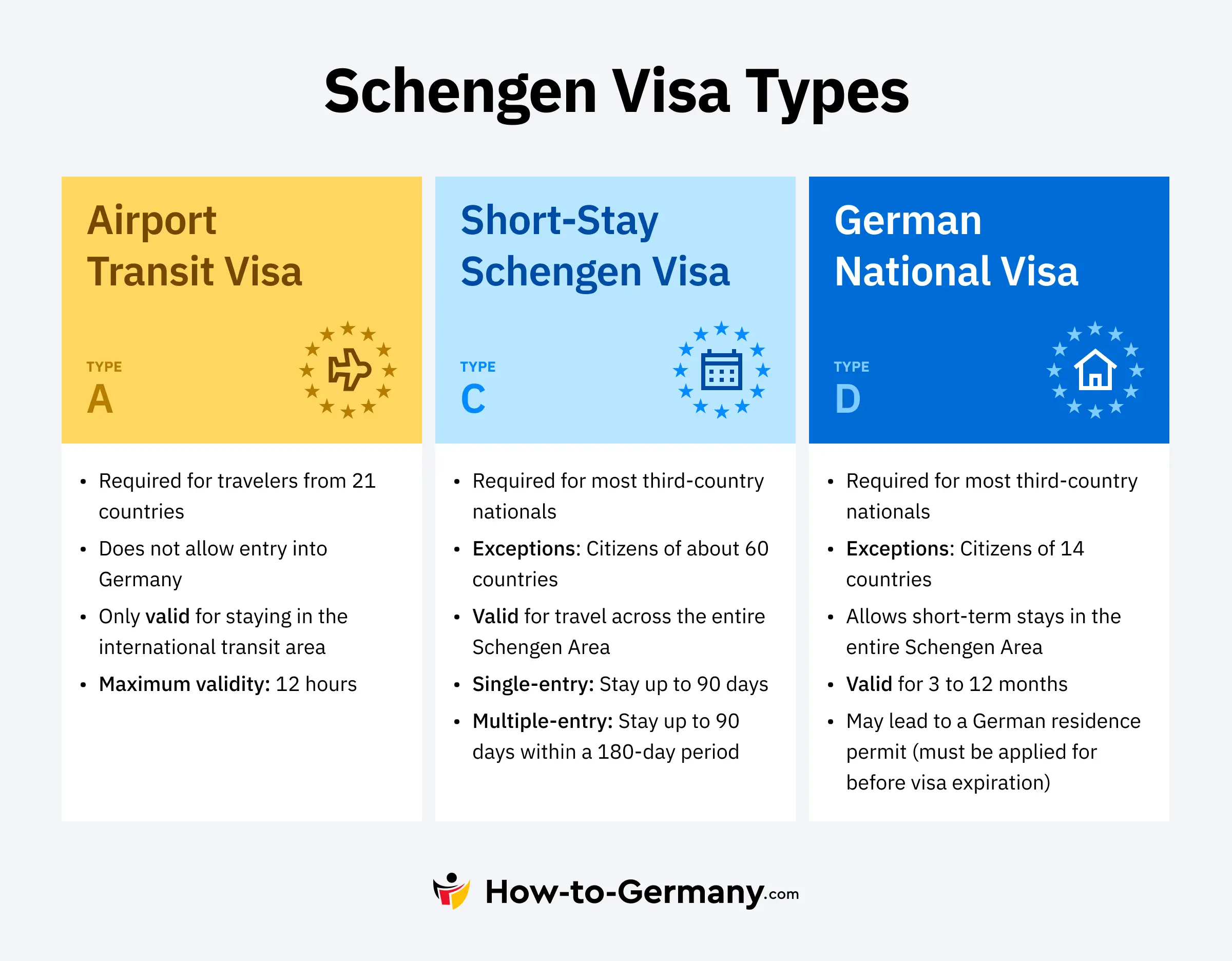
- Schengen visa A: Airport transit visa. This is only needed by certain travelers who transit through the international transit area of a Schengen airport.
- Schengen visa C: Short stay visa for a maximum of 90 days in any 180-day period. C visas can be issued to tourists, people visiting family members and friends, business travelers, and participants in short study programs. A residence permit for Germany is not required for a short C visa stay, and work is usually not allowed.
- National visa D: You need a D visa to stay in Germany for more than 90 days. After arrival, you usually apply for a residence permit in Germany. How long you can stay with a D visa depends on the reason for your stay, such as study, work, training, language learning, family reunification, job seeking, or the Opportunity Card. Work may be possible depending on the visa type and the conditions printed on the visa or residence permit.
Schengen C visas can be extended only in exceptional cases
It is too absolute to say that a Schengen C visa can never be extended. Under Schengen rules, a C visa can be extended in exceptional situations, especially if you can prove force majeure, humanitarian reasons, or serious personal reasons.
Examples can include:
- Force majeure: No air traffic because of extreme weather, strikes, or other events outside your control.
- Humanitarian reasons: Sudden serious illness, urgent medical treatment, or inability to travel.
- Serious personal reasons: Important unexpected personal circumstances that make timely departure impossible.
These extensions are exceptional and must be requested before your visa or visa-free stay expires. They are not a normal way to turn a short stay into a long-term residence route.
A Schengen C visa is normally not extendable, but exceptional extensions may be possible for force majeure, humanitarian reasons, or serious personal reasons. This does not change the basic rule that C visas are for short stays only.
Each route has its own guide:
- Short-stay visas (C): business trips, trade fairs, cultural and sports events, medical treatment and airport transit.
- Long-stay visas (D): study, skilled work, the EU Blue Card, the Opportunity Card, job seeking, freelancing, language courses, internships, research and family reunion.
- Visa requirements: passport, photos, the application steps, travel health insurance and the declaration of commitment.
- Visa rules and administration: the Schengen Area, the 90/180-day rule, visa fees, ETIAS and what to do after a refusal.
Who requires a Schengen visa?
All citizens of third countries who are not exempt from visa requirements must have a Schengen visa for entry and short stays in Germany and the Schengen zone.
In principle, expats from the European Union, EEA, Switzerland, and other Schengen countries do not need a visa to enter Germany or a national residence permit.
If you have a valid visa or residence permit from another Schengen country, you usually do not need a separate Schengen visa for short stays in Germany, regardless of your country of origin. However, long-term residence, work, study, or family reunification in Germany may still require a German national residence title.
Due to common legal regulations for all Schengen countries, citizens of around 60 other countries do not require an entry visa for Germany and the Schengen area for short-term stays. These travelers can usually stay for up to 90 days in any 180-day period without a Schengen visa, as long as they meet entry requirements.
For D visas, Germany has national rules. Currently, visa-free entry to Germany for later residence permit applications is possible for citizens of certain countries, including the United Kingdom, the United States, Canada, Australia, Israel, Japan, South Korea, and New Zealand. They then have 90 days to apply for the correct national residence permit, depending on their stay purpose.
Quick visa check: Which route fits your stay?
Use this quick check as an orientation tool before you apply.
| Your situation | Likely route | Important note |
|---|---|---|
| I am an EU, EEA, or Swiss citizen | No German visa needed | You may need to register your address after moving to Germany. |
| I am visa-exempt and staying up to 90 days | No Schengen visa, but EES now applies and ETIAS may apply later | You must still respect the 90/180-day rule and meet entry conditions. |
| I need a visa and will visit for up to 90 days | Schengen C visa | Use the official VIDEX form and embassy checklist. |
| I want to search for a job in Germany | Opportunity Card or another national job-search route | The Opportunity Card is a national long-stay route, not a Schengen C visa. |
| I want to work, study, train, or live in Germany | National D visa or residence permit route | A Schengen C visa is not the right route for long-term residence. |
| I want to stay more than 90 days | National D visa | Choose the D visa category that matches your actual purpose of stay. |
EES and ETIAS change travel to Germany in 2026
Two major EU border systems matter for travelers in 2026: the Entry/Exit System and ETIAS.
The Entry/Exit System (EES) is no longer just an upcoming system. It began its progressive rollout on October 12, 2025 and became fully operational across the Schengen Area on April 10, 2026. The system digitally registers entries, exits, and refusals of entry for non-EU nationals traveling for short stays. It has replaced physical passport stamps for many short-stay border crossings and helps authorities detect overstays. Travelers may need to provide biometric data, such as a facial image and fingerprints, depending on the border process.
The European Travel Information and Authorisation System (ETIAS) is not a visa. It is a travel authorization for visa-exempt travelers entering participating European countries for short stays. ETIAS has not started yet, and the EU has not set a start date: the official ETIAS portal (checked on October 7, 2026) says the date will be announced several months before the launch, and the earlier target of late 2026 is no longer listed there. Until then, visa-exempt travelers do not need ETIAS. Once ETIAS starts, applicants between 18 and 70 years old generally need to pay a €20 application fee, while travelers under 18 or over 70 are exempt from this fee. Travelers who need a Schengen visa do not apply for ETIAS; they apply for the visa instead.
EES records entries and exits at the border. ETIAS is a pre-travel authorization for visa-exempt travelers. Schengen visa holders use the visa process; visa-exempt travelers may need ETIAS once it becomes mandatory.
German Schengen visa application
You can apply for a German Schengen visa at the German Embassy or a German Consulate in your country of residence. In some countries, applications are submitted through a commercial visa center that accepts documents and biometrics on behalf of the German mission.
Before applying, use official tools where possible:
- Visa Navigator: Use the official Federal Foreign Office Visa Navigator to check which visa type fits your purpose.
- VIDEX: Use the official VIDEX online form for Schengen visa applications where instructed by the German mission.
- Consular Services Portal: For many national visa routes, use the official Consular Services Portal if your visa type and mission support online application.
Step-by-step German visa roadmap
The process is easier if you follow the application in chronological order.
| Step | What to do | Why it matters |
|---|---|---|
| 1. Check visa-free status | Confirm whether your nationality requires a visa for short stays. | Visa-exempt travelers do not apply for a Schengen visa, but must still follow the 90/180-day rule. |
| 2. Choose C visa or D visa | Match the visa type to your stay length and purpose. | C visas are for up to 90 days; D visas are for longer stays or residence purposes. |
| 3. Use the Visa Navigator | Check the official German visa category for your purpose. | This reduces the risk of applying under the wrong route. |
| 4. Complete VIDEX or the correct online form | Fill in the official application form carefully. | Errors in dates, passport details, or travel purpose can delay or weaken your application. |
| 5. Book the appointment | Schedule the embassy, consulate, or visa-center appointment early. | Appointment wait times can be long in many countries. |
| 6. Prepare documents | Collect passport, photos, insurance, accommodation, financial proof, itinerary, and purpose documents. | Incomplete applications can be delayed or refused. |
| 7. Attend the appointment | Submit documents, give biometrics, pay the fee, and answer questions if required. | The visa officer reviews whether your trip is credible and documented. |
| 8. Track the decision | Wait for processing and respond quickly if the mission asks for more information. | Missing follow-up documents can delay the decision. |
Visa requirements and documents
If you apply for a Schengen visa, you must fulfill certain requirements and prove this with documents:
| Document | Requirement | Example / Details | Notes |
|---|---|---|---|
| Application Forms | Completed and signed. | Visa application forms, usually completed through VIDEX where required. | Must be filled out correctly. |
| Biometric Photos | 2 passport photos. | Biometric standard photos. | Must meet official requirements. |
| Civil Status Documents | If applicable. | Marriage certificate, children’s birth certificates, or family documents. | Shows family ties to home country. |
| Cover Letter | Personal statement required. | Explanation of purpose of travel, route, and return plan. | Should clearly state reasons for the trip. |
| Documents for Minors | If applicable. | Signed application by parents, passport copies, consent letter. | Special rules apply for unaccompanied minors. |
| Education Proof | If applicable. | No-objection certificate from school or university. | Required for many pupils and students. |
| Employment Proof | If applicable. | Employment letter, salary slips, and leave approval. | Confirms job status and return ties. |
| Flight Reservation | Travel itinerary required. | Outbound and return flight reservations. | Return proof is especially relevant for C visas. |
| Passport | Valid passport required. | Original passport and copies. | Must meet Schengen validity and issue-date rules. |
| Proof of Accommodation | Accommodation required. | Hotel booking, rental confirmation, or invitation letter. | Must cover the stay, especially for C visas. |
| Proof of Financial Means | Proof of sufficient funds. | Bank statements, salary slips, sponsor letter, declaration of commitment, or blocked account. | For short stays, plan roughly €45–€50 per day as orientation; exact expectations depend on the mission and trip details. |
| Proof of Residence | Address verification required. | Utility bills, residence permit, or local registration proof. | Used if you apply outside your country of citizenship. |
| Statement of Accuracy | Signed declaration required. | Declaration confirming all information is true. | Usually part of the application package. |
| Travel Health Insurance | Minimum coverage required. | Schengen insurance with at least €30,000 coverage. | Must cover the entire Schengen stay. |
| Visa Fee Payment | Proof of payment required. | Receipt of visa fee. | The standard adult Schengen visa fee is €90. |
An invitation letter or a declaration of commitment from relatives or friends with their main residence in Germany can be used as proof of accommodation and financing of your stay. An invitation letter also requires current address proof from the inviting person. A formal declaration of commitment must be submitted to the local immigration office in Germany and is accepted only if the sponsor meets the financial requirements.
The German missions abroad may require further documents, including notarization if necessary. For student and work visas, for example, proof of educational and professional qualifications and knowledge of the German language may be required. Always check the German Embassy website in your country of residence before you apply for a visa.
The documents for the visa application may need to be submitted in the original and with copies. Check the local embassy or visa-center checklist before the appointment.
Financial proof depends on the visa type
For Schengen short stays, there is no single universal bank balance that guarantees approval. As a practical orientation, applicants often need to show around €45–€50 per day for Germany, plus credible accommodation and return-travel proof. The embassy may expect more if the trip is long, accommodation is expensive, the travel plan is unclear, or the applicant has weak ties to the home country.
For national student visas, the blocked account amount is more specific. In 2026, students generally need €992 per month, or €11,904 per year, in a blocked account or equivalent proof of financing. Other national visa categories can require different amounts.
A bank balance alone does not guarantee approval. The embassy also checks whether the money is credible, recent, consistent with your income, and enough for your travel plan.
The Opportunity Card is a national job-search route
The Opportunity Card, or Chancenkarte, is a newer German job-search residence route introduced in June 2024. It is not a Schengen C visa and cannot be used for a short tourist-style stay. It is a national long-stay route for qualified job seekers who want to come to Germany to look for work.
Applicants usually need either recognition as a skilled worker or enough points under the Opportunity Card points system. They must also prove that they can support themselves during the stay. For 2026, the financial benchmark is usually €1,091 net per month. This can be shown through a blocked account, sufficient part-time income, or a combination of both, depending on the case.
Use the official Opportunity Card self-check to understand whether this route may fit your job-search plans.
A Schengen C visa is for short visits of up to 90 days. The Opportunity Card is a national German residence route for job seekers and has different eligibility, financial proof, and work rules.
Visa application process
The visa application process usually requires you to submit the visa documents in person at an embassy, consulate, or visa center and complete an interview or identity check where required. You’ll need to schedule an appointment with enough notice.
Exceptions may apply if you apply through a visa center or online portal. For many national visa applications, Germany’s Consular Services Portal now allows digital application preparation, although biometric data and original documents may still require an in-person step.
Study mobility inside the EU requires notification
For study visits of up to 360 days in another EU member state, a student with a valid residence permit from one participating EU country may not need a separate visa for the host country. However, this does not mean the student can simply move without procedure.
Under EU student mobility rules, a notification procedure is required. For Germany, this usually involves the host higher education institution notifying the Federal Office for Migration and Refugees, known as BAMF, before the mobility stay begins.
A separate visa may not be required for certain study mobility stays, but the host-country notification procedure still matters. Students should coordinate with the host university before travel.
Conclusion
Obtaining a Schengen visa for Germany involves a structured application process and compliance with specific requirements. Understanding the visa categories and their conditions is essential for short-term visits, extended stays, or specialized purposes such as work or study.
The most important correction for 2026 is that a German Schengen C visa does not allow travel for “more or less than 90 days.” It is strictly limited to 90 days in any 180-day period. Stays longer than 90 days require a national D visa or residence permit route.
The Schengen Area now consists of 29 member states. Travelers should also account for the Entry/Exit System, which is now fully operational, and ETIAS, which will apply to visa-exempt travelers once it starts; the EU has not set the date yet. Until then, travelers do not need ETIAS.
Preparing early, using official tools such as VIDEX and the Visa Navigator, checking the embassy-specific checklist, and making sure your documents are complete can significantly improve the likelihood of a successful application.
Frequently Asked Questions
If Germany is your only travel destination in Europe, if you mainly want to stay there or are entering the Schengen area via Germany, you can apply for a visa at a German mission abroad.
The visa application can be made 6 months before the planned trip. However, especially with national visas for a longer stay, you also have to expect a processing time of up to 3 months. Tourist visas and private visits can sometimes be obtained after just 3 weeks. The latest possible time for the visa application is 14 days.
Normally, a Schengen C visa cannot be extended. However, an extension may be possible in exceptional cases, such as force majeure, humanitarian reasons, or serious personal reasons. Examples include sudden illness, urgent medical treatment, or canceled transport caused by events outside your control.
The Entry/Exit System, or EES, digitally records entries and exits of non-EU nationals traveling for short stays. It replaces manual passport stamping and helps track the 90/180-day rule. Travelers may need to provide biometric data at the border.
In some cases, students with a valid residence permit from another participating EU country can study in Germany for up to 360 days without applying for a separate German visa. However, this requires a formal mobility notification procedure, usually handled through the host university and BAMF.