
How we earn our money
We finance our services on how-to-germany.com through affiliate programs.
When a user orders a financial product through our site and their application is approved, we may receive a commission from some providers. It’s important to note that this does not in any way influence our independent ratings and recommendations.
All the products we present on how-to-germany.com are selected for their quality, range of services, and excellent value for money.
Bank Accounts in Germany
 Written by
Janine El-Saghir
Janine El Saghir is an editor at How-to-Germany.com, where she specializes in the practical aspects of daily life and integration for expatriates. With years of...
Written by
Janine El-Saghir
Janine El Saghir is an editor at How-to-Germany.com, where she specializes in the practical aspects of daily life and integration for expatriates. With years of...
 Reviewed by
Erkan Boga
Erkan Boga is the founder and CEO of qmedia GmbH, the publishing house behind How-to-Germany.com. He established the platform with the clear vision of creating...
Reviewed by
Erkan Boga
Erkan Boga is the founder and CEO of qmedia GmbH, the publishing house behind How-to-Germany.com. He established the platform with the clear vision of creating...
 Edited by
Sadie Voss
Content Lead & Editor
Sadie Voss is the Lead Editor for How-to-Germany.com. As an expat who carved her own way into Berlin from the United States, Sadie is deeply...
Edited by
Sadie Voss
Content Lead & Editor
Sadie Voss is the Lead Editor for How-to-Germany.com. As an expat who carved her own way into Berlin from the United States, Sadie is deeply...
- C24 Current Account – Strong digital current account option with modern app features, German IBAN, and competitive everyday banking tools.
- Commerzbank Current Account – Best branch-bank option for people who want in-person support. The digital GiroKonto currently costs €4.90/month for new customers; the StartKonto is free for eligible students and young people under 28.
- comdirect Current Account – Strong online account from the Commerzbank group, especially for users who want a current account and securities account from one provider.
- DKB Current Account – Best bank account in Germany for established expats with German registration, suitable SCHUFA profile, and regular incoming payments. Free with active status from more than €700 monthly incoming payments or for many users under 28.
- ING Current Account – Also great for established expats. Free with at least €1,000 monthly incoming payments or for account holders under 28. Everything in German.
- Trade Republic Account – Strong broker-linked current account for investing, card spending, interest on cash, SEPA payments, direct debits, and standing orders, but currently without overdraft limits or joint accounts.
Compare Bank Accounts in Germany




Most banks will offer their websites only in German. Translate the pages using the Chrome browser’s built-in feature (Right-click → Translate to English). If a button or link is unresponsive, switch back to the German version and retry.
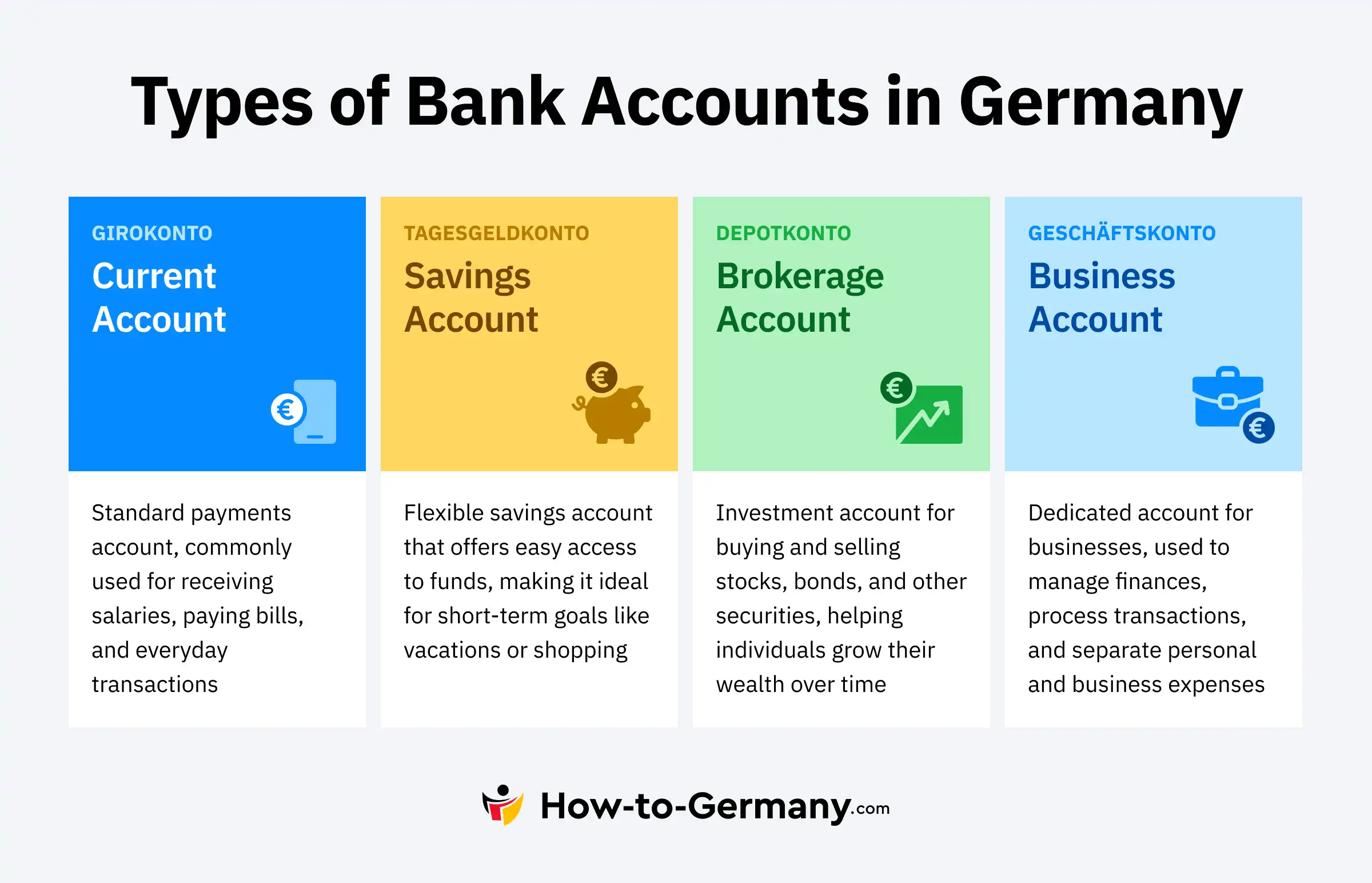
Choosing the Right German Bank Account

When selecting a German bank account, it’s crucial to consider factors such as language support, accessibility, fees, and banking preferences. Recently, the German banking market has witnessed the rise of innovative neo-banks, offering attractive features like user-friendly apps, competitive plans, and service in English. However, traditional banks remain popular among locals and expats alike. It’s important to weigh the pros and cons of different banks to find the one that fits your needs best.
Having a German bank account is essential for various purposes, including employment, renting, and insurance policies. A European bank account is also required to receive your salary, pay rent, and pay taxes. In the following sections, we’ll delve deeper into the factors you should consider when choosing a German bank account and present you with the top options available.
- A German or SEPA IBAN for salary, rent, utilities, insurance, and taxes.
- Clear ATM rules, because “free account” does not always mean free cash withdrawals.
- English support if you are not comfortable handling banking, fraud reports, or blocked cards in German.
- Reliable direct debits and standing orders for rent, electricity, internet, phone contracts, and insurance bills.
- SCHUFA compatibility, especially if you want a traditional account, overdraft, credit card, or later rental application support.
2026 bank account cost comparison
| Bank | Monthly Account Fee | Card Notes | Best For | Main Caution |
|---|---|---|---|---|
| Bunq | Paid plans for strongest features | Card setup depends on plan | International app-based banking | Best features are usually not free |
| C24 | Low-cost digital account options | Card setup depends on account model | Modern German current account | German-focused onboarding and regulation history should be checked |
| Commerzbank | Digital GiroKonto currently €4.90/month for new customers | Girocard included in digital account model | Branch support and Cash Group access | Not generally free for new standard account users |
| comdirect | Can be free if conditions are met | Visa debit / card options depend on model | Online banking with established bank group | May require stronger German setup and SCHUFA profile |
| DKB | Free with active status from more than €700 monthly incoming payments or for many users under 28; otherwise monthly fee may apply | Visa Debit free; physical Girocard costs extra | Established expats with regular income | Newcomers may be rejected due to SCHUFA or verification checks |
| ING | Free from €1,000 monthly incoming payments or under 28; otherwise €4.90/month | Visa debit included; optional Girocard costs extra | Established German direct-bank users | German language and upcoming subscription model changes |
| N26 | Standard has no monthly account fee | Virtual debit Mastercard included; physical card costs extra | English app and fast onboarding | Limited free ATM withdrawals on the free plan |
| Trade Republic | Free current account | Virtual card free; physical cards cost extra | Banking plus investing in one app | No overdraft limit or joint account |
| Tomorrow | Can start at €0 only under conditions; otherwise paid plan | Virtual or physical card depending on plan; no free metal card | Sustainability-focused banking | Pockets and pricing depend on plan |
Hands-on bank account checklist
Use this checklist before recommending or choosing a German bank account:
- Account type: Confirm whether it is a full Girokonto, broker-linked account, blocked account, business account, or basic payment account.
- ATM access: Check the number of free withdrawals, partner ATM network, and fee after the free limit.
- Card type: Check whether the account includes a debit card, charge card, true credit card, virtual card, or paid physical card.
- Everyday payments: Confirm direct debits, standing orders, salary payments, rent transfers, and utility payments.
- Fee waiver: Check whether the account is only free with a minimum monthly incoming payment, age limit, active status, or digital-only use.
- Language support: Test the app, support chat, phone support, and document language.
- SCHUFA impact: Check whether the account requires a credit check or may affect future applications.
Language Support and Accessibility
Language support and accessibility are crucial aspects to consider when selecting a German bank account, especially for expats and English speakers. While many traditional banks in Germany offer English support, they might not provide the same level of convenience as online banks. Online banks typically offer a more user-friendly experience, with many of them providing English customer support and more accessible authentication methods.
Opening an account with some online banks, such as DKB, can be challenging for newcomers. However, other online banks like N26, Tomorrow, and Bunq, which we’ll discuss in detail later, have a more streamlined process for expats and English speakers. These banks often use video identification providers such as IDnow to authenticate the identity of new customers, making the process smooth and efficient.
Even if a banking app is partly available in English, the legally binding account terms, price lists, and notices may still be German. This matters for overdraft rules, fee changes, direct debit disputes, card liability, blocked cards, and account termination. Expats should not rely only on translated marketing pages when choosing a main bank account.
Fees and Charges
Another vital aspect to consider when choosing a German bank account is the fees and charges associated with the account. Some common fees to be aware of include account management fees (kontoführungsgebühren), card fees, ATM fees, cash deposit fees, and foreign currency fees. Online banks often offer low-cost basic accounts, but the word “free” can be misleading if key features such as physical cards, extra cash withdrawals, or subaccounts cost extra. Traditional branch banks, however, generally charge a monthly fee or require minimum incoming payments.
It’s crucial to compare the fees and charges of different banks to ensure you’re getting the best deal. DKB is generally free only with active status from more than €700 monthly incoming payments or for many users under 28; otherwise a monthly fee may apply. ING is free with at least €1,000 monthly incoming payments or for account holders under 28; otherwise the Girokonto costs €4.90 per month. Commerzbank’s digital GiroKonto currently costs €4.90 per month for new standard account users, while the StartKonto is free for eligible students and young people under 28.
A free German bank account can still include limits. N26 Standard, for example, is a free online account with a virtual debit Mastercard, but it includes only a limited number of free euro ATM withdrawals per month and a one-time fee for a physical card. Tomorrow can start at €0 only under certain conditions, such as being under 21 or receiving at least €500 per month. DKB and ING are also only free under specific income or age conditions. Always check the bank’s current price list before applying.
Banking Preferences
While Germany is gradually moving towards a cashless society, cash remains indispensable, particularly in restaurants and cafés. In 2018, card payments surpassed cash payments for the first time, but it’s still important to consider your banking preferences when choosing a German bank account. One key factor to consider is the availability of ATMs, as they can be limited to specific banks or partner banks, with comparatively lower availability than in other countries.
Debit card usage is another essential aspect to consider. Many German accounts now provide Visa or Mastercard debit cards rather than traditional credit cards. When selecting a bank account, it’s crucial to ensure that the debit card provided is widely accepted and allows you to withdraw cash from ATMs conveniently.
If you prefer a local branch, traditional banks like Deutsche Bank, Commerzbank, and Postbank may be a better fit for you. These banks have numerous branches across the country, allowing you to visit in person for any banking needs. However, if you’re comfortable with online banking, online and mobile banks like N26, Tomorrow, Bunq, C24, Trade Republic, and comdirect may be more suitable. These banks provide user-friendly apps and digital services, allowing you to manage your finances from anywhere.
SCHUFA and account approval
SCHUFA can affect whether a bank approves your application, especially for traditional banks, overdrafts, credit cards, and some established online banks. A newcomer may have little or no SCHUFA history, which can make approval harder even without negative records. For more on SCHUFA and SCHUFA-free cards, visit our SCHUFA explainer.
DKB, ING, and comdirect are often better suited to people who are already registered in Germany and have a more established financial profile. This does not mean you need permanent residence in Germany. A temporary residence permit can be accepted, but the bank may still reject the application based on address, identity verification, income, risk checks, or SCHUFA data.
- No SCHUFA history can make approval harder, even if your record is not negative.
- Online banks may be easier for newcomers, but they still apply identity and risk checks.
- Opening many accounts quickly can complicate your financial profile, so choose carefully.
- Traditional banks may ask for proof of address, income, employment, or residence status.
The Anmeldung problem for new arrivals
New expats often face a chicken-and-egg problem: they need a bank account to rent an apartment, receive salary, or set up contracts, but some banks want a registered German address, German tax ID, or SCHUFA profile before opening the account.
A practical solution is often to start with a more newcomer-friendly digital account, EU/SEPA account, or blocked account provider if you are a student, then switch to a stronger German main account after Anmeldung and SCHUFA history are established.
- Before Anmeldung: check whether a digital bank, blocked account provider, or existing SEPA account can cover your first salary, deposit, and basic transfers.
- After Anmeldung: apply for stronger German current accounts such as DKB, ING, comdirect, C24, Commerzbank, Sparkasse, or another full Girokonto.
- After stable income: reassess whether you need a credit card, overdraft, joint account, savings account, or broker account.
Best Online Banks for Expats and English Speakers

For expats and English speakers, online banks like N26, Tomorrow, Bunq, C24, Trade Republic, and comdirect are often useful because they offer digital sign-up, modern apps, and lower fees than many traditional banks. These banks provide a range of services and features tailored to meet the unique needs of expats and English speakers living in Germany.
Let’s take a closer look at each of these online banks and what they have to offer.
Bunq
Bunq is a digital bank that offers standard banking services such as checking and savings accounts, along with additional functionalities like transfers, foreign currency features, and tools to organize spending. Bunq supports Apple & Google Pay and is known for a highly digital banking experience.
One of the standout features of Bunq is its app-based account management and international-friendly setup. However, users should compare the monthly plan fees, card rules, and withdrawal limits carefully, as Bunq’s strongest features are usually tied to paid plans rather than a completely free account.
C24 Bank
C24 Bank is one of the stronger newer digital current account options in Germany. It offers a modern app, German IBAN, card payments, and everyday banking tools that are useful for people who want a mobile-first account but still need a practical German current account.
For expats, the main limitation is language and onboarding. C24 is built primarily for the German market, so it may be less accessible than N26 or Bunq if you need English support. However, it is worth comparing because it has become a serious market player for everyday banking in Germany.
C24 Bank is supervised like other German banks, but BaFin ordered measures against C24 Bank in 2025 concerning proper business organisation. This does not automatically mean the account is unsuitable, but it is worth mentioning on a finance page because regulatory quality, compliance, and customer protection matter when choosing a main bank account.
comdirect
comdirect is an online bank in the Commerzbank group. It can be a strong option for users who want a current account, card products, and investment access from a more established banking group. It may suit expats who are already registered in Germany and want something more traditional than a pure neobank, but more digital than a branch bank.
The downside is that comdirect is not always as newcomer-friendly as app-first banks. Approval may depend on identity verification, German address registration, income details, and SCHUFA checks.
N26
N26 is a popular choice among expats and English speakers due to its comprehensive mobile banking experience and English customer support. They offer a variety of bank accounts, including N26 Smart, N26 Standard, and business bank accounts, providing money management tools, Spaces subaccounts on paid plans, and mobile-first banking.
One of the significant advantages of N26 is its simple app and English-language experience. However, the fee structure should be described accurately. N26 Standard is not a credit card account; it comes with a virtual debit Mastercard. A physical card costs a one-time delivery fee, and the free plan includes only a limited number of free euro ATM withdrawals per month, with fees after that limit.
To open an N26 account, you usually complete the mobile banking sign-up and identity verification process through the app.
Tomorrow
Tomorrow is a “bank-with-a-mission” that finances climate-related projects globally. It offers a sustainability-focused current account with German IBAN, app-based banking, Apple Pay and Google Pay, and card payments.
Tomorrow should not be described as an unconditionally free bank account. Its entry plan can start at €0 only for users under 21 or users who receive at least €500 per month. Otherwise, the basic plan has a monthly price. Tomorrow also does not offer a free metal Visa debit card. Depending on the plan, customers may receive a virtual or physical card, and the premium card option is a wooden card rather than a metal card.
Tomorrow’s Pockets are useful for budgeting, but they do not provide 15 free subaccounts with separate IBANs. The number of Pockets depends on the plan: the basic Now plan allows up to 2 Pockets, the Change plan allows up to 6, and the Plus plan allows unlimited Pockets.
The wide range of services and features, coupled with their commitment to sustainability, makes Tomorrow an interesting choice for environmentally conscious expats and English speakers. The convenience of their app-based banking experience, coupled with their sustainability focus, makes Tomorrow a contender among online banks in Germany, but users should check the current plan price and feature limits carefully.
Traditional German Banks for Newcomers

For those who prefer a more traditional banking experience, Deutsche Bank, Commerzbank, Postbank, Sparkasse, and Volksbank are excellent options for newcomers. These banks offer a range of services and features, along with the added benefit of physical branches across the country. However, they often come at a higher price range compared to their online counterparts.
Let’s explore these traditional German banks in more detail.
Commerzbank and Postbank
Commerzbank and Postbank are two of the largest banks in Germany, offering a wide range of services and features, such as online banking, account transfers, account model changes, and account switching services. Commerzbank’s customers can withdraw cash free-of-charge at Deutsche Bank, Postbank, and Hypovereinsbank ATMs, while Postbank customers can avail of cash withdrawals free-of-charge at Cash Group ATMs, including those of Deutsche Bank, Commerzbank, and Hypovereinsbank.
However, there are fees and charges associated with these banks. Commerzbank’s digital GiroKonto currently costs €4.90 per month for new standard account users, while the KlassikKonto costs more and is designed for users who want more branch service. Students, apprentices, trainees, interns, and similar eligible young people up to and including age 27 can use the StartKonto without a monthly account fee. It’s essential to compare the fees and charges of these banks to ensure you’re getting the best deal.
Deutsche Bank
Deutsche Bank is a major German bank that offers a variety of products and services for private customers, corporate clients, asset managers, and institutions, including banking products, investment services, and financial advice. They charge a monthly fee for their current accounts and fees for specific services such as international transfers and cash withdrawals.
Deutsche Bank provides various banking preferences, such as online banking, telephone banking, and customer service hotlines. Their customer support and services make them a reliable option for newcomers looking for a more traditional banking experience in Germany.
DKB
DKB is often one of the strongest current account options for people who are already established in Germany. It can work well as a main account, especially for users who want a digital account with strong everyday banking features.
However, DKB should not be described as requiring permanent residence. In practice, applicants usually need a German registered address, identity verification, and a suitable SCHUFA profile. A temporary residence permit can be accepted, but newcomers without German credit history, registration, or stable income may still be rejected.
The DKB account is not automatically free for everyone. It is generally free if you receive more than €700 per month into the account or qualify through age/student conditions. Without active status, a monthly account fee may apply. The Visa Debit card remains free, while a physical Girocard costs extra per month.
ING
ING is one of Germany’s largest direct banks and can be a strong option for people who want a reliable current account, app-based banking, and a broad product range. It is especially suitable for established expats who are comfortable with German-language banking.
The ING Girokonto is free with at least €1,000 monthly incoming payments or for account holders under 28. Otherwise, it costs €4.90 per month. The Visa debit card is included, while the optional Girocard costs extra. In June 2026, ING also announced a broader subscription banking model with Go, More, Extra, and Max plans across its retail markets, including Germany. This means users should check whether ING’s current German account model changes before applying.
Sparkasse and Volksbank
Sparkasse and Volksbank are two of the largest public-sector and cooperative banking networks in Germany, offering a wide range of services, such as current accounts, online banking, ATMs, and payment services. Additionally, they provide savings accounts, loans, and mortgages. These banks offer extensive branch and ATM networks across the country, making them convenient for customers.
The primary disadvantage of using Sparkasse and Volksbank is that fees and digital quality vary by local institution, and they are not always as technologically advanced as some of the more modern online banking services. However, for newcomers who prefer a local branch and in-person support, these banks may be a suitable choice.
Specialized Banking Options

In addition to the online and traditional banks mentioned above, there are specialized banking options available in Germany that cater to specific needs. These options include freelancer-friendly banks like Kontist, broker-linked accounts like Trade Republic, and banks for students such as Fintiba and X-patrio.
Let’s explore these specialized banking options in more detail.
Broker-linked accounts
Trade Republic offers an IBAN, card, interest on cash, and strong investment features. It can be useful if you want a broker account combined with a modern current account.
Trade Republic has expanded beyond a simple broker cash account. It now supports core current-account functions such as SEPA transfers, salary payments, direct debits, and standing orders. This makes it more practical for everyday banking than it used to be.
| Stock exchange: | Lange & Schwarz Exchange |
|---|---|
| Order price: | €1 |
Remark

| Stock exchange: | Gettex |
|---|---|
| Order price: | €0.99 |
| Stock exchange: | Tradegate Exchange |
|---|---|
| Order price: | €4.90 + 0.25% |
| Maximum price: | €69.90 |
However, Trade Republic is still not perfect for every expat as a main account. It currently lacks overdraft limits (Dispokredit) and joint accounts, which can matter for couples, shared households, or users who want a traditional German banking setup with more credit flexibility.
Trade Republic now works much more like a current account because it supports key SEPA payment functions, including direct debits and standing orders. However, it currently does not offer overdraft limits or joint accounts. If you need a Dispokredit, shared household account, branch support, or more traditional banking services, keep a second full-service account as backup.
Freelancer-Friendly Banks
Freelancer-friendly banks and business bank accounts offer services tailored to meet the unique requirements of self-employed individuals. One such bank is Kontist, which provides a variety of features designed to help freelancers differentiate their business-related transactions from their personal ones. Kontist offers services such as business bank accounts, services dedicated to self-employed and freelancers, digital bank account services, tax-related tools, and integrations for business finances.

€0 / monthYearly Plan (prepaid):
€108 / year (€128.52 with VAT)
Equiv. to approx. €9 / monthFlex Plan (monthly cancelable):
€11 / month (€13.09 with VAT)
Billed monthly

€107.88 / year (€128.38 with VAT)
Equiv. to approx. €8.99 / monthFlex Plan (monthly cancelable):
€10.99 / month (€13.08 with VAT)
Billed monthly
While freelancers in Germany are not legally required to maintain a separate bank account for their business-related transactions, choosing a freelancer-friendly bank like Kontist can help simplify financial management and ensure a more organized approach to handling business finances.
Banks for Students
In Germany, student bank accounts provide services such as student accounts, overdraft facilities, credit cards, and student loans. Notable banks for students in Germany include Commerzbank, Deutsche Bank, DKB, Postbank, and N26. Fintiba and X-patrio offer blocked accounts for student visas, which enable students to open a German bank account without having to present proof of residence.
These banks cater to the unique financial needs of students, making it easier for them to manage their finances while studying in Germany. It’s essential to choose a bank that offers specialized services and support for students to ensure a hassle-free banking experience.
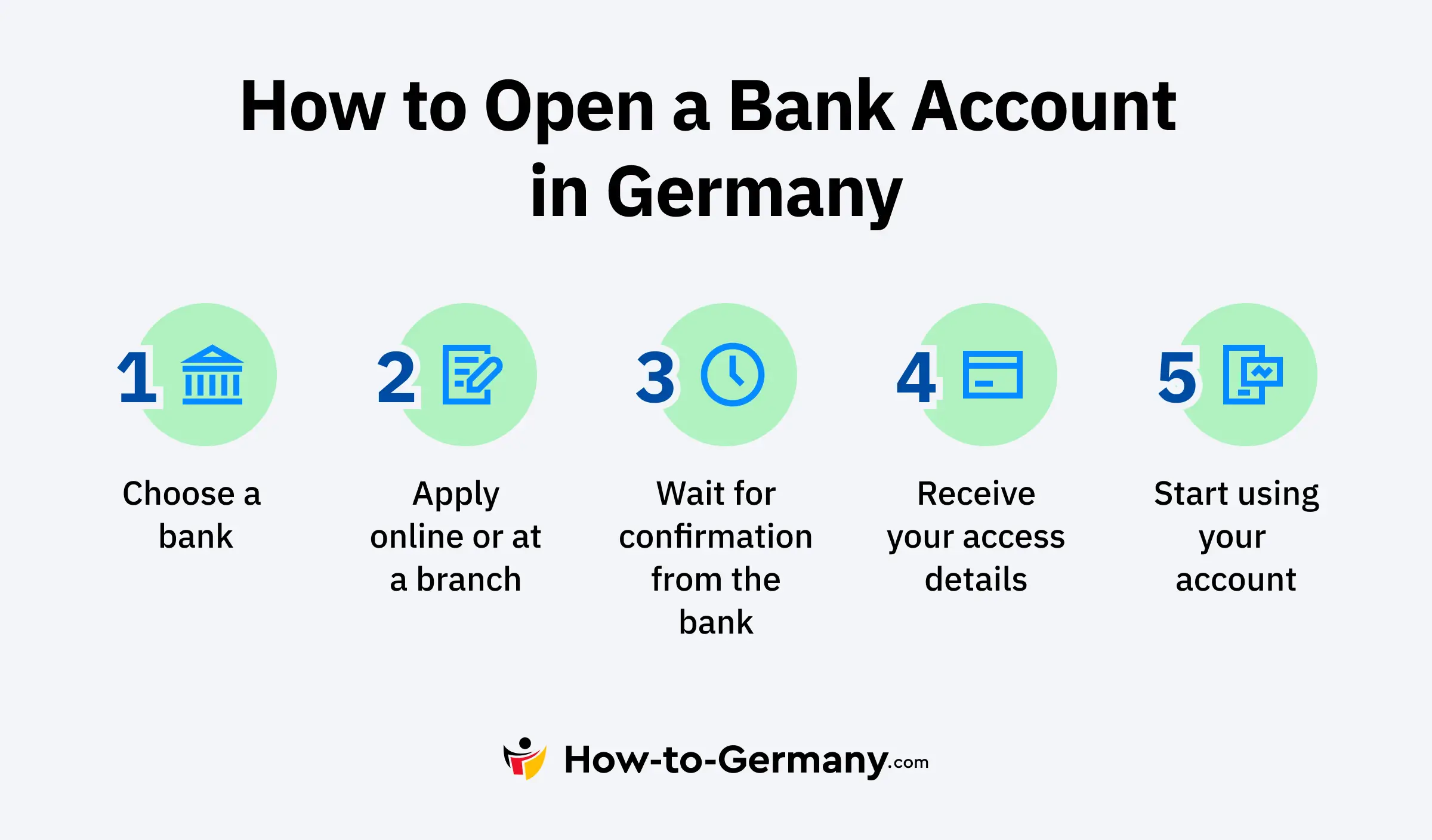
Opening a Bank Account in Germany: Step-by-Step Guide

Now that you have an overview of the various banking options available in Germany, let’s take a look at the step-by-step process of opening a bank account. The procedure may vary depending on whether you are selecting an online or physical option, or if you are opening an account from outside the country.
In the following sections, we’ll discuss the required documents and the differences between online and in-person account opening.
Required Documents
To open a bank account in Germany, you will need to provide several documents. These generally include a duly completed application form, a valid passport, a current German residence permit or visa, and proof of registration/address. Some banks may also require additional documents such as proof of income/employment and an initial deposit.
It’s essential to have all the necessary documents ready before you start the account opening process. This will ensure a smooth and hassle-free experience, allowing you to open your German bank account quickly and efficiently.
Online vs. In-Person Account Opening
The process of opening a bank account in Germany can differ depending on whether you choose an online or in-person option. Online account opening is generally more convenient and faster, allowing you to open an account from any location. However, online account opening may require specific identity verification methods, and not every passport or residence status is supported by every provider.
On the other hand, in-person account opening may offer more personalized guidance and generally requires fewer digital steps. However, it can be more time-consuming and inconvenient compared to online account opening.
Understanding the differences between these two options will help you choose the most suitable method for your needs.
- After Anmeldung: compare DKB, ING, comdirect, C24, Commerzbank, Sparkasse, and other full current accounts.
- Before Anmeldung: check newcomer-friendly online options and blocked account providers if you are a student.
- Before applying to several banks: consider SCHUFA impact and avoid unnecessary duplicate applications.
- Before choosing a free plan: check ATM withdrawal limits, physical card fees, cash deposit costs, and foreign currency charges.
- Before choosing Trade Republic as main account: confirm whether you need an overdraft limit, joint account, branch service, or cash deposit function.
Money Transfers and Credit Cards in Germany
Managing your finances in Germany involves more than just opening a bank account. It’s also essential to understand the options available for money transfers and credit card usage in the country.
In this section, we’ll explore cost-effective options for international money transfers and discuss the uncommon use of credit cards in Germany.
International Money Transfers
When it comes to international money transfers, services like Wise can be more cost-effective than using traditional banks. Wise, for example, offers advantageous exchange rates and reduced fees compared to banks. Other cost-effective options for international money transfers to a German bank account include XE.com.
Some online banks also integrate international transfer partners or offer competitive foreign currency card payments depending on the plan. By utilizing these services, you can save money on your international financial transactions and ensure a smooth and efficient transfer process.
Credit Card Usage in Germany
Credit cards are not as common in Germany as they are in other countries. The most widely accepted card networks are Visa and Mastercard. However, many German bank accounts now provide debit cards rather than true credit cards. There are various types of cards available in Germany, such as charge credit cards, revolving credit cards, debit cards, and prepaid cards.
Despite the availability of cards, cash remains indispensable in many establishments, especially restaurants and cafés. When choosing a bank account in Germany, it’s essential to consider your card usage and ensure that the card provided is widely accepted and allows for convenient cash withdrawals.
Glossary of Key German Banking Terms
To help you navigate the world of German banking, here’s a glossary of essential German banking terms:
- Dauerauftrag (Standing Order)
- Dispo / Dispokredit (Overdraft Limit)
- Geldeingang (Incoming Payment)
- Geldautomat (ATM)
- Gemeinschaftskonto (Joint Account)
- Girocard (German Debit Card)
- IBAN (International Bank Account Number)
- Konto (Account)
- Lastschrift (Direct Debit)
- SCHUFA (German credit reporting agency)
- Unterschrift (Signature)
- Zinsen (Interest)
Familiarizing yourself with these terms will ensure a smoother banking experience as you navigate your financial journey in Germany.
Conclusion

In conclusion, finding the perfect German bank account depends on your individual needs and preferences. By considering factors such as language support, fees, SCHUFA requirements, ATM access, and everyday payment functions, you can choose the bank account that best suits your requirements.
For many expats, the safest setup is a full current account for salary, rent, bills, and direct debits, plus a separate broker or savings product if needed. Online banks like N26, Bunq, Tomorrow, C24, Trade Republic, and comdirect can be useful depending on your situation, while traditional banks like Commerzbank, Deutsche Bank, Sparkasse, and Volksbank may be better if you want branch support.
Trade Republic is now much closer to a true current account than older reviews suggest, because it supports key SEPA payment features such as direct debits and standing orders. Still, it lacks some traditional banking features such as overdraft limits and joint accounts. DKB and ING remain strong direct-bank options for established expats, but both depend on fee-waiver conditions. Commerzbank is useful for branch access, but its standard current account is no longer best described as a free account for most new adult users. Whether you opt for an online bank, a traditional bank, or a specialized banking option, this guide gives you the information you need to make a more informed decision.
Frequently Asked Questions
Yes, foreigners can open a bank account in Germany provided they have the required documents including a valid passport, certificate of registration and wage statement (if applicable). Documents issued abroad must be authenticated by an apostille or legalisation.
From the reviews of experienced expats, N26 appears to be the most recommended option for opening an account in Germany. This bank has a great online banking system and English customer service, making it an ideal choice for those who need an easy and reliable banking experience abroad.
In order to open a bank account in Germany, you will need to have a valid passport, a residence permit, and a certificate of registration. Furthermore, depending on the type of account, you may be asked to provide a wage statement.