
Blocked Account for Visa Applicants in Germany
 Written by
Janine El-Saghir
Janine El Saghir is an editor at How-to-Germany.com, where she specializes in the practical aspects of daily life and integration for expatriates. With years of...
Written by
Janine El-Saghir
Janine El Saghir is an editor at How-to-Germany.com, where she specializes in the practical aspects of daily life and integration for expatriates. With years of...
 Reviewed by
Erkan Boga
Erkan Boga is the founder and CEO of qmedia GmbH, the publishing house behind How-to-Germany.com. He established the platform with the clear vision of creating...
Reviewed by
Erkan Boga
Erkan Boga is the founder and CEO of qmedia GmbH, the publishing house behind How-to-Germany.com. He established the platform with the clear vision of creating...
 Edited by
Sadie Voss
Content Lead & Editor
Sadie Voss is the Lead Editor for How-to-Germany.com. As an expat who carved her own way into Berlin from the United States, Sadie is deeply...
Edited by
Sadie Voss
Content Lead & Editor
Sadie Voss is the Lead Editor for How-to-Germany.com. As an expat who carved her own way into Berlin from the United States, Sadie is deeply...
- International students, job-seeker visa applicants, and au pairs may need a blocked account to obtain a visa to enter Germany.
- You mainly have to open the blocked account abroad and provide it for the visa application. People from countries that do not require a visa can also open a blocked account after entering Germany.
- A blocked account in Germany is usually open for one or two years, but an extension is possible.
- For a student visa, the account must currently hold €11,904 (status 2026; the German government regularly adjusts the amount). €992 can be withdrawn per month.
- Job-seeker visa and Opportunity Card applicants usually need a higher amount: in 2026, this is typically €13,092 per year, or €1,091 per month. Always confirm the exact amount with the German mission handling your application before transferring funds.
- German banks and specialized financial service providers offer blocked accounts for Germany. Important online providers include Expatrio, Fintiba, and Studely. Coracle has paused its blocked account opening fee/new sign-up offer and should not be treated as an active option until its blocked account service is available again.
- You can usually open your blocked account online on short notice with active providers.
- In addition to a blocked account, you must open a current account at any German bank.
How to finance your studies in Germany
International students from non-EU/EEA countries may work during their studies, but there are legal limits. Since the Skilled Immigration Act updates, the key benchmark is 140 full days or 280 half-days per year. Alternatively, students may usually work up to 20 hours per week during the lecture period; during the semester break, work is generally possible without the same weekly restriction. You can check the official rules on the Make it in Germany student work guide.
What is a blocked account for visa application?
A blocked account is a special bank account in which a certain amount is deposited. The provider with whom you opened the account handles its administration. He works with a bank for this purpose.
Students from countries outside the European Union and the Schengen Area need a blocked account to obtain a student visa to enter Germany. This regulation also affects some other visa applicants. You can check the official visa requirements through the German Federal Foreign Office visa information.
Visa applicants who have to open a blocked account
You have to open a blocked account if you wish to apply for one of the following visas for Germany:
- Student visa
- Visa for vocational training or an apprenticeship
- Visa for German language training
- Visa for the recognition of foreign academic and professional qualifications
- Job-seeker visa, including entry to seek employment with the Germany Opportunity Card (“Chancenkarte”)
- Au pair visa
Do not assume that the student blocked account amount applies to every visa type. For 2026, student visa applicants usually need €11,904 per year, or €992 per month. Job-seeker visa and Opportunity Card applicants usually need €13,092 per year, or €1,091 per month. Professional, vocational, and language-course visas may also require a higher amount. Always confirm the exact figure with the German mission responsible for your application.
Different requirements for visa and residence permit in Germany
For your stay in Germany apply different requirements, which also determine whether you need a blocked account and whether you can open it after entering Germany:
- Those entering from the EU, Switzerland, Liechtenstein, Norway, and Iceland do not require an entry visa, a residence permit or a blocked bank account. Suppose you come from one of these countries. In that case, you only have to register at the residents’ registration office. This registration is mandatory for all individuals living in Germany.
- Citizens of various other countries, including Australia, Canada, Israel, Japan, New Zealand, South Korea, the United Kingdom and the United States, do not require an entry visa but must apply for a residence permit within 90 days. To achieve this, you will need all the documents required to apply for a student visa abroad, and you will most likely also have to open a blocked account.
- Citizens of all other countries require a visa and a residence permit to study or seek employment in Germany. You must apply for your visa at the German Embassy in your home country. The visa will only be issued if you can prove at the visa appointment that you have a blocked account and paid the prescribed amount.
Deposit amount in a blocked account for Germany
The deposit amount in the blocked bank account for a student visa application is required by law and is currently €11,904 (as of 2026). German authorities adjust it regularly to the cost of living in Germany — information on changes you can obtain from the German Embassy in your country or through the German Federal Foreign Office visa information. The calculation of the amount refers to the estimated annual cost of living for students in Germany according to the Federal Training Assistance Act (BAföG).
The blocked account balance ensures that you can independently finance your living expenses during your stay. For student visas, the monthly withdrawal limit is €992. For job-seeker visa and Opportunity Card applicants, the monthly amount is usually higher.
It does not make sense to deposit more than the required amount in the blocked bank account if you expect to access the additional money freely. The monthly payment restriction means that extra money may also remain blocked until the account term ends or the provider releases it.
Do not transfer exactly the minimum blocked amount if you are sending money from outside Germany. Intermediary banks, currency conversion, and sending-bank charges can reduce the amount that arrives in the blocked account. If even a small amount is missing, your confirmation letter may be delayed and your visa appointment may be affected. Always check your provider’s transfer instructions and add a safe buffer for bank charges.
Where to open a blocked bank account?
To open a blocked bank account, you need a specialized blocked account provider. A few years ago, international students and other visa applicants could only open a blocked account offline at Deutsche Bank.
Various online providers are now active in this market, which has significantly simplified the process. Some local banks in Germany may also offer blocked or escrow-style accounts in limited cases. However, working with an online provider is usually much more efficient if you need to open a blocked bank account from your home country.
Suppose you apply for a job-seeker visa, Opportunity Card, professional, vocational, or language-course visa. In that case, the required deposit on the blocked account is usually higher than the standard student deposit. For 2026, these applicants may need around €13,092 for one year, with a monthly payout of around €1,091. Always confirm the exact amount with the German mission handling your visa before transferring funds.
Online providers
Online providers of blocked bank accounts act as intermediaries between their customers and an established bank. They open the account in your name and on your behalf at a German or European bank with which they cooperate. They charge a fee for this.
Some providers use an escrow model instead. The blocked account is not opened in your name but in the name of an escrow agent. The German missions abroad accept both the direct bank model and the trust model for visa issuance.
You can apply for and open an account online, so it doesn’t matter which country you apply from. In addition, you benefit from these companies’ extensive experience with international students and other visa applicants.
Established online providers for blocked accounts include Expatrio, Fintiba, and Studely. Coracle previously offered blocked account services but should be treated as paused for new blocked account sign-ups until its blocked account opening fee and application process are available again. Some providers also offer additional services such as arranging a German current account, travel health insurance, or long-term health insurance. Their blocked accounts are generally available worldwide and accepted by German diplomatic missions when they meet embassy requirements.
Suppose the provider of blocked accounts works according to the direct banking model. In that case, its partner bank must have a German banking license. For escrow models, providers may cooperate with financial service providers in EU countries. However, German embassies do not accept banks based outside the European Union. In such a case, you may still receive a visa. However, you must transfer the requested deposit to an accepted account before obtaining a residence permit. You can save yourself additional work and the risk of a visa refusal if you open your blocked account with a provider recognized in Germany from the outset.
Security and costs of a blocked bank account
The balance in a blocked account is subject to Europe-wide statutory deposit insurance — if the account-holding bank becomes insolvent, customer funds are protected up to €100,000. Therefore, there is no risk of loss with a blocked account.
A fee is charged for opening a blocked account, and depending on the provider, there may also be a monthly fee for account management. The opening fee is often between €70 and €160, but pricing changes regularly and bundled products can have different conditions.
Some providers also require a buffer deposit of about €100 when opening the account to cover transfer costs and other fees. This money is returned to you once the opening procedure is complete or when you close the account.
Overview of online providers of blocked bank accounts
| Provider | One-Time Opening Fee | Monthly Fee | Account Opening Time | Time to Transfer Funds |
|---|---|---|---|---|
| Coracle | Paused / coming soon | Check provider before applying | Not currently reliable for new blocked account sign-ups | Do not plan around Coracle until new applications are confirmed active |
| Expatrio | €89.00; standalone pricing increases to €119.00 from July 7, 2026 | €5.00; standalone pricing increases to €9.00 from July 7, 2026 | Usually less than 24 hours after successful application | Usually 3–5 days, depending on transfer method and bank route |
| Fintiba | €159.00 | €9.90 | Often within minutes after successful application | Usually 3–5 days, depending on transfer method and bank route |
| Studely | €70.00, or around €127.00 as a 12-month flat-fee package depending on region and package | €4.70, unless included in a flat-fee package | Usually within 24 hours after successful application | Usually 2–5 days, depending on transfer method and bank route |
To estimate the minimum amount to transfer, add the required blocked amount, the provider’s opening fee, all monthly account fees for the planned term, and a transfer buffer for international bank charges. Example for a student visa in 2026: €11,904 + provider opening fee + 12 monthly fees + transfer buffer = safer total transfer amount. Example for a job-seeker visa or Opportunity Card in 2026: €13,092 + provider opening fee + 12 monthly fees + transfer buffer = safer total transfer amount.
Blocked accounts at German banks
Alternatively, you may be able to open a blocked or escrow-style account through a local German bank. However, this is usually not a practical remote option for international visa applicants applying from abroad.
Major direct and private banks such as Commerzbank, DKB, HypoVereinsbank, Postbank, and Targobank do not generally offer simple standalone digital blocked accounts for international visa applicants applying from abroad. In practice, bank-based blocked account options are usually local, paper-heavy, and tied to specific branches, Sparkassen, or Volksbanken. They may require physical presence in Germany, local registration, or direct contact with the branch.
Deutsche Bank used to be the only bank that offered blocked accounts for visa applicants. However, in 2022, they stopped offering this service – new customers can no longer open a blocked account at Deutsche Bank.
This option makes sense only in limited cases, for example if you are already in Germany and a local branch confirms that it can provide the required blocked account confirmation. However, if you need the blocked account to obtain a visa, it is less recommended because opening an account from abroad takes significantly longer than with online providers. Often, banks do not allow online applications. Instead, you must send the account application and other documents by post or handle the process in person.
Opening procedure for a blocked bank account
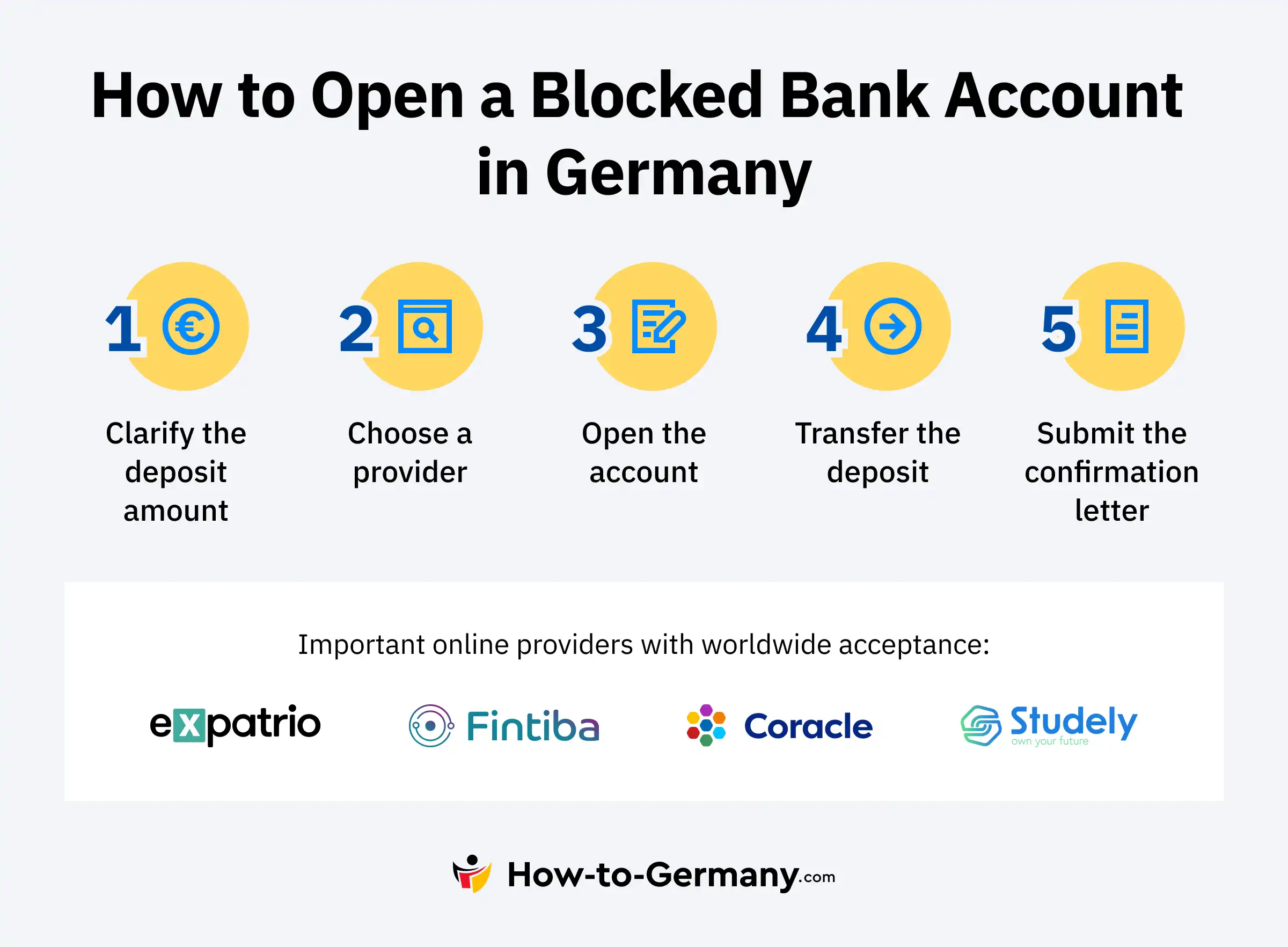
You will usually open your blocked account in your home country. Opening an account is then a requirement for applying for a German visa. The procedure involves the following steps:
- Clarify the deposit amount with the German Embassy: This may vary depending on the type of visa you require. You should only transfer funds to the blocked account when you know the exact amount.
- Account application
- Deposit transfer: As soon as your account application has been approved, you will receive the IBAN (International Bank Account Number) of the account from your provider and instructions on how to make the transfer. Depending on the provider, the deposit can be made as a bank transfer from your local bank account or via a transfer service provider. The transfer time is 2–5 days. Add a transfer buffer so the final amount that arrives is not reduced below the required blocked amount by intermediary bank fees.
- Confirmation letter: You will receive a confirmation letter of the payment from your provider to present to the German Embassy.
- Visa application: You will usually submit this document with all the other documents at a personal visa appointment at the German Embassy.
Step 1: Confirm the required amount with the embassy or consulate.
Step 2: Choose an active provider accepted by German missions.
Step 3: Submit your online application and identity documents.
Step 4: Transfer the required amount plus a transfer buffer.
Step 5: Wait for the blocked account confirmation letter.
Step 6: Submit the confirmation with your visa application.
Documents for opening a blocked account
You will usually need the following documents to open an account:
- Passport
- Local ID card
- Application form with your data
- Proof of the origin of the money, for example, through bank statements
- If applicable: proof of admission to a university in Germany
The documents requested depend on your provider. Fintiba, for example, may only require a valid passport from its customers, while other providers can ask for additional documents.
When you apply online, you upload copies of all the documents on the provider’s website.
After arriving in Germany – activating your account
You can only activate the blocked account after entering Germany. For this, you need a German residence permit, which you apply for at the local immigration office within the first 90 days.
As soon as you have sent a copy of the residence permit to your online provider or German bank, the monthly payments will be released from your blocked account.
However, direct withdrawals of money from this account are not possible. You require a German checking account to receive the payments, which you can open at any bank.
After getting your residence permit, you can open a current account at a German bank and then receive payments from your blocked account. Since it can take a few weeks before the residence permit is finally issued, you should plan for the first few weeks with a reserve fund.
Documents for activating your blocked account
To activate your blocked account, the provider also needs various documents:
- Passport with entry stamp
- Residence permit
- Certificate of residence from the residents’ registration office
- German current account details
Extending the blocked account
Blocked accounts are set up for a maximum of one to two years. If you need the account for longer, you have to request an extension from your provider, which is usually subject to a fee. You should only deposit money into the account once you have received written confirmation of the extension.
Closing a blocked account
There are various scenarios for closing a blocked account:
- Some providers automatically close the account after the end of the term. Due to the monthly payments, the balance in the blocked account is typically used up.
- Alternatively, the account is set to inactive after the end of the term. If you still require it, you can activate it within a certain period.
- You have to close your blocked account early. There may be various reasons for this. Perhaps your visa application has been rejected, you must cancel your visa, or you will have to return to your home country during the term. You then must request an early closure from your provider, who may require official proof from the embassy or your German university stating why. The provider will transfer the remaining deposit to your bank account within two to four weeks. Some providers will refund the account opening fees if the embassy rejects your visa application.
Studying in Germany without a blocked account
International students from non-Schengen countries do not need a blocked account if they receive a scholarship from their university or public institutions or if a sponsor with German residence signs a declaration of commitment.
The scholarship must be a full scholarship that is sufficient to cover all living expenses and German health insurance.
A declaration of commitment requires that the sponsor has EU citizenship or a permanent German residence permit, is registered in Germany, and can prove that they have sufficient financial means. The declaration is submitted to the local immigration office. It is valid for the entire course of study in Germany and can be extended if necessary. However, there may be acceptance problems with a declaration of commitment from the German embassies. Some embassies only accept this alternative to a blocked account in exceptional cases.
Conclusion
International students and other visa applicants must set up a blocked account before applying for a German visa to prove they can support themselves in Germany. Without a blocked account, they cannot receive a German visa. Students from non-Schengen countries that do not require an entry visa for Germany can also open a blocked account when they are already in Germany. Still, they need it to obtain a residence permit and, therefore, to open this account.
A blocked account is the safest way to get a visa for Germany without any issues, provided you choose a recognized provider that fully meets the requirements of the German embassies.
We recommend opening the blocked account with an active online provider because the process is easier and faster. Before applying, check the current provider status, pricing, visa-specific deposit amount, and accepted partner bank. Coracle should not be treated as an active blocked account option for new sign-ups until its blocked account application process and pricing are clearly available again.
Frequently Asked Questions — FAQ
The immigration office of the city you are studying in has the final say here. To obtain a German student visa, you are required to have a blocked account in the first year. Students from non-Schengen countries who are exempt from entry visa requirements also require a blocked account to obtain a residence permit.
As a rule, you will receive a one-year student residence permit. If you want to extend it, you must prove again that you have sufficient funds to finance your stay. However, this does not always require a blocked account. Immigration authorities also accept bank statements as proof, provided you have a sufficient balance. Alternatively, you can provide evidence of financial support from your parents or a sponsor.
Usually not. Most providers offer a blocked account for 12 months, but in some cases, you can also have the account for 24 months. Subsequently, you can apply to your provider for an extension if you still need your blocked bank account. You will again pay a fee for this, typically lower than the initial fee.
Yes. If you are already in Germany, you can also open a blocked account directly at a bank. This approach can be useful if you do not need a visa to enter Germany. So far, only branch banks offer a blocked account for international students and job-seekers. If you open the account at a branch bank, an employee will assist you throughout the procedure.
This amount is enough to cover your basic living expenses. However, you should expect high rents in bigger cities. International students also have the opportunity to work part-time alongside their studies. You can work up to 20 hours per week during the lecture period and without any restrictions during the semester break.