
How we earn our money
We finance our services on how-to-germany.com through affiliate programs.
When a user orders a financial product through our site and their application is approved, we may receive a commission from some providers. It’s important to note that this does not in any way influence our independent ratings and recommendations.
All the products we present on how-to-germany.com are selected for their quality, range of services, and excellent value for money.
Statutory Health Insurance in Germany
 Written by
Janine El-Saghir
Janine El Saghir is an editor at How-to-Germany.com, where she specializes in the practical aspects of daily life and integration for expatriates. With years of...
Written by
Janine El-Saghir
Janine El Saghir is an editor at How-to-Germany.com, where she specializes in the practical aspects of daily life and integration for expatriates. With years of...
 Reviewed by
Erkan Boga
Erkan Boga is the founder and CEO of qmedia GmbH, the publishing house behind How-to-Germany.com. He established the platform with the clear vision of creating...
Reviewed by
Erkan Boga
Erkan Boga is the founder and CEO of qmedia GmbH, the publishing house behind How-to-Germany.com. He established the platform with the clear vision of creating...
 Edited by
Sadie Voss
Content Lead & Editor
Sadie Voss is the Lead Editor for How-to-Germany.com. As an expat who carved her own way into Berlin from the United States, Sadie is deeply...
Edited by
Sadie Voss
Content Lead & Editor
Sadie Voss is the Lead Editor for How-to-Germany.com. As an expat who carved her own way into Berlin from the United States, Sadie is deeply...
- Health insurance is mandatory in Germany. Everyone must be insured either through statutory or private health insurance.
- The same regulations generally apply to expats with long-term residence as to German citizens.
- Employees with an income up to the compulsory insurance threshold of €77,400 (2026) must be insured in statutory health insurance; switching to private insurance is not permitted.
- Freelancers, the self-employed, and civil servants are not subject to compulsory statutory insurance and can choose between voluntary statutory insurance and private health insurance.
- Students can apply for an exemption from statutory insurance at the beginning of their studies and opt for private health insurance instead.
How does German Health Insurance Work?
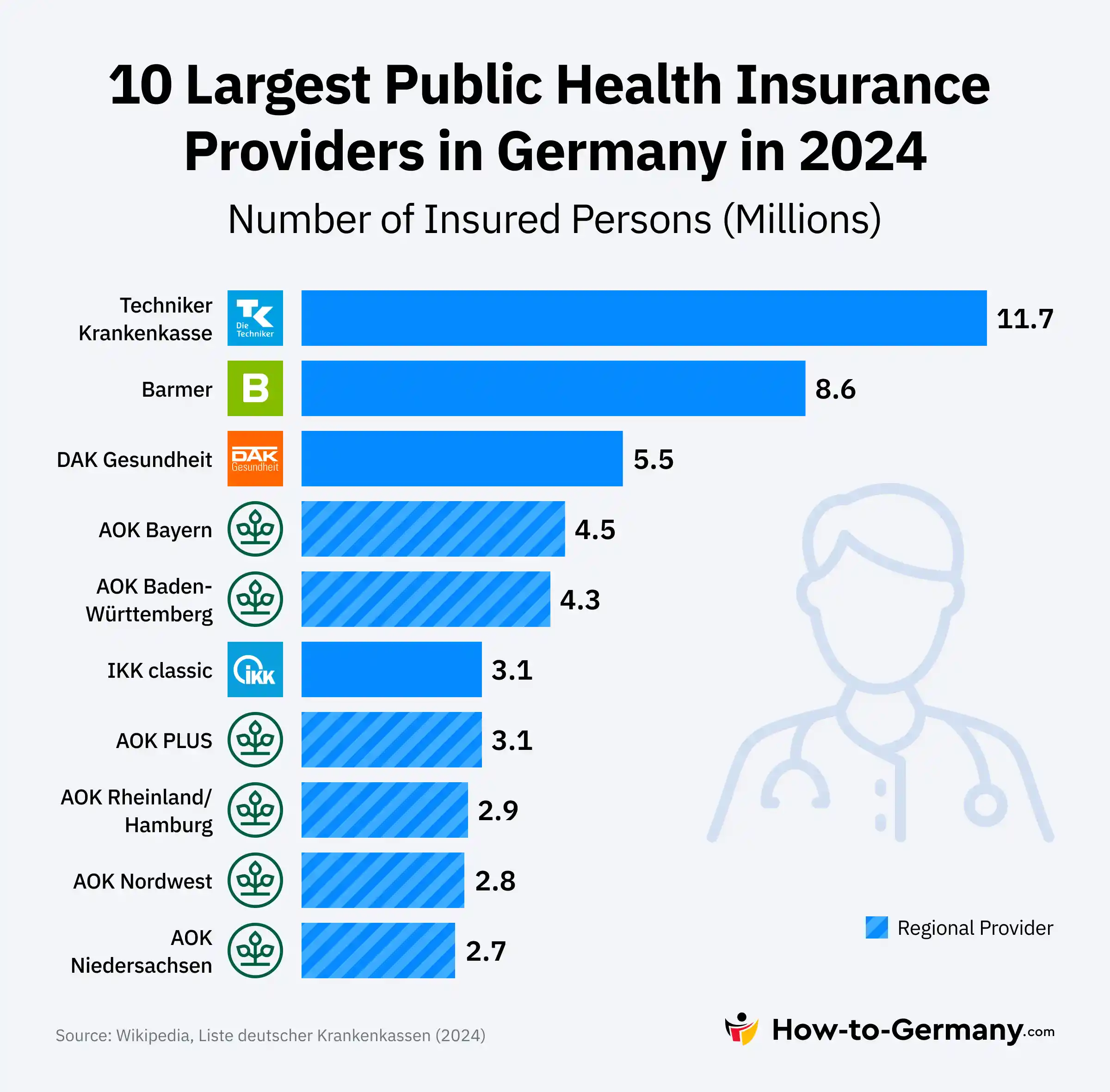
Health insurance in Germany is divided into statutory and private health insurance. Statutory health insurance is the most important pillar of the health insurance system. 90% of all inhabitants are insured under a statutory health insurance scheme.

The Statutory Healthcare System in Germany
The foundations for today’s statutory health insurance in Germany were laid back in 1883 and became a model for many other countries. Today, people with public insurance can choose between statutory health insurance funds.
Statutory health insurance providers are public, self-governing, non-profit organizations.
Public insurance in Germany is divided into three areas, but its benefits are identical: compulsory, voluntary, and non-contributory family insurance.
Compulsory Health Insurance
The compulsory insurance threshold for public insurance is adjusted annually. It currently (2026) stands at €77,400. Employees with a lower gross income must take out statutory health insurance. They must take out insurance with a statutory health insurance fund.
Voluntary Insurance with a Statutory Health Insurance Scheme
Employees with income above the €77,400 threshold in 2026, freelancers, the self-employed, and civil servants can take out voluntary public health insurance or switch to private insurance.
Special regulations for students
Special regulations apply to students. Up to 30, they can take out statutory student health insurance at a particularly favorable rate. Subsequently, they can take out voluntary, statutory health insurance at higher premiums or change to a private insurance provider.
Alternatively, students can apply for an exemption from public insurance at the beginning of their studies and take out private insurance. Private insurers also offer special rates and favorable conditions for private students’ health insurance.
Non-Contributory Family Insurance Cover
Spouses and children can be insured free of charge if their income does not exceed the marginal earnings threshold of currently €565 per month in 2026 (mini-jobbers: €603). Students up to the age of 25 can also take advantage of non-contributory insurance.
Private Health Insurance in Germany
If you meet the requirements, you can take out private health insurance.
The benefits and premium amounts of private health insurance depend on your chosen tariff. You conclude an individual contract with your private health insurance company. Your age, state of health at the start of insurance, and professional and personal risk profile determine the premium amount.
Private insurance offers a broader range of benefits than the statutory system and enables more adequate health insurance with customized tariffs. However, non-contributory insurance for family members is not possible with private health insurance.
What Regulations Apply to Health Insurance for Expats?
The same regulations apply to health insurance for expats with a residence permit of at least 12 months as for German citizens. As an expat, you can only take out private health insurance if you earn more than €77,400 (2026) per year as an employee, are a student, or work as a freelancer or self-employed person.
Some expats cannot take out public insurance. This concerns:
- Freelancers and self-employed individuals who take out health insurance in Germany for the first time
- People who currently have no health insurance and were previously privately insured in Germany
- Students in language and preparatory courses
- Visiting academics without a regular employment relationship with their German university
EU citizens and expats from Iceland, Liechtenstein, Norway, Switzerland, and the United Kingdom can also receive medically necessary public healthcare in Germany with a valid EHIC, UK-issued EHIC, or UK Global Health Insurance Card (GHIC). However, these cards are not a permanent substitute for comprehensive health insurance if you live in Germany long term.
Private health insurance providers such as ottonova and Feather offer special expat insurance to students and other expats living in Germany temporarily (maximum 5 years).
What Benefits does Statutory Health Insurance Offer?
You can claim all relevant health benefits if you opt for public insurance. Statutory health insurance coverage includes:
- Auxiliary aids — for example, wheelchairs, prostheses, and visual aids
- Dental treatment, dentures
- Hospital treatment
- Medical rehabilitation (if not covered by pension insurance)
- Medication
- Orthodontics (up to the age of 18, higher degrees of severity only)
- Outpatient medical treatment (general practitioner and specialists)
- Preventive medical check-ups (for certain illnesses, with age limits)
- Psychotherapy
- Remedies — for example, physiotherapy or speech therapy
However, statutory health insurance benefits are limited to medically necessary and cost-effective treatments. The system only covers standard benefits; insured people must pay for all other therapies.
Patients with public insurance must make co-payments for many medical services. They are particularly high for dentures and certain dental treatments, as statutory health insurance dentists must always choose the most cost-effective treatment option. Dental health insurance is available for additional coverage.
Does German Statutory Health Insurance Coverage Apply Abroad?
The European Health Insurance Card (EHIC) allows you to use public healthcare services within the EU and in Iceland, Liechtenstein, Norway, and Switzerland. UK visitors can also use a valid UK-issued EHIC or GHIC for medically necessary state healthcare during temporary stays in Germany.
To travel to other countries, you will need travel insurance, for which you can find affordable offers from many insurers.
Privately insured patients generally have worldwide insurance coverage through their private health insurance policy.
What is Private Supplementary Insurance?
Private health insurance providers offer private supplementary insurance to patients with statutory insurance. With such a policy, you can take advantage of health services that are otherwise reserved for privately insured patients.
Private supplementary insurance is particularly recommended for dental treatment and dentures. Expats in Germany can find high-performance supplementary dental insurance from the digital insurance companies ottonova, Feather, and Getsafe in particular. All three providers specialize in the needs of expats with their digital offers and bilingual services.
ottonova offers proprietary digital supplementary hospital insurance that can give statutory health insurance holders access to private hospital benefits such as chief physician treatment and single or twin rooms. Getsafe should be understood differently: it acts as a digital insurance broker for many supplementary health products and can compare or arrange third-party offers from external insurers. Getsafe’s own health-related products are focused on areas such as travel health and dental insurance.
How Much does Statutory Health Insurance Cost?
The contribution to statutory health insurance funds is currently 14.6% of your gross salary as the legal baseline rate. In addition, every public health insurance provider charges an individual additional contribution (Zusatzbeitrag). In 2026, the average Zusatzbeitrag is around 2.9%, so the average total public health insurance contribution is around 17.5% of gross income, up to the contribution assessment ceiling. If you are employed, your employer pays half of the health insurance contribution and transfers it directly to your health insurance provider.
The contribution assessment ceiling (Beitragsbemessungsgrenze, BBG) is €69,750 per year or €5,812.50 per month in 2026. This is different from the compulsory insurance threshold (Jahresarbeitsentgeltgrenze, JAEG) of €77,400. Contributions are calculated only up to the BBG, so income between €69,750 and €77,400 does not increase your statutory health insurance contribution.
Freelancers and the self-employed do not receive an employer subsidy for their statutory health insurance. They can opt for a reduced contribution of 14% if they waive sick pay, but they still pay the Zusatzbeitrag and long-term care insurance themselves.
Contributions to statutory long-term care insurance
Long-term care insurance is another compulsory insurance in Germany. In 2026, the general contribution is 3.6% of gross income. Childless members aged 23 and older pay 4.2%. For employees, the employer’s general contribution is 1.8%, while the childless surcharge is paid by the employee.
How to Find the Best Public Health Insurance?
You can choose your health insurance provider in the public health insurance system. Unlike private insurers, statutory health insurance funds must accept all eligible individuals, regardless of age or health status, including serious illness. Waiting periods also do not play a role in public insurance.
Choosing a Good Health Insurance
It would be best to compare several statutory health insurance funds before deciding on a particular health insurance scheme. Important selection criteria are the amount of the additional contributions and the additional benefits of the statutory health insurance funds. On average, many statutory health insurance plans offer similar rates and benefits:
| Medical Expense | Typical GKV Patient Cost | GKV Coverage Level | Typical Private Billing Amount | Notes |
|---|---|---|---|---|
| Advanced Dental Treatment | €500–3,000+ | Partial | €2,000–5,000+ | Supplementary insurance recommended. |
| Ambulance | €10 | ~100% | €300–1,000 | Flat copay per use. |
| Basic Dental Treatment | ~20–40% | ~60–80% | €200–2,000+ | Expect a copay under the GKV. |
| Doctor Visit | €0 | 100% | €50–150 | The private amount is an example of the medical invoice amount, not a monthly insurance premium. |
| Emergency Treatment | €0–€10 | ~100% | €500–5,000+ | Limited copay under GKV. |
| Hospital Stay (Per Day) | €10/day (max 28 days/year) | ~99% | €300–1,000/day | Typically capped at €280/year. |
| Prescription Medication | 10% (min €5, max €10) | ~90–95% | €20–200+ | Price per item can add up over time. |
| Preventive Checkups | €0 | 100% | €50–300 | Age-based programs are offered under GKV. |
| Sick Leave Pay (After 6 Weeks) | €0 (income replacement) | ~70% salary | N/A | Standardized in the GKV. |
| Surgery (Non-Cosmetic) | €0 (+ potential hospital fee) | ~100% | €2,000–20,000+ | The private amount shows a possible medical billing range, not the cost of private insurance premiums. |
Important: Under statutory health insurance (GKV), most medical costs are covered. Patients pay small, regulated co-payments (“Zuzahlungen”), usually capped and income-linked. For coverage gaps in medical fields like dentistry, it can be advisable to seek supplementary insurance.
For expats, the best statutory health insurance provider is usually the one that combines a reasonable Zusatzbeitrag, English-friendly service, easy digital registration, and useful extra benefits. The medical core coverage is largely standardized, so the difference is often practical: support quality, language, app experience, bonus programs, travel vaccination reimbursement, osteopathy reimbursement, dental cleaning subsidies, and how easy it is to get documents for your employer, visa file, or university.
| Provider | 2026 Zusatzbeitrag | 2026 total health contribution | Best for expats who want… | What to check |
|---|---|---|---|---|
| AOK | Varies by region; for example, AOK Bayern 2.69%, AOK Plus 3.10% | Approx. 17.29% at AOK Bayern; 17.70% at AOK Plus | Regional branch access and local support | AOK is regional, so contribution rates, extra benefits, and service quality vary by federal state. |
| Barmer | 3.29% | 17.89% | A large national provider with broad digital access | Barmer is nationwide and broadly accessible, but its 2026 contribution is higher than TK and some regional AOKs. |
| TK | 2.69% | 17.29% | Strong digital service and expat-friendly onboarding | TK is often popular with international employees and students; check whether the exact documents you need are available in English. |
Choose TK if you want a strong digital experience, English-friendly onboarding, and a 2026 Zusatzbeitrag of 2.69%. Choose Barmer if you want a large nationwide provider with broad services, but note its 2026 Zusatzbeitrag of 3.29%. Choose AOK if you prefer regional branch access and local support, but compare your regional AOK rate first.
Insurance Application, Change of Insurance, Termination
You can apply for insurance with a statutory health insurance company online. You will then get a health card to prove your insurance status at doctor’s visits and with other medical service providers. You can automatically use it in other EU countries as a European Health Insurance Card (EHIC).
For expats starting work in Germany, the practical steps are usually:
- Complete your Anmeldung and receive your registration certificate (Meldebescheinigung), if your provider or employer asks for proof of address.
- Choose a statutory health insurance provider before or shortly after signing your work contract.
- Apply online and provide your passport, address, employment details, and start date.
- Receive a membership confirmation (Mitgliedsbescheinigung) for your employer.
- Send the membership confirmation to your employer so payroll can register you correctly.
- Your employer registers you for German social security and payroll contributions.
- Your German social security number (Sozialversicherungsnummer) is issued automatically if you do not already have one, usually through the pension insurance system.
- Your electronic health card (Gesundheitskarte) is sent by post after your registration is processed.
After arriving in Germany, first complete your Anmeldung, then choose your health insurance provider, send your employer the membership confirmation, and wait for your social security number and electronic health card. If you are a student or freelancer, you usually apply directly with the provider and submit the insurance confirmation to your university, visa office, or client/payroll contact when needed.
Students usually apply directly to the health insurance provider and then submit the insurance confirmation to their university. Freelancers and self-employed people apply directly and must pay their contributions themselves, usually by direct debit.
A change of statutory health insurance funds is possible after 12 months at the earliest. The standard notice period for cancellation is two months.
A special right of termination applies in the following cases:
- The conditions for non-contributory insurance are no longer met.
- Your annual gross salary rises above the €77,400 (2026) limit.
- You are starting as a full-time freelancer or self-employed.
- You have become unemployed.
- You have voluntary statutory health insurance. As your income has fallen, you are now subject to compulsory insurance.
Conclusion
Statutory health insurance is the basis of the healthcare system in Germany. Review a German private health insurance list to understand how public and private systems differ. In statutory health insurance, contributions depend on income only up to the contribution assessment ceiling (BBG), which is €69,750 per year or €5,812.50 per month in 2026. The higher compulsory insurance threshold (JAEG) of €77,400 determines whether employees may leave GKV for private insurance, but it is not the ceiling for contribution calculation.
Statutory health insurance companies offer their policyholders various additional benefits. Choosing your provider wisely can optimize your healthcare in the public health system. For expats, the most practical providers are often TK, Barmer, and AOK, but the best choice depends on your language needs, location, Zusatzbeitrag, digital service expectations, and whether you need documents for a job, visa, or university.
Before joining a provider, compare the total contribution rate, not only the 14.6% legal base rate. The Zusatzbeitrag and long-term care insurance contribution can make a visible difference to your monthly cost, especially for high earners and self-employed people. In 2026, TK and AOK Bayern are examples of lower Zusatzbeitrag options at 2.69%, while Barmer is higher at 3.29%.
Frequently Asked Questions
Statutory health insurance has a legal base contribution of 14.6% of gross income. In addition, every public health insurance provider charges an individual Zusatzbeitrag. Currently, the average Zusatzbeitrag is around 2.9%, which brings the average total GKV health insurance contribution to around 17.5% of gross income, up to the contribution ceiling. Employees share this cost with their employer, while freelancers and self-employed people usually pay the full amount themselves.
For many expats, TK, Barmer, and AOK are common choices. TK is often attractive for digital service and English-friendly onboarding, Barmer is a large nationwide provider with broad services, and AOK can be useful if you want regional branch access. The core medical benefits are mostly standardized, so compare the Zusatzbeitrag, English support, app quality, bonus programs, extra benefits, and how easily the provider issues documents for your employer, university, or visa file.
If you start employment in Germany and do not already have a German social security number, your employer usually registers you through payroll after you choose a statutory health insurance provider. The number is then issued automatically through the German pension insurance system. You normally need to give your employer your health insurance membership confirmation, personal details, and tax information. Students and freelancers may need different registration steps depending on their status.