
How we earn our money
We finance our services on how-to-germany.com through affiliate programs.
When a user orders a financial product through our site and their application is approved, we may receive a commission from some providers. It’s important to note that this does not in any way influence our independent ratings and recommendations.
All the products we present on how-to-germany.com are selected for their quality, range of services, and excellent value for money.
Electricity in Germany: Cost Comparison 2026
 Written by
Sadie Voss
Content Lead & Editor
Sadie Voss is the Lead Editor for How-to-Germany.com. As an expat who carved her own way into Berlin from the United States, Sadie is deeply...
Written by
Sadie Voss
Content Lead & Editor
Sadie Voss is the Lead Editor for How-to-Germany.com. As an expat who carved her own way into Berlin from the United States, Sadie is deeply...
- Liberalized Market & The Default Trap: Germany has a competitive energy market where you can choose your own supplier. If you don’t sign a contract, you fall into the Grundversorgung (basic supply)—often the most expensive default tariff provided by the local utility. Use our energy calculator to determine if you’re being overcharged.
- Price Structure: Your bill is split into a fixed monthly Grundpreis (base fee) and a usage-based Arbeitspreis (unit rate). According to the BDEW electricity price analysis for April 2026, the national household average is around 37.0 cents/kWh, while many newly signed customer tariffs are lower at roughly 26.8–34.0 cents/kWh due to federal grid fee subsidies.
- The Payment Cycle: You pay a fixed monthly installment called an Abschlag. Once a year, you receive your Jahresabrechnung (annual statement), which compares your payments to actual usage, resulting in either a refund or a Nachzahlung (extra payment).
- Provider Choice: English-friendly electricity providers such as Ostrom, Octopus Energy, Tibber, and Vattenfall can be easier for expats than traditional local utilities.
- Switching Protection: Switching electricity providers does not interrupt your power supply. The physical grid stays the same, and only your billing provider changes.
Compare Best Electricity Plans in Germany
Choosing an electricity provider in Germany is not just about finding the lowest advertised price. Expats should also check contract flexibility, app quality, English-language support, tariff type, and whether the plan requires a smart meter. A low unit price can become expensive if the contract has long notice periods, unclear price changes, or poor support when you move apartments.
The providers below are especially relevant for expats because they are digital-first, app-based, or easier to manage than many traditional local utilities. However, prices depend heavily on your postcode, annual consumption, meter type, and current wholesale market conditions. Always compare the final offer for your exact address before signing.
| Provider | Best For | English Friendliness | Tariff Types | Contract Flexibility | Important Limitation |
|---|---|---|---|---|---|
| Octopus Energy | Green electricity, modern customer service, and smart-tariff users | Good digital experience; English brand background | Fixed, variable, and smart-energy tariffs depending on availability | Depends on selected tariff | Some smart or EV tariffs require compatible technology. |
| Ostrom | Expats who want an English-friendly app and simple digital onboarding | Very strong English-language positioning | SimplyFair variable tariff and SimplyDynamic dynamic tariff | Flexible, app-based setup | SimplyDynamic requires a smart meter. |
| Tibber | Smart-home users, EV owners, and households that can shift electricity use | Strong app experience, but German market content can be German-heavy | Simple Fix fixed-price tariff and Smart Dynamic 15-minute tariff | Fixed or flexible depending on tariff | 15-minute dynamic savings depend on smart meter access or a compatible digital meter with Tibber Pulse. |
| Vattenfall | Expats who prefer a large established provider with broad availability | Moderate; more traditional provider experience | Fixed-price and green electricity plans depending on region | Depends on contract term | Not as app-first or expat-focused as newer digital providers. |
Understanding the German Electricity Market
The average electricity price for German households should be understood in two ways: according to the BDEW electricity price analysis for April 2026, the national average across household electricity contracts is around 37.0 cents per kWh, while many newly signed customer tariffs have dropped to roughly 26.8–34.0 cents per kWh. A typical single-person household consumes about 1,500 kWh annually. At 37.0 cents/kWh, this equals about €555 per year, or €46.25 per month, before the monthly Grundpreis is added. Since many providers charge a base fee of roughly €10–€15 per month, a realistic monthly total is closer to €55–€65 including the base price. Prices vary based on your region, provider, and whether you use electricity for water heating. For current market figures, compare data from the BDEW electricity price analysis and the Bundesnetzagentur energy price guidance.
Those who don’t switch to private plans have to pay a flat fee, which expats often aren’t aware of. Electricity bills for expats in Germany don’t have to be expensive: with federal subsidies on grid fees and the rise of dynamic tariffs, companies offer more competitive new-customer plans — if you know where to find them.
The German electricity market is characterized by high transparency but complex pricing structures. Unlike many countries where a flat rate might apply, German utility bills are divided into fixed and variable costs. Understanding these components is essential for using an electricity calculator effectively.
The basic supply (Grundversorgung) applies when you move into a new home and use electricity without signing a separate contract. In this case, you are automatically supplied by the local default provider. This is often one of the most expensive tariff types. If you do not want to stay in the Grundversorgung, you can usually cancel it with two weeks’ notice and switch to a private provider.
Example Calculation of a Fair German Electricity Price
| Step / Description | Calculation |
|---|---|
| 1. Convert Power to Kilowatts (kW) | 500W / 1,000 = 0.5 kW |
| 2. Calculate Daily Energy Consumption (kWh) | 0.5 kW × 6 hours/day = 3 kWh |
| 3. Calculate Weekly Energy Consumption (kWh) | 3 kWh/day × 5 days/week = 15 kWh |
| 4. Calculate Weekly Electricity Cost | 15 kWh × €0.37/kWh = €5.55 |
| Final Monthly Cost | €5.55 x 4 = €22.20 |
Key Electricity Terms
- Abschlagszahlung (Installment): Monthly payments based on estimated annual usage. A final settlement (Abrechnung) occurs once a year.
- Arbeitspreis (Unit Price): The cost per kilowatt-hour (kWh) consumed. This is the primary lever for reducing your bill through energy-saving habits.
- Grundpreis (Base Price): A fixed monthly fee independent of consumption. It covers grid maintenance and billing administration.
- Zählernummer (Meter Number): The unique number of your electricity meter. Providers need it to assign your contract to the correct apartment.
- Zählerstand (Meter Reading): The number shown on your electricity meter. You usually submit it when moving in, switching providers, or receiving an annual bill.
How to Switch Electricity Providers in Germany
Switching electricity providers in Germany is usually simpler than expats expect. You do not need a technician visit, and your electricity supply will not be interrupted. The physical grid remains operated by the local network operator, while your chosen provider handles billing and electricity supply contracts.
In most normal cases, the new provider handles the cancellation of your old electricity contract automatically. You should only cancel yourself if you are using a special termination right, such as after a price increase, or if your new provider explicitly tells you to do so.
Find Your Electricity Meter
Your electricity meter is usually located in one of these places:
- Basement utility room
- Building hallway meter cabinet
- Dedicated meter room
- Inside the apartment near the fuse box
- Shared technical room managed by the Hausverwaltung
Look for the meter number (Zählernummer) printed on the meter case or shown on a sticker. This is not always the same as the long number on your bill, so compare it carefully. If you cannot access the meter room, ask your landlord, Hausverwaltung, or building caretaker.
Electricity Switching Checklist for Expats
Before switching, collect the following details:
- Your postcode and full address: Electricity prices vary by grid area.
- Your annual consumption: Use your last bill if you have one. If not, estimate 1,500 kWh for one person, 2,500 kWh for two people, or 3,500+ kWh for a family.
- Your Zählernummer: This identifies the exact electricity meter for your apartment.
- Your Zählerstand: Take a photo of the meter reading on move-in or switching day.
- Your current provider and customer number: Needed if you are already in a contract.
- Your IBAN: Most German electricity providers use SEPA direct debit for monthly Abschläge.
You will not lose electricity just because you switch providers. If a switch fails, a provider goes insolvent, or you move in without an active contract, German households are protected by basic or replacement supply rules. This means the local default supplier continues supplying electricity, although usually at a less attractive tariff.
Components of the Electricity Price
The price paid by consumers is composed of several regulated and market-driven factors. According to the 2026 BDEW electricity price analysis, the breakdown is as follows:
Electricity Bill Page 1: The Summary
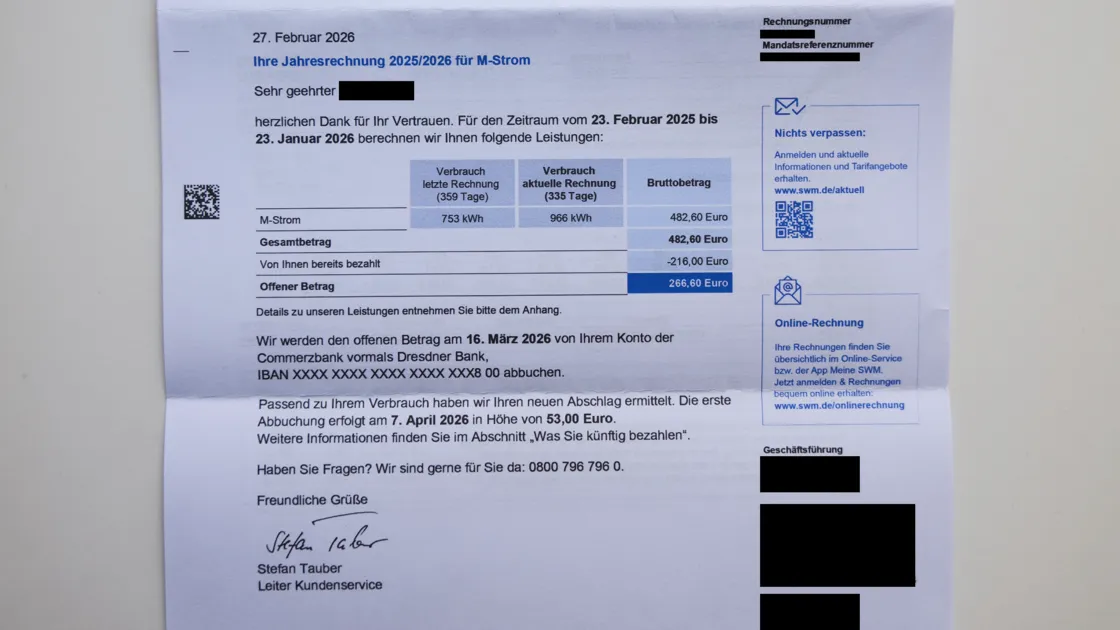
The front page is your annual summary. It shows whether you have a credit (Guthaben) or if you owe an additional payment (Nachzahlung). Good to watch for: A large Nachzahlung and a big jump in your new monthly payment (Abschlag) are the first signs your current plan is too expensive for your actual energy usage.
Electricity Bill Page 2: Price Breakdown
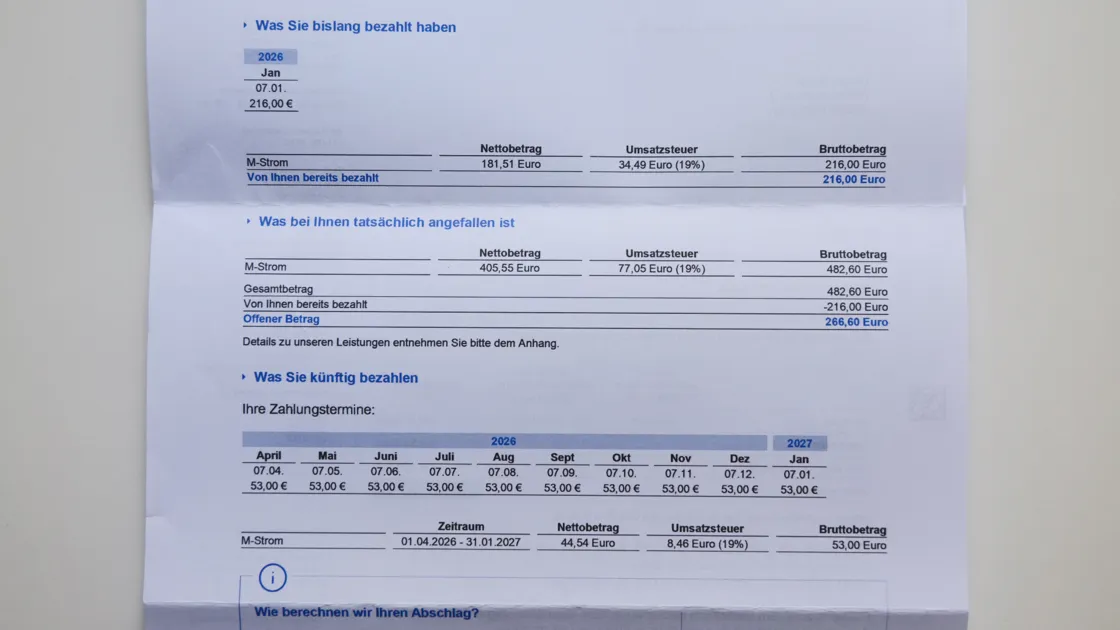
This page details your total electricity cost for the year before deducting the monthly payments you’ve already made. It separates the cost of the electricity itself from the fees for using the grid (Netznutzung).
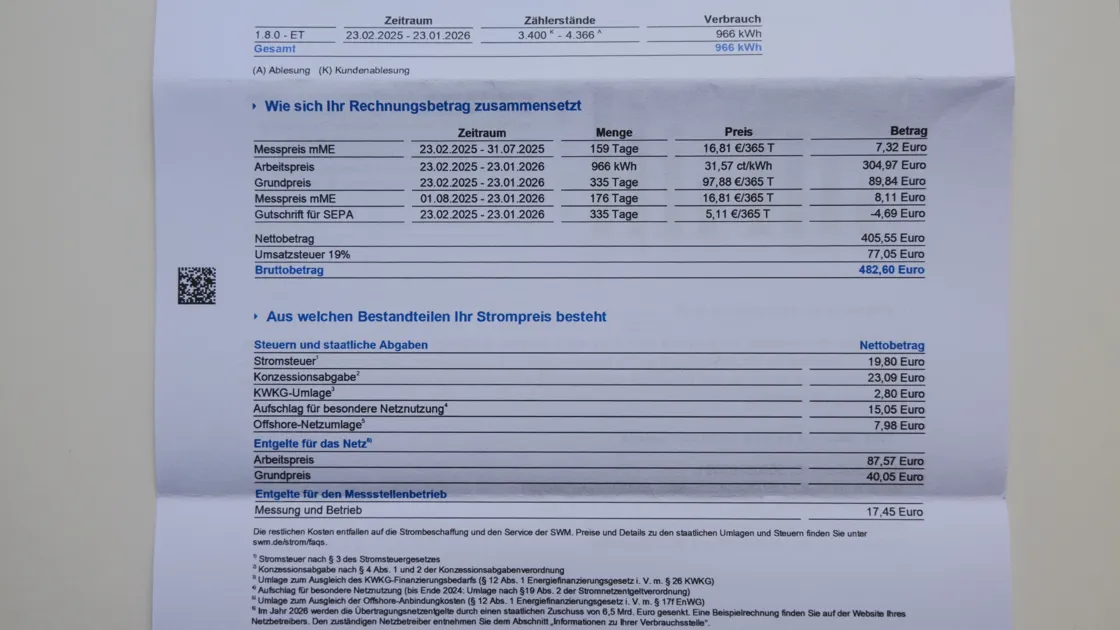
Some price distributions vary, but in general, the bill is comprised of:
- Procurement, Sales, and Provider Margin (~41.3%): The cost for providers to buy energy on the European Energy Exchange (EEX), serve customers, and cover their margin.
- Network Charges (Netznutzungsentgelte) (~24.8%): Fees for the transport of electricity. These fell from 27.6% in 2025 due to the federal grid fee subsidy, but still vary strongly by region.
- Taxes and Levies (~33.9%): Includes the 19% VAT (Umsatzsteuer), Electricity Tax (Stromsteuer), concession fees, and surcharges such as the Offshore Liability Levy.
Energy Calculator: Determine Overpriced Electricity
To get an accurate estimate of your future bills or to check if a provider’s offer is competitive, you will need:
- Your Annual Consumption: Found on your last Stromabrechnung (annual bill).
- The Power Rating (Watts): For individual appliances, check the label on the back or bottom of the device.
- Calculate Daily Consumption: Energy calculator tools like the one in the image below determine if you’re being charged too much for your electricity bill.
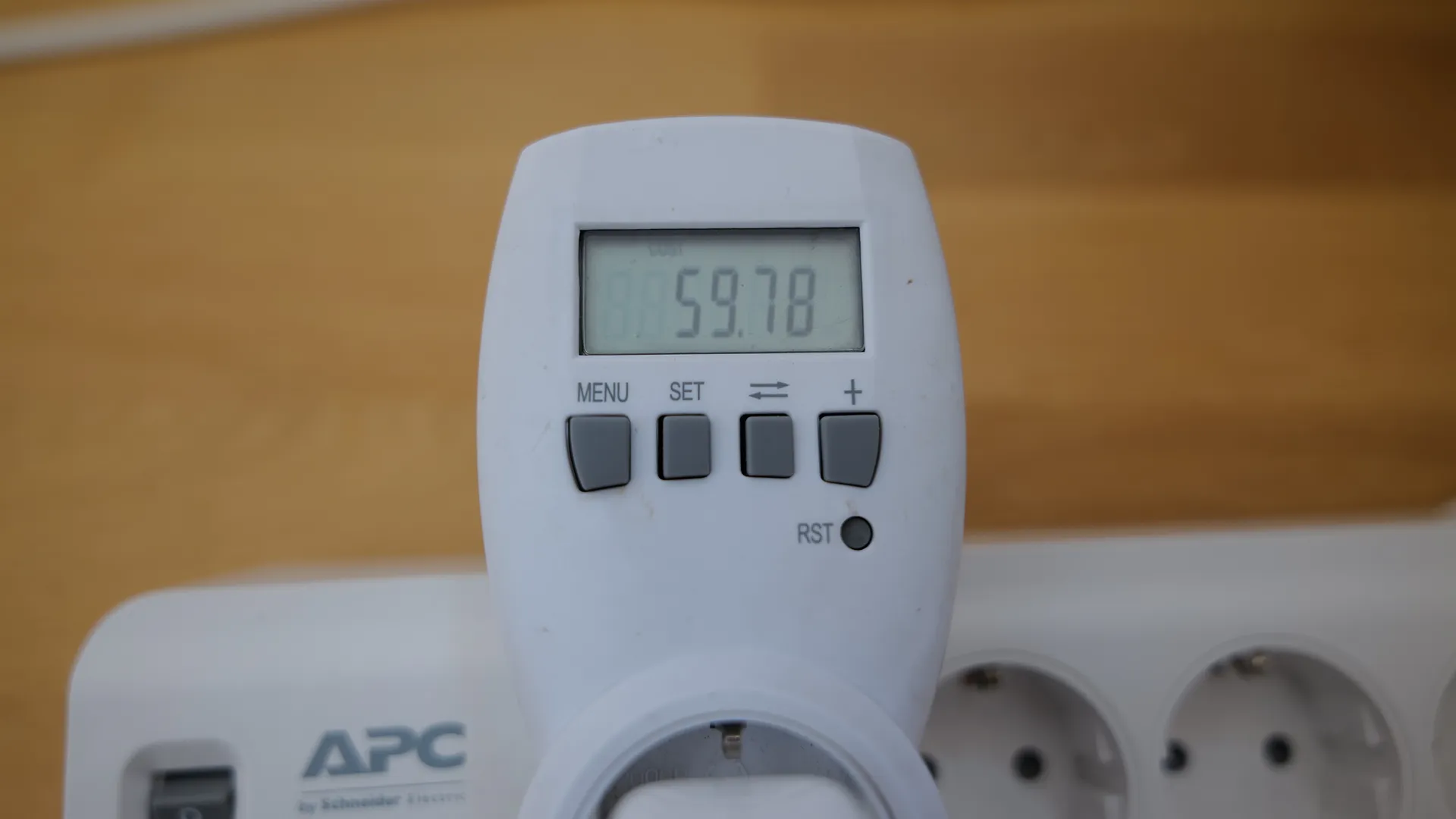
Important: This calculator helps you pinpoint exactly how much a single appliance costs you per year based on its power usage and your personal electricity rate. To see if your base rate is too high, compare the annual cost using your current price per kWh against both the German national household average of around 37 cents and competitive new-customer tariffs around 27–34 cents. Remember that your full monthly bill also includes the Grundpreis, so a low Arbeitspreis alone does not always mean the cheapest total contract.
Average German Electricity Expense by Family
| Household Size | Avg. Annual Consumption | Est. Monthly Cost | Recommendation |
|---|---|---|---|
| 1 Person | 1,500 kWh | €55–€65 | Ideal for single-person or flexible app-based plans. At 37.0 ct/kWh, usage alone is about €46/month before the Grundpreis. |
| 2 People | 2,500 kWh | €85–€95 | Compare green electricity plans and contract terms. |
| 3 People | 3,500 kWh | €115–€130 | High potential for savings via switching. |
| 4+ People | 4,500+ kWh | €145+ | Very high potential for savings via switching. |
German Electricity Provider Reviews
Ostrom
Ostrom is one of the most expat-friendly electricity providers in Germany. Its strongest advantage is its digital-first setup: the app, onboarding, tariff management, and support experience are designed to be easier than traditional Stadtwerke contracts. This makes Ostrom especially useful if you are new to Germany, do not want to handle long German paperwork, or need to switch quickly after moving into a new apartment.
Ostrom’s main tariff distinction is between SimplyFair and SimplyDynamic. SimplyFair is the simpler option for most households because it does not require a smart meter and is based on a variable pricing model. SimplyDynamic is the more advanced option because it tracks wholesale market prices more closely and requires a smart meter. This can work well for users who can shift consumption into cheaper hours, but it is not the best choice for everyone.
Best for: Expats who want English-friendly onboarding, app-based electricity management, and a simple alternative to Grundversorgung.
Watch out for: Dynamic tariffs are only useful if you understand price changes and have the right meter setup.
Octopus Energy
Octopus Energy is a strong choice for users who want a modern electricity provider with a focus on green energy and innovative tariff models. The company is known internationally for app-based energy management and smart tariffs, including tariffs designed around electric vehicles and flexible consumption. In Germany, Octopus Energy is especially interesting for expats who want a provider that feels more modern than a traditional municipal utility.
The main advantage of Octopus Energy is its combination of digital service, renewable electricity positioning, and smart-energy products. Some tariffs are better for normal household electricity use, while others are more relevant if you have an EV, heat pump, smart meter, or flexible consumption pattern.
Best for: Households that want a modern green electricity provider and may use smart-energy products later.
Watch out for: More advanced tariffs may require compatible hardware or a smart meter, so check the exact tariff conditions before signing.
Tibber
Tibber is best suited for people who actively want to manage their electricity use. It is not just a normal electricity provider; it is built around app-based consumption tracking, smart-home integrations, dynamic prices, and flexible usage. This can be a major advantage if you have an electric vehicle, home battery, heat pump, solar setup, or smart-home devices.
Tibber offers a fixed-price option and a dynamic tariff option. Its Smart Dynamic tariff uses 15-minute market prices, which means electricity can be cheaper during certain times and more expensive during others. Tibber’s dynamic setup is more flexible than a simple smart-meter yes/no rule. With a standard analog or digital meter, Tibber can offer monthly dynamic billing based on the monthly average spot price. With a compatible digital meter and Tibber Pulse IR tracker, 15-minute billing may be possible without a full physical smart meter. This makes Tibber attractive for tech-friendly households, but less ideal for people who just want a predictable monthly bill. Check the current setup rules on the Tibber tariff page.
Best for: EV owners, smart-home users, and people who can shift energy use to cheaper time slots.
Watch out for: Dynamic tariffs can increase risk if you use a lot of electricity during expensive periods or do not have the right meter setup.
Vattenfall
Vattenfall is a large, established electricity provider and can be a practical option for expats who prefer a familiar, mainstream company rather than a newer app-first provider. Its plans are generally easier to understand than fully dynamic tariffs, and it is often available in many German regions.
The main advantage of Vattenfall is stability and broad brand recognition. The downside is that the experience may feel less expat-focused than Ostrom, Octopus Energy, or Tibber. English support and app experience can be less central to the product, so it may not be the easiest option if you want everything handled in English.
Best for: Expats who want a large established provider and prefer predictable fixed-price electricity plans.
Watch out for: Always compare the final postcode-specific price, contract length, and cancellation period against digital providers before signing.
Fixed Price or Dynamic Electricity Tariff?
Use this quick decision guide before choosing a tariff:
| Your Situation | Better Tariff Type | Why |
|---|---|---|
| You are new to Germany and want predictable bills | Fixed-price tariff | A fixed Arbeitspreis makes monthly budgeting easier. |
| You do not have a smart meter | Fixed or standard variable tariff | Some dynamic tariffs require smart-meter data, while others use monthly average spot prices or a digital meter with an IR tracker. |
| You have an EV, heat pump, battery, or flexible appliances | Dynamic tariff | You may be able to shift usage into cheaper price windows. |
| You work from home and use electricity throughout the day | Fixed-price tariff | Dynamic prices may be harder to optimize if usage is constant. |
| You enjoy app-based control and checking prices | Dynamic tariff | You can react to price signals and automate consumption. |
For most new expats, a fixed-price or simple variable tariff is the safest first choice. Dynamic tariffs become more attractive once you understand your consumption, have the right meter, and can shift large electricity use into cheaper time periods.
Conclusion
Navigating the German electricity market is a matter of proactive management rather than passive acceptance. While newly signed customer tariffs can be much lower than the national household average of around 37.0 cents/kWh, the most crucial takeaway is that significant savings are readily available to those who take action.
The default basic supply (Grundversorgung) tariff, where many residents and nearly all newcomers start, is often one of the most expensive options. The single most effective strategy for reducing your electricity bill is to compare offers and switch to a competitive private provider. This simple step can save a typical household between €200 and €400 annually, depending on region, consumption, and current tariff.
For expats, the best electricity provider is not always the absolute cheapest. A good plan should combine a fair Arbeitspreis, a reasonable Grundpreis, transparent contract terms, and support you can actually understand. Ostrom, Octopus Energy, Tibber, and Vattenfall each fit different user types: simple app-based onboarding, smart-energy tariffs, dynamic price optimization, or traditional provider stability.
By understanding the key components of your bill—the Arbeitspreis and Grundpreis—and securing a contract with a price guarantee (Preisgarantie) or a dynamic tariff that fits your lifestyle, you can create predictable and manageable energy costs. Ultimately, the power to lower your electricity expenses in Germany lies firmly in your hands.
Frequently Asked Questions
For a single-person household with an average annual consumption of 1,500 kWh, you can expect a monthly bill of roughly €45 to €55. This includes both the consumption price per kWh and the fixed monthly base price (Grundpreis).
Your electricity bill consists of two parts: the Arbeitspreis (the price you pay for each kWh consumed) and the Grundpreis (a fixed monthly base fee). The base fee covers the costs of the meter, billing, and grid access. Even if you use zero electricity, you will still be charged the Grundpreis.
For most private consumers on standard contracts, the answer is no. Night-time tariffs (Nachttarife) were common for older storage heaters, but they are becoming rare. However, if you have a Smart Meter, you can now switch to Dynamic Tariffs. These allow you to pay lower rates during off-peak hours (like midday when solar production is high or late at night).
You can usually find the wattage (W) on a silver sticker or plate located on the back or bottom of the device. Common examples include:
Kettle: 2,000–2,400W
Gaming PC: 200–600W
LED TV: 50–150W
Laptop: 30–60W