
How we earn our money
We finance our services on how-to-germany.com through affiliate programs.
When a user orders a financial product through our site and their application is approved, we may receive a commission from some providers. It’s important to note that this does not in any way influence our independent ratings and recommendations.
All the products we present on how-to-germany.com are selected for their quality, range of services, and excellent value for money.
Internet Providers in Germany
 Written by
Janine El-Saghir
Janine El Saghir is an editor at How-to-Germany.com, where she specializes in the practical aspects of daily life and integration for expatriates. With years of...
Written by
Janine El-Saghir
Janine El Saghir is an editor at How-to-Germany.com, where she specializes in the practical aspects of daily life and integration for expatriates. With years of...
 Reviewed by
Erkan Boga
Erkan Boga is the founder and CEO of qmedia GmbH, the publishing house behind How-to-Germany.com. He established the platform with the clear vision of creating...
Reviewed by
Erkan Boga
Erkan Boga is the founder and CEO of qmedia GmbH, the publishing house behind How-to-Germany.com. He established the platform with the clear vision of creating...
 Edited by
Sadie Voss
Content Lead & Editor
Sadie Voss is the Lead Editor for How-to-Germany.com. As an expat who carved her own way into Berlin from the United States, Sadie is deeply...
Edited by
Sadie Voss
Content Lead & Editor
Sadie Voss is the Lead Editor for How-to-Germany.com. As an expat who carved her own way into Berlin from the United States, Sadie is deeply...
- DSL, cable, and fiber are the main ways of getting a home internet connection in Germany. The options available to you depend on the infrastructure installed at your house or apartment. Enter your address on any major internet provider website (Telekom, Vodafone, 1&1, O2) to check availability.
- Telekom is the best internet provider in Germany and has the best DSL coverage. Vodafone offers the fastest internet connection through TV cable. 1&1 and O2 are cheaper alternatives.
- An internet contract is typically for 2 years. After this, you can terminate it with a one-month notice. Telekom, 1&1 and O2 also offer internet plans without contract. If you move abroad or move to an address where your provider cannot deliver the contracted service, you may have a special termination right with a 1-month notice period.
Compare Internet Providers in Germany


Types of internet connections in Germany
To get connected to the internet in Germany, you can choose between:
- DSL
- TV cable
- Fiber optic
- Mobile
- Satellite
Before deciding on a specific connection type, you should find out what is available at your house/apartment. DSL and cable are still widely available, while fiber optic is expanding quickly. By mid-2025, FTTH/B homes-passed availability had reached around 52.8% in Germany, representing about 24.3 million households, and coverage is expected to continue growing in 2026. Active fiber subscriptions are still much lower than technical availability, so you should always run an address check before choosing a fiber plan. In situations where none of these lines are available, your only choices are mobile and satellite internet.
DSL
DSL is the most common type of internet connection in German apartments, running through the local telephone line. It offers download speeds of up to 250 Mbit/s and upload speeds of up to 50 Mbit/s. However, the exact speed largely depends on the development of your local telephone line. For instance, while almost every line can now handle 16 Mbit/s, only some lines can achieve 200 Mbit/s or more.
One of the main advantages of the DSL internet connection is its stability. The internet speed does not vary with the number of users.
TV cable
Cable connections, on the other hand, use television cable lines to provide internet access. They offer speeds of up to 1000 Mbit/s for download. Upload speeds are much lower than on fiber connections: even after Vodafone’s 2026 upload upgrades, the maximum upload speed on many gigabit cable plans is up to 75 Mbit/s. Upload speeds of 200 Mbit/s or more are generally reserved for fiber-to-the-home connections. As cable users share the line with their neighbors, internet speed can drop when many people are online simultaneously.
One important thing to note with TV cable connections is that the choice of providers is limited. You can only select the provider that operates the line in your building. Usually, your landlord can tell you who that is.
Since July 1, 2024, landlords can no longer automatically pass classic cable TV connection fees on to tenants through the Nebenkosten bill. This mainly affects cable TV, not a separate cable internet contract. For renting expats, it means you are no longer forced to pay for a bundled cable TV connection through rent and can decide whether you want a separate TV or internet contract.
Fiber optic
If speed is your top priority, you might want to consider a fast internet connection through fiber optic cable. Considered a future technology, fiber connections transmit information through light signals, making them faster and less prone to disruption than DSL or cable. They can offer internet speeds of up to 1000 Mbit/s for download and 500 Mbit/s for upload, with the potential for even higher speeds.
Fiber optic connections have particularly low latencies, meaning fewer delays in video streaming or online gaming. This makes them the best internet connection for heavy internet users.
Mobile
Mobile internet connections, such as 4G, LTE, and 5G, provide a practical alternative for those who don’t have a reliable home internet connection, especially in rural areas where fast internet is often still in short supply. However, it’s important to note that mobile internet is not a full replacement for a home internet connection. Many mobile internet plans limit the data volume or only have mediocre reception in certain locations.
Despite these limitations, mobile internet plans are an excellent solution for commuters, gardens, campsites, and holiday homes.
Satellite
Lastly, satellite internet connections are a niche solution primarily used by sailors or cruisers. They come with high acquisition costs, offer a relatively low internet speed, and often limit the data volume.
Nonetheless, in certain scenarios, they could be the only connection type available.
Important to know about an internet contract in Germany
Before choosing an internet plan and concluding a contract, consider the internet speed you need, the contract term, potential price increases, router costs and any one-time connection fees charged by the provider.
Internet speed
The most important factor when choosing an internet contract is the appropriate download speed.
- If you only need the internet connection for basic tasks such as emailing, watching YouTube videos, and occasional Netflix streaming, then 25 megabits per second (Mbit/s) should suffice.
- If you work from home or share your house with others who do the same, you might require higher speeds, ranging from 50-100 Mbit/s to 200 Mbit/s.
- For those who do lots of video streaming and online gaming, a cable or fiber optic plan with the fastest download speed available, 1000 Mbit/s, is advisable.
Keep in mind that the actual internet speed you get will always be slightly slower than advertised.
Minimum contract term
It’s common for German internet providers to offer home internet plans on 2-year contracts. After this initial term, you can terminate the contract by giving a one-month notice.
For those who are only staying in Germany for a short period, like students studying for a semester, internet service providers like Telekom, 1&1, and O2 offer flexible internet plans that can be cancelled every month.
If you move abroad or move to a new address in Germany where your current internet provider cannot deliver the contractually agreed service, you may have a special termination right under § 60 Abs. 2 TKG. In practice, the contract can usually be terminated with a 1-month notice period after you inform the provider about the move and provide the required proof. This is especially important for expats who are worried about signing a 24-month contract before leaving Germany.
Price increases
Some internet providers in Germany may adjust their prices after the first 3–12 months of a contract. Look at the full price of the contract and not only at the special offer for the first months.
Connection fees
Some providers also charge a one-time connection or activation fee when setting up a new internet contract. Depending on the provider and tariff, these fees can range from a few euros to around €70 and should be considered when comparing offers.
Router costs
Most internet providers offer routers for rent, usually for about €5 per month. However, if you have your own router, you can save these costs.
Plus, if you frequently struggle with your wireless internet reception, investing in a decent internet router for €100–200 would be a more cost-effective solution than booking the cheapest rental model included in the contract.
Best internet providers in Germany
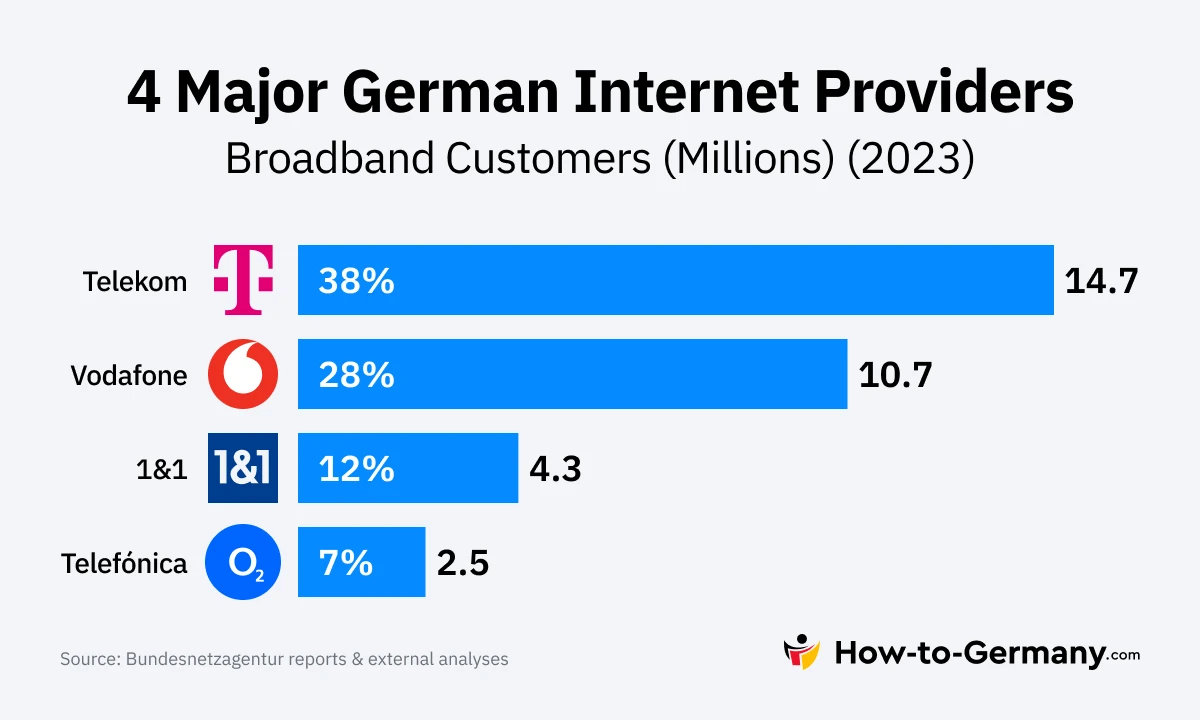
The vast majority of Germans get their internet from one of the four major providers:
- Telekom
- Vodafone
- 1&1
- O2
These four big internet providers offer reasonably priced plans considering the internet speed and coverage of their networks, making them competitive with local internet providers and other internet providers.
They also offer discounts if you add TV, landline, or mobile plans with your internet contract, if you’re under 28 years old, or if you switch from another internet provider. They all have physical stores, so you don’t have to wait on the customer hotline if you have a question.
| Provider | Typical Entry Plan | English Support | Best For |
|---|---|---|---|
| 1&1 | DSL 50, depending on address and promotion | Mostly German; English support depends on the agent | Price-conscious users who want DSL alternatives to Telekom |
| O2 | DSL, cable, fiber, or mobile home internet, depending on availability | More expat-friendly than many providers, including an active English-speaking community | Flexible contracts, mobile bundles, and English-speaking help resources |
| Telekom | MagentaZuhause S for basic DSL; MagentaZuhause M for 50 Mbit/s | Mostly German; strong shop network and service infrastructure | DSL coverage, reliability, rural addresses, and full-service support |
| Vodafone | GigaZuhause 50 Kabel, where cable is available | Mostly German; broad hotline and shop network | Cable internet, high download speeds, and TV/internet bundles |
Telekom
Telekom is the biggest and best internet provider in Germany and offers the best DSL internet connection. The company emerged from Deutsche Telekom, operating the telephone network, and thus, has the best DSL coverage, especially in rural areas.
Telekom’s entry-level DSL tariff is MagentaZuhause S, with up to 16 Mbit/s download speed and a regular base price of around €38.95 per month. The 50 Mbit/s tariff is MagentaZuhause M, which is a VDSL plan rather than the basic ADSL entry tariff. Current online promotions for MagentaZuhause M can start at around €9.95 per month for the first 3 months and then increase to around €43.95 per month from the 4th month, depending on address, contract type, and promotion. In 2026, Telekom also introduced price increases for some older legacy fixed-line accounts. While Telekom is usually a bit more expensive compared to other internet service providers in Germany, their extensive coverage makes them a reliable choice, especially for those living outside major cities.
Vodafone
Vodafone is the second-largest internet provider in Germany and offers the fastest cable internet connection. Unlike Telekom, Vodafone relies mostly on internet via TV cable. Here are some key facts about Vodafone’s internet service:
- Vodafone has almost 24 million households with a cable connection.
- Vodafone offers high-speed cable internet plans.
- Vodafone’s cable internet connection is known for its speed, though performance can vary in buildings where many neighbors share the same cable segment.
If you have a Vodafone cable in your house, you have a good chance of getting cheap cable internet access, either with Vodafone or with one of their partners, Eazy or O2. Vodafone’s basic GigaZuhause 50 Kabel tariff is currently around €19.99 per month for the first 9 months and then around €39.99 per month from the 10th month for up to 50 Mbit/s download and up to 25 Mbit/s upload speed. In January 2026, Vodafone also updated its higher cable tiers, replacing older 100, 250, and 500 Mbit/s plans with 150, 300, and 600 Mbit/s options. New cable plans above 50 Mbit/s may include up to 75 Mbit/s upload speed. Vodafone pricing changes regularly, so always check the final monthly price after the promotional period before ordering.
1&1
1&1 is the third-largest internet provider in Germany and offers affordable DSL plans with reasonable internet cost. Their DSL 50 tariff offers up to 50 Mbit/s download and up to 20 Mbit/s upload speed. Current promotions may temporarily reduce the monthly price at the beginning of the contract, while the regular monthly price is typically higher after the promotional period.
O2
O2 is the fourth-largest internet provider in Germany and has entered into a partnership with Vodafone to use their cable network. Their cheapest cable internet plan is usually positioned as a lower-cost alternative to Vodafone cable, with up to 50 Mbit/s download and up to 25 Mbit/s upload speed. As with all providers, check your address first because O2 can offer DSL, cable, fiber, or mobile-based home internet depending on availability.
Cheapest internet plans in Germany
You can find cheap internet plans for both cable and DSL with the comparison calculators on the internet, such as Tariffuxx, Check24, and Verivox. Tariffuxx provides the most accurate prices. Check24 and Verivox offer additional portal bonuses.
How to get an internet connection in Germany?
If you’re renting, you might be able to take over the previous tenant’s contract. However, if you’ve bought your own house, you’ll likely need to set up a new connection, which could take up to two weeks for your router to be delivered and a technician to open your line.
Enter your address on any major internet provider website (Telekom, Vodafone, 1&1, O2) to see what options are available for your house/apartment. Then, choose a suitable internet plan and conclude the contract on their website. A typical German checkout asks you to run an address check, select the technology and speed, choose whether to rent or use your own router, enter your personal details, select an installation or activation date, and confirm the monthly price after the promotional period.
Before ordering internet in Germany, prepare your full German address, your name as written on your ID, your date of birth, your email address, your phone number, and your IBAN for direct debit. Some providers may also ask for your previous provider details if you are switching, your previous landline number if you want to keep it, or proof that you live at the address. If you do not yet have a German IBAN, check whether the provider accepts SEPA IBANs from another EU country.
How to terminate an internet contract?
After the end of the initial contract term, you can provide a one-month notice for termination.
Most major internet providers now offer online contract cancellation through their website. If you cancel online, always keep a copy of the confirmation for your records. Some providers may still accept cancellation by letter, but digital cancellation has become the standard.
If you are leaving Germany or moving to an address where your provider cannot supply the agreed internet service, contact your provider before the move and ask about special termination. Under § 60 Abs. 2 TKG, the special termination notice period is generally 1 month. You will usually need to provide proof of the move, such as deregistration, a new address, or other documentation requested by the provider.
Internet providers in Germany may run identity or creditworthiness checks before activating a contract, especially for 24-month postpaid contracts. If you have no German credit history yet, check whether the provider offers prepaid, monthly cancellable, mobile home internet, or in-store alternatives. Do not rely only on the headline monthly price if you are new to Germany and still setting up your bank account, Anmeldung, and credit profile.
How to change internet provider?
Switching from one internet provider to another can be done easily online through the new provider’s form on their website. The new internet provider will terminate your previous contract and ensure a smooth transition.
The technical change can take a few weeks. To avoid ending up without internet during this transition period, give the new internet provider notice at least 1–2 months in advance.
Conclusion
In conclusion, securing the right internet connection in Germany involves understanding the different types of connections, considering key aspects of an internet contract, and choosing the internet provider that best suits your needs and budget.
For expats and renters, the most important details are availability at your exact address, the full price after the promotional period, whether support is available in English, and whether you may need to terminate early when moving. Since July 2024, tenants also have more freedom around cable TV billing because classic cable TV fees can no longer be automatically bundled into Nebenkosten.
Frequently Asked Questions
In Germany, the main types of internet connections are DSL, cable, fiber, mobile, and satellite. Choose the one that is available at your house/apartment.
In Germany, the most common internet service providers are Telekom, Vodafone, 1&1, and O2. They all offer reasonably priced plans considering the internet speed and coverage of their networks.
You can find the cheapest internet plans in Germany by using comparison calculators such as Tariffuxx, Check24, and Verivox. These tools can help you compare different providers and their offerings to find the best internet plan for your needs.