
German Visa Fees & Exemptions
 Written by
Janine El-Saghir
Janine El Saghir is an editor at How-to-Germany.com, where she specializes in the practical aspects of daily life and integration for expatriates. With years of...
Written by
Janine El-Saghir
Janine El Saghir is an editor at How-to-Germany.com, where she specializes in the practical aspects of daily life and integration for expatriates. With years of...
 Reviewed by
Erkan Boga
Erkan Boga is the founder and CEO of qmedia GmbH, the publishing house behind How-to-Germany.com. He established the platform with the clear vision of creating...
Reviewed by
Erkan Boga
Erkan Boga is the founder and CEO of qmedia GmbH, the publishing house behind How-to-Germany.com. He established the platform with the clear vision of creating...
 Edited by
Sadie Voss
Content Lead & Editor
Sadie Voss is the Lead Editor for How-to-Germany.com. As an expat who carved her own way into Berlin from the United States, Sadie is deeply...
Edited by
Sadie Voss
Content Lead & Editor
Sadie Voss is the Lead Editor for How-to-Germany.com. As an expat who carved her own way into Berlin from the United States, Sadie is deeply...
- Most third-country citizens require a valid visa to enter Germany and the Schengen area.
- You should apply for a German Schengen visa if Germany is your first or main European destination.
- Schengen visas are subject to a fee. The fees for airport transit visas (visa category A) and Schengen visas for stays of up to 90 days (visa category C) are uniformly regulated for all Schengen countries by the Schengen visa code. On the other hand, national visas (visa category D) are subject to the residence regulations of the individual Schengen member states, including the fees.
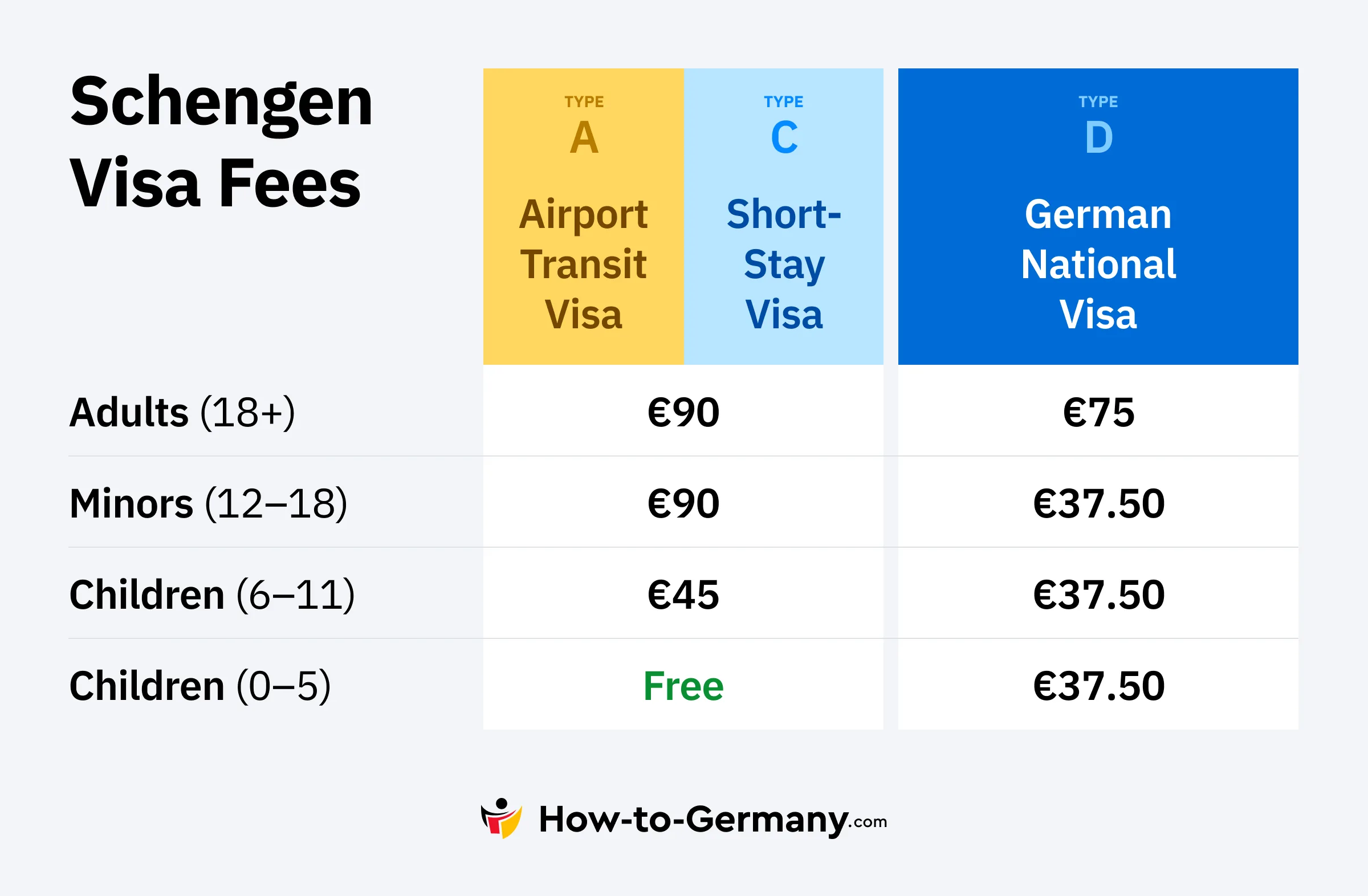
- The regular fee for Schengen visas in categories A and C is €90, while German national visas cost €75. Understanding these distinctions can help you choose the right visa for your travel needs.
- Both the visa code and German residence regulations allow fee waivers and fee reductions for certain groups and countries, potentially making travel plans more affordable.
Schengen area visa obligations & Types
According to our German visa guide, German visa requirements indicate if you are traveling to Germany from a country where a visa is required, you will need a Schengen Visa, valid for the entire Schengen area.
The Schengen area
The Schengen area consists of 29 states, including all EU countries except Ireland and Cyprus and the non-EU states Iceland, Norway, Liechtenstein, and Switzerland.
There are normally no border controls between the Schengen states. Travelers are only checked at the external borders of the Schengen area.
Visa obligations for the Schengen area
- Citizens of the European Union and the other Schengen states have complete freedom of travel within the entire Schengen area without any formalities.
- Foreign nationals from third countries with a valid residence permit from a Schengen country also generally do not require a visa to travel within the Schengen area or to stay in another Schengen country for a maximum of 90 days.
- For stays of up to 90 days, travelers from 60 countries do not need a visa. However, as soon as ETIAS (European Travel Information and Authorization System) comes into force, they will need a digital European travel authorization to enter Germany and other participating European countries.
- Citizens of all other countries require a valid visa to enter the Schengen area and, consequently, to enter Germany. They might also have to meet German visa insurance requirements.
Schengen visa types
The type of German visa depends on the purpose of the trip and the planned stay:
- German airport transit visas (A visas) authorize travelers to pass through a German airport’s transit area without entering the Schengen area.
- Visas for short-term stays (C visas) like German business visas, German trade fair visas, or German medical treatment visas, are valid for up to 90 days within 180 days. You can get a C visa for tourist, family, study, or business trips.
- National visas (D visas) or German long-stay visas entitle the holder to stay for more than 90 days and may require a national residence permit after entry. These can be, for example, student visas, German job seeker visas, German Opportunity Card visas, EU Blue Card visas, or family reunion visas.
The Schengen visa code regulates the conditions for A visas and C visas.
National visas are subject to the national residence regulations of the individual Schengen states.
German Schengen visa fees
The following visa fees apply for A visas and C visas (airport transit visas and short stays):
- Adults and minors aged 12 years and over: €90
- Children aged between 6 and under 12 years: €45
- Children aged under 6 years: no fee
The exemption for children under six applies specifically to Schengen A and C visa applications. It does not create a general exemption from German national visa fees.
A National Visa (D visa) costs €75 for adults. Minors pay a reduced fee of €37.50 regardless of their age, unless they qualify for a separate national visa fee waiver.
If the responsible German mission uses an external application center such as VFS Global, TLScontact, or BLS International, applicants normally pay an additional service fee on top of the official €90 or €75 visa fee. The exact amount depends on the country and provider but is often approximately €15 to €40 or more. Optional services such as document scanning, courier delivery, SMS notifications, or premium appointments can cost extra.
Visa fee waivers and reductions
The following exemptions mainly apply to short-stay Schengen A and C visa applications under the Schengen Visa Code:
| Category | Eligibility | Details | Notes |
|---|---|---|---|
| Children | Under 6 years of age. | Children below age 6 are exempt from Schengen A and C visa fees. | Does not apply automatically to German national D visas; minors applying for a D visa normally pay €37.50. |
| Educational Participants | Pupils, students, postgraduate participants, and accompanying teachers. | Travel must be for study or educational training within an organized program. | Applies to qualifying short-stay Schengen visa applications, including school trips and university exchanges. |
| Non-Profit Event Participants | Representatives of non-profit organizations aged 25 or under. | Participation in seminars, conferences, sporting, cultural, or educational events. | Events must be organized by non-profit organizations. |
| Researchers | Researchers traveling for the purpose of carrying out scientific research. | Qualifying short-term research trips may include scientific research activities, conferences, or related academic stays. | The statutory exemption applies to qualifying Schengen A and C visas. A long-stay guest scientist German visa is a national D visa and normally costs €75 unless a separate national exemption applies. |
| Trade Fair Exhibitors | Exhibitors at German trade fairs who hold an official exhibitor pass. | The exemption applies to the visa fee for qualifying short-term trade-fair travel. | Trade-fair visas are Schengen C visas. The exemption does not generally apply to national D visas. |
| Visa Transfer Cases | Travelers with a valid visa in a full passport. | Visa is transferred to a new passport where the relevant procedure is available. | No fee may be charged for the transfer process. |
The exemption from visa fees for study or training purposes generally applies only to qualifying short stays undertaken within an organized educational program. Student applicant visas for study orientation and preparation, as well as national visas for confirmed full-time degree studies in Germany, are normally subject to a fee.
A specific exception applies to qualifying Indian scholars, school or university exchange students, and participants in short-term academic programs lasting up to 90 days. Under the Germany-India Migration and Mobility Partnership framework, these applicants may receive a fee-free Schengen C visa. Long-term Indian degree students applying for a national D visa normally remain subject to the €75 fee.
General German visa fee waivers
The German authorities generally do not charge visa fees for spouses, registered partners, and minor unmarried children of German citizens. The same applies to qualifying family members of citizens of the EU, EEA, or Switzerland who benefit from free-movement rights. Parents of minor German citizens may also qualify for an exemption.
In addition, Germany has concluded visa facilitation agreements with some states that provide fee reductions or exemptions for certain groups. Depending on the agreement, these provisions may apply, for example, to children, students, researchers, journalists, or members of official delegations.
Issuance of national visas free of charge
Visa fees can also be waived for national visas. The following applicants may be eligible for a German national visa free of charge:
- Employees of diplomatic missions, consular posts, and international organizations present in Germany may be exempt from visa fees. Applicable exemptions may also cover their spouses, registered partners, and dependent children.
- Visitors whose stay is financed by a scholarship from German public funds, for example through the German Academic Exchange Service (DAAD) or the Alexander von Humboldt Foundation, may be exempt from national visa fees. Spouses, registered partners, and minor children may also be exempt if their stay is included in the public funding.
- Researchers and guest scientists applying for an ordinary employment-based national visa are not generally fee-exempt. A standard national D visa for a research or guest-scientist position normally costs €75. An exemption may apply where the stay is funded by a qualifying scholarship from German public funds or another specific legal waiver.
- Citizens of countries where Germany has committed itself in bilateral or multilateral agreements to waive visa fees for national visas. Contractually agreed conditions may apply to the exemption from fees.
Fee reductions for citizens of certain countries
Visa facilitation agreements provide a reduced fee of €35 for certain Schengen visas in categories A and C for eligible citizens of Armenia, Azerbaijan, and Belarus, as well as qualifying applicants from Albania, Bosnia & Herzegovina, Georgia, Moldova, Montenegro, North Macedonia, Serbia, and Ukraine.
Citizens of Albania, Bosnia & Herzegovina, Georgia, Moldova, Montenegro, North Macedonia, Serbia, and Ukraine who hold qualifying biometric passports can generally travel to the Schengen area without a visa for stays of up to 90 days within a 180-day period. The €35 facilitated fee is therefore primarily relevant to applicants from these countries who still require a visa, including holders of non-biometric passports.
For eligible citizens of Cabo Verde (Cape Verde), the facilitated Schengen visa fee is €67.50.
The EU visa facilitation agreement with Russia is fully suspended. Russian applicants are therefore generally subject to the standard Schengen visa rules and fees rather than the facilitated conditions previously available under that agreement.
The regular fees apply for national visas, provided that no deviating bilateral agreements on visa fees exist between Germany and these countries.
Further reductions and exemptions from visa fees for Germany
In addition, German missions abroad may check whether reductions or exemptions from visa fees are possible in individual cases. Reasons for this are, for example:
- Travel that serves a vital public interest — for example, in the context of foreign policy development or development policy cooperation
- Travel to promote cultural and sporting interests
- Humanitarian reasons
Conclusion
Understanding the visa fees and exemptions for Germany and the Schengen area is essential for planning your travel efficiently. The standardized fees for Schengen visas and the flexibility of reductions and exemptions for certain groups ensure that the system accommodates diverse needs.
It is important to distinguish between exemptions under the Schengen Visa Code and exemptions for German national visas. Children under six, qualifying short-stay researchers, and eligible trade-fair exhibitors may be exempt from Schengen A or C visa fees. These exemptions do not automatically apply to national D visas. Minors applying for national visas normally pay €37.50, while researchers and guest scientists normally pay €75 unless they qualify for a separate waiver, such as qualifying funding from a German public scholarship.
Applicants should also budget for any mandatory external service fee charged by the application center. Payment methods vary by German mission and external provider and may include debit or credit cards, mobile payments, bank transfers, or other cashless methods. Applicants should check the instructions for their specific application location rather than assuming that the visa fee must be paid in cash.
For the best outcome, applicants should ensure their documentation is complete and up to date and consult the responsible German mission or authorized application center for specific guidance related to their situation.
Frequently Asked Questions
Payment methods depend on the German embassy, consulate, or external application center handling your application. Many locations accept or require debit or credit cards, bank transfers, mobile payments, or other cashless methods. Some locations may still accept cash in the local currency, but you should not assume that cash is available or permitted. Check the payment instructions published by the responsible mission or application provider before your appointment.
Usually, yes. If a German mission uses an external provider to collect applications, documents, and biometric information, the provider normally charges a mandatory service fee in addition to the official visa fee. This is often approximately €15 to €40 or more, depending on the country and provider. Optional services such as courier delivery, document scanning, SMS updates, or premium appointments may cost extra.
There is no general fee exemption for every international student. National visas for full-time degree studies normally cost €75 for adults. Fee exemptions may apply to scholarship recipients, qualifying participants in organized educational programs, or applicants covered by a bilateral agreement. Qualifying Indian scholars, exchange students, and participants in short-term academic programs of up to 90 days may receive a fee-free Schengen C visa, while long-term Indian degree students normally still pay the national visa fee.