
The German Spouse Visa
 Written by
Janine El-Saghir
Janine El Saghir is an editor at How-to-Germany.com, where she specializes in the practical aspects of daily life and integration for expatriates. With years of...
 Reviewed by
Erkan Boga
Erkan Boga is the founder and CEO of qmedia GmbH, the publishing house behind How-to-Germany.com. He established the platform with the clear vision of creating...
 Edited by
Sadie Voss
Content Lead & Editor
Sadie Voss is the Lead Editor for How-to-Germany.com. As an expat who carved her own way into Berlin from the United States, Sadie is deeply...
- The German spouse visa is a family reunification visa designed specifically for third-country nationals who wish to live with their spouse or registered partner in Germany.
- As a German national visa it allows you to establish a life in Germany and obtain a German residence permit.
- The visa requirements usually include proof of basic German language skills (A1 level, simple everyday language). However, under certain conditions, this can be waived.
- If one partner is a third-country national with a German residence title, they must also prove sufficient financial means to support you without state assistance.
- In the first 3 years, your German residence permit depends on your partner and the continuation of the marriage or registered civil partnership, except in hardship cases.
- Subsequently, you can obtain an independent right of residence.
Germany spouse visa: Obligations & requirements
The protection of marriage and family has constitutional status in Germany, which provides the fundamental basis for a spouse visa. Details of the issuance of visas and residence permits are regulated by the immigration law of the Federal Republic of Germany in line with Germany visa Schengen requirements.
Spouse visas are Germany long-stay visas (national D visas). The Federal Foreign Office determines the criteria for issuance. This special family reunification visa is available to spouses and registered partners of individuals living in Germany, and it entitles you to receive a German residence permit.
Typically, a German spouse visa is issued for 3 months. However, depending on the country and personal circumstances, a visa for up to 6 months may be issued. During this time, you must apply for a residence permit at the German immigration office.
In addition to national visas, German embassies also issue short-term visas (C visas) for stays of up to 90 days. Their issuance is uniformly regulated in all Schengen countries. Such a visa does not constitute a residence permit for the subsequent immigration of a spouse.
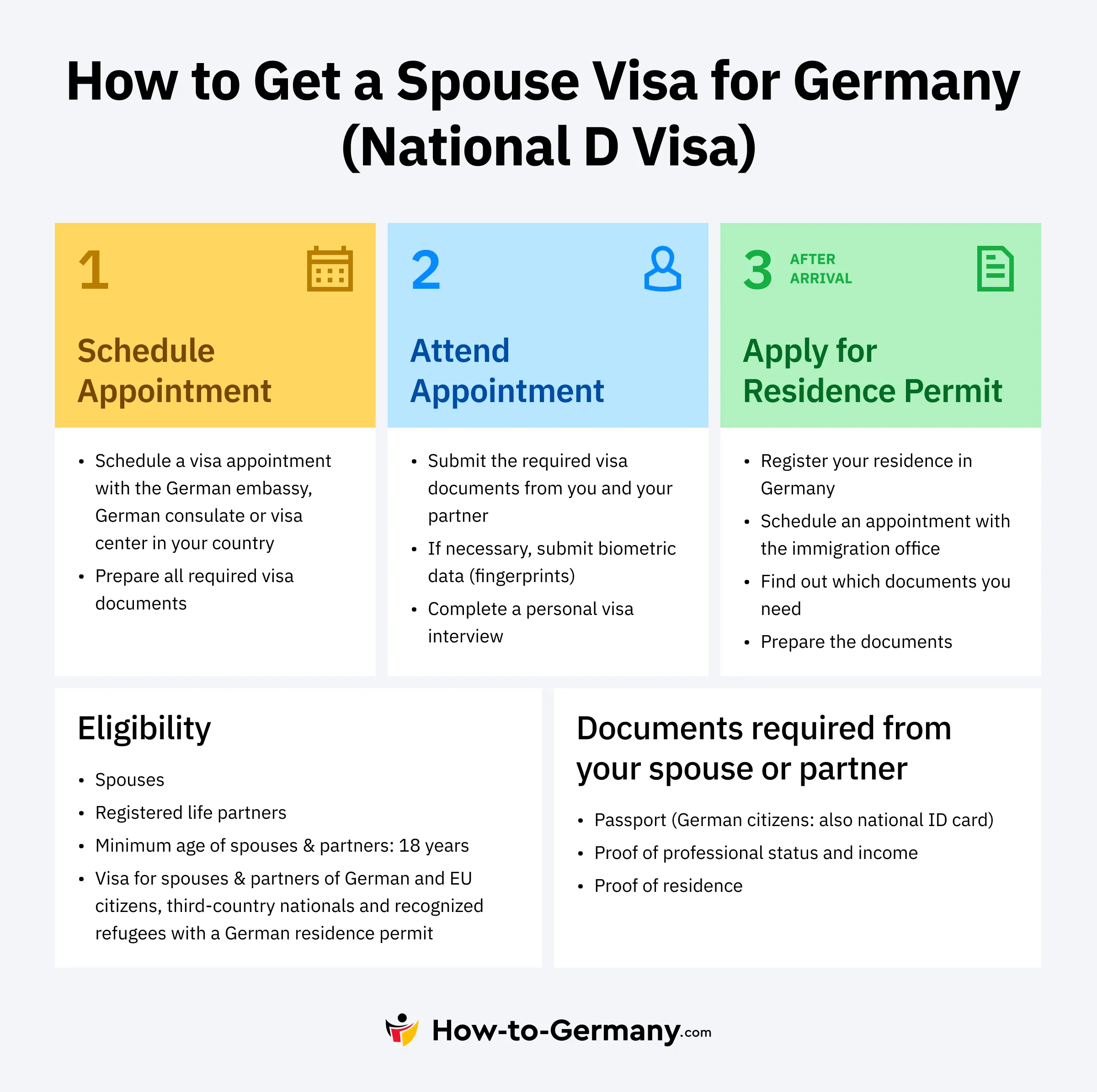
Visa eligibility
You can apply for spousal reunification if your partner in Germany meets one of the following requirements:
- German citizenship
- Citizenship of an EU member state or another Schengen country (Switzerland, Norway, Iceland, Liechtenstein)
- Third-country national with a residence title for Germany (for example via a Germany work visa or Germany job seeker visa, residence permit, EU Blue Card for graduates, settlement permit, EU long-term residence permit). A temporary residence permit does not preclude a spouse visa. Partners must be able to support themselves independently.
- Recognized refugee under the Geneva Convention. In this case, proof of a secure livelihood and language skills are not required for the visa to be issued.
General visa obligation
A German spouse visa is required by spouses and registered partners from a country whose citizens need a visa to enter Germany.
Citizens of the member states of the EU, the 4 other Schengen countries, and some other countries are exempt from visa requirements and can travel to Germany without a visa for more than 90 days.
Citizens of Australia, Canada, Israel, Japan, New Zealand, South Korea, the United Kingdom, and the USA do not need a visa even for long stays in Germany. They can enter without a visa and apply for the spousal residence permit directly at the immigration office in Germany. But they must apply within 90 days of entry. The same applies to citizens of Andorra, Brazil, El Salvador, Honduras, Monaco, and San Marino, but only if they do not intend to work in Germany. If you are from one of these six countries and want to work, apply for the spouse visa at the embassy before you travel.
Married during a visit: Germany or Denmark makes the difference
Many couples marry while the non-EU partner is in Germany on a Schengen visa or as a visa-free visitor. Whether you can then stay and apply for the residence permit in Germany depends on where you married:
- Wedding in Germany: If you are in Germany legally on a Schengen visa or visa-free and marry here, you can apply for the residence permit at the local immigration office. You do not have to leave the country, because your right to the permit arose after you entered. At that point you must already meet all requirements, including basic German where it is required.
- Wedding in Denmark or another Schengen country: If you marry abroad and then return to Germany, the marriage took place before your last entry. In this case, you cannot apply from within Germany — Germany’s highest administrative court ruled so in 2011. You normally have to leave and apply for the spouse visa at the embassy. The immigration office can make an exception in individual cases. But being apart for the usual length of the visa procedure is not reason enough on its own.
- Honest visa application: If you state “visit” as the purpose in a Schengen visa application although you already plan to marry and stay, this counts as false information. You then have no right to apply in Germany, as the same court ruled in 2010. Once you leave and apply for the spouse visa from abroad, it can no longer be held against you.
Citizens of the eight countries named above can apply in Germany within 90 days of entry, no matter where they married. For the six countries with the work restriction, the same applies only if they do not intend to work.
Visa requirements for third-country nationals with an EU residence permit
Third-country nationals with an EU residence permit enjoy freedom of travel throughout the Schengen area. Still, they usually require a residence permit for more than 90 days in another Schengen country.
Whether you need a spouse visa for Germany as a third-country national with an EU residence permit depends on your partner’s status and on whether you already meet all requirements:
- If your partner is a German citizen, a third-country national with a German residence permit, or a recognized refugee, you can apply for the residence permit directly at the immigration office in Germany. You can do this while you are here on your residence permit from the other Schengen country — provided you already meet all requirements, such as basic German where it is required. You must apply within 90 days of entry. If a requirement is missing, you need the spouse visa. You can apply for it in your home country or in the EU/Schengen country that issued your residence permit.
- If your partner in Germany is a citizen of an EU or Schengen country, you do not need a visa with an EU residence permit. Still, you can obtain a residence permit directly based on your marriage/registered partnership.
Exemptions for the language certificate
Proof of German language skills at the A1 level is not required in the following cases:
- The partner living in Germany is not a German citizen and is either self-employed or works as a highly qualified specialist (e.g., residence through EU Blue Card, scientist, IT specialist). The same regulation applies to recognized refugees.
- The partner living in Germany has a permanent settlement permit or an EU long-term residence permit.
- Special circumstances make it impossible or unreasonable for the immigrating partner to learn basic German before entry — for example, because no German course or A1 exam is available in their country. The embassy decides case by case.
- The immigrating partner has verifiable other integration achievements — for example, a university degree or good English skills.
Rights and residence status through spouse immigration
As soon as you have received a German residence permit through spouse immigration, a world of opportunities opens up for you. You have extensive rights, including the freedom to work, conduct vocational training or apply for programs such as a Germany internship visa to temporairly enroll at a university in Germany without restrictions or additional visa requirements.
However, your residence permit is tied to the existence of the marriage or civil partnership for the first 3 years. After that, you can obtain an independent right of residence provided that you can secure your livelihood from your means. In cases of hardship — for example, the death of your partner or separation for serious reasons such as domestic violence — an independent residence permit is possible earlier.
After 5 years, you are entitled to permanent residence in Germany through a settlement permit, provided that you can support yourself. If your partner is a German citizen, you will usually receive it after 3 years with a residence permit — provided you still live together in Germany and speak German at B1 level.
If you are married to a German, you can usually be naturalized after 3 years of legal residence in Germany, once the marriage has lasted at least 2 years. Otherwise, it takes 5 years. In both cases you need German at B1 level, must pass the naturalization test, and generally have to support yourself without social benefits. The former fast track to citizenship after 3 years with B2 German no longer exists.
Visa application and visa documents
You submit your visa application at the German Embassy in your home country or in the country in which you reside. German consulates or visa centers are responsible for visa matters in some countries.
Visa application process
The application for a spouse visa involves the following steps:
- Arrange a personal appointment at the German Embassy or the visa center.
- Compile the required documents.
- At the Embassy appointment: submit the documents and biometric data (fingerprints), document check, complete a visa interview
A German spouse visa will only be granted if the embassy or the immigration office in Germany does not doubt that the marital relationship will continue in Germany and that the relationship is voluntary. So, you may receive an invitation from the embassy to a second interview, in which the embassy will ask how well you know your partner and what your relationship is like. At the same time, your partner will receive an invitation from the German immigration office, where they will answer the same questions.
Required Documents
Your visa application will only be successful if you submit all documents in full and in the correct form. If documents are missing, the application will be delayed or rejected.
You’ll need to submit the original of your visa documents along with 2 photocopies in German or English. Documents in other languages must be translated into one of these languages by a sworn translator recognized by the embassy.
The websites of the German missions abroad provide information on which documents and, if applicable, certifications are required for a spousal visa, as well as lists of translators recognized by the embassies.
The following documents are generally required for the visa application —, however, the embassy may request further documents:
Your documents:
| Document | Requirement | Example / Details | Notes |
|---|---|---|---|
| Application Form | Completed and signed. | National visa (D visa) application form. | Usually submitted in duplicate. |
| Biometric Photos | 2 recent photos. | Germany visa photo requirements (biometric). | Incorrect format may cause delays. |
| Marriage Certificate | Official and certified. | Marriage certificate or civil partnership declaration. | May require legalization or translation. |
| Passport | Valid passport. | Issued within last 10 years, valid 12+ months. | Submit original + copies. |
| Proof of Health Insurance | Valid coverage. | Schengen travel insurance (€30,000 minimum coverage) in accordance with Germany visa insurance. | Must cover entire visa period. |
| Proof of Language Skills | A1 German (if required). | Goethe or equivalent certificate. | Exemptions may apply. |
| Visa Fee Payment | €75 fee (free for spouses of German citizens). | Receipt of visa fee payment. | Usually paid at appointment. |
Documents of your partner (only copies):
| Document | Requirement | Example / Details | Notes |
|---|---|---|---|
| Identity Document | Valid proof of identity. | Passport or German ID card. | Copies only. |
| Residence Permit / Citizenship Proof | If applicable. | Residence permit or naturalization certificate. | Not required for German citizens. |
| Proof of Residence | Address in Germany. | Rental contract, ownership proof, registration certificate. | Must show living situation. |
| Employment / Income Proof | Proof of financial stability. | Employment contract, self-employment records, or a German declaration of commitment. | Required for third-country nationals. |
| Bank Statements | Recent financial records. | Statements from the last 3 months. | Supports proof of income. |
The Travel health insurance for the visa application must cover acute treatments in the entire Schengen area. However, when you apply for your residence permit, you will need German comprehensive health insurance, which you can take out with a public or private insurer. If your partner in Germany is covered by public health insurance, you can be covered by his insurance without having to pay contributions as long as you have little or no income.
Processing time and visa fee
After submitting your visa application, you must expect a processing time of several weeks, sometimes months, depending on the country and individual requirements. The occasionally long processing times result from the fact that the embassy also consults authorities in Germany before issuing the visa.
The spouse visa is a national visa (D visa), not a Schengen visa. The fee is €75. Spouses and registered partners of German citizens pay nothing. All visa types are compared on our Germany visa page.
Conclusion
The German spouse visa is a vital legal pathway for third-country nationals who wish to join their partner in Germany. While the process involves fulfilling specific requirements—such as proving language skills and financial stability—certain groups, including highly qualified professionals and refugees, are exempt.
The application requires thorough documentation and a detailed interview process and can take several months. Once granted, the visa leads to a residence permit that initially depends on the continuation of the marriage but can later provide an independent right of residence. With time, spouse visa holders can obtain permanent residency or even German citizenship, making it an essential step toward long-term integration in Germany.
Frequently Asked Questions
Yes. Both partners must be at least 18 years old. Applications from younger individuals will not be accepted, even if marriages can be contracted earlier in the respective country. The partner moving to Germany usually needs basic German (A1) — the embassy may ask for a certificate, unless one of the exemptions applies.
Yes. There are no time limits between marriage and visa application. What is important for the visa to be granted is that you and your partner meet the requirements and present all the necessary documents.
Yes, applying for a visa to get married in Germany is also possible. For this, you need the same documents as for a spouse visa and a confirmation from the German registry office that the marriage will be registered and all the necessary documents are available. After the marriage, you apply for a residence permit directly.
The German Embassy will inform you of the reasons for the rejection in writing and will indicate the legal remedy. Since July 1, 2025, there is no appeal at the embassy (remonstration) anymore. You have two options: submit a new application with the missing or improved documents, or file a lawsuit against the refusal at the Berlin Administrative Court within the deadline stated in the refusal notice, usually one month. If the rejection is not only due to missing papers, the support of a lawyer in Germany can be helpful.
If the embassy has not allowed you to submit the documents for the old application, you should submit any missing documents together with a new visa application.
This is impossible except in cases of proven hardship recognized by the embassy. However, there are some alternatives. You can try to get a visa to get married, a work or student visa, or a job-seeker visa for Germany.
Footnotes and Sources
- https://digital.diplo.de/navigator/en/visa/overview/join-spousal
- https://www.bamf.de/SharedDocs/Anlagen/DE/MigrationAufenthalt/Ehegattennachzug/ehegattennachzug-en.pdf?__blob=publicationFile&v=11
- https://allemagneenfrance.diplo.de/fr-de/service/visa/2581868-2581868
- Residence Ordinance (AufenthV), retrieved October 19, 2026: § 39 (applying in Germany), § 41 (visa-free countries, 90-day deadline), § 46 and § 52 (visa fee and exemptions)
- Residence Act (AufenthG), retrieved October 19, 2026: § 2 (language levels), § 5, § 28 and § 30
- Nationality Act (StAG), retrieved October 19, 2026: § 9 and § 10
- Federal Administrative Court: judgment of January 11, 2011, 1 C 23.09 (marriage in Denmark, § 39 No. 3 AufenthV) and judgment of November 16, 2010, 1 C 17.09 (false statements in a Schengen visa application)