
Business Visa for Germany
 Written by
Janine El-Saghir
Janine El Saghir is an editor at How-to-Germany.com, where she specializes in the practical aspects of daily life and integration for expatriates. With years of...
Written by
Janine El-Saghir
Janine El Saghir is an editor at How-to-Germany.com, where she specializes in the practical aspects of daily life and integration for expatriates. With years of...
 Reviewed by
Erkan Boga
Erkan Boga is the founder and CEO of qmedia GmbH, the publishing house behind How-to-Germany.com. He established the platform with the clear vision of creating...
Reviewed by
Erkan Boga
Erkan Boga is the founder and CEO of qmedia GmbH, the publishing house behind How-to-Germany.com. He established the platform with the clear vision of creating...
 Edited by
Sadie Voss
Content Lead & Editor
Sadie Voss is the Lead Editor for How-to-Germany.com. As an expat who carved her own way into Berlin from the United States, Sadie is deeply...
Edited by
Sadie Voss
Content Lead & Editor
Sadie Voss is the Lead Editor for How-to-Germany.com. As an expat who carved her own way into Berlin from the United States, Sadie is deeply...
- A business visa is a Schengen visa type C for short stays of up to 90 days. It entitles the holder to enter Germany and travel freely in all other Schengen countries.
- All business travelers from countries without visa waivers for Germany and the Schengen area require this visa.
- To obtain a business visa, the reason for the trip must be proven by appropriate documents.
- Also essential are European travel health insurance and proof of financing.
- A business visa can be issued as a single-entry or multiple-entry visa.
How to get a German business visa
All travelers entering Germany for business reasons and who do not come from a visa-exempt country must obtain a business visa for Germany and the Schengen area under the Germany Schengen visa requirements.
No visa requirement applies to:
- EU citizens, as well as citizens of Switzerland, Norway, Iceland, and Liechtenstein, which also belong to the Schengen area
- Foreign nationals with a residence permit for one of these countries
- Travelers from around 60 countries who are exempt from visa requirements for Germany and the Schengen area for stays of up to 90 days. When ETIAS goes live in late 2026, visa-exempt third-country nationals will need a digital ETIAS travel authorization before entering the Schengen area. A transitional grace period is expected before mandatory enforcement in 2027, but business travelers should still prepare early once the system opens.
A business visa is a Schengen visa type C (short-term Schengen visa) that entitles the holder to stay in the entire Schengen area for up to 90 days. Remember, short-stay visas are subject to the strict Schengen limit. Use our 90/180 day visa rule calculator to check your allowed days before applying.
Since 2026, non-EU travelers entering or leaving the Schengen area are registered through the EU’s digital Entry/Exit System (EES). Passport stamps have been replaced by digital border records using passport data and biometrics, such as facial images and fingerprints. Business travelers should allow extra time at major German airports and other Schengen border points, especially during peak travel periods, because biometric registration can increase waiting times.
C visa and D visa (national visa)
C visas are the regular Schengen visas for short stays in Germany. In addition, Germany also issues D visas (national visas) that entitle the holder to a longer stay and require a German residence permit after the visa has expired. These are, for example, work or student visas. However, national visas are not relevant for business trips.
Business visa for single or multiple entry
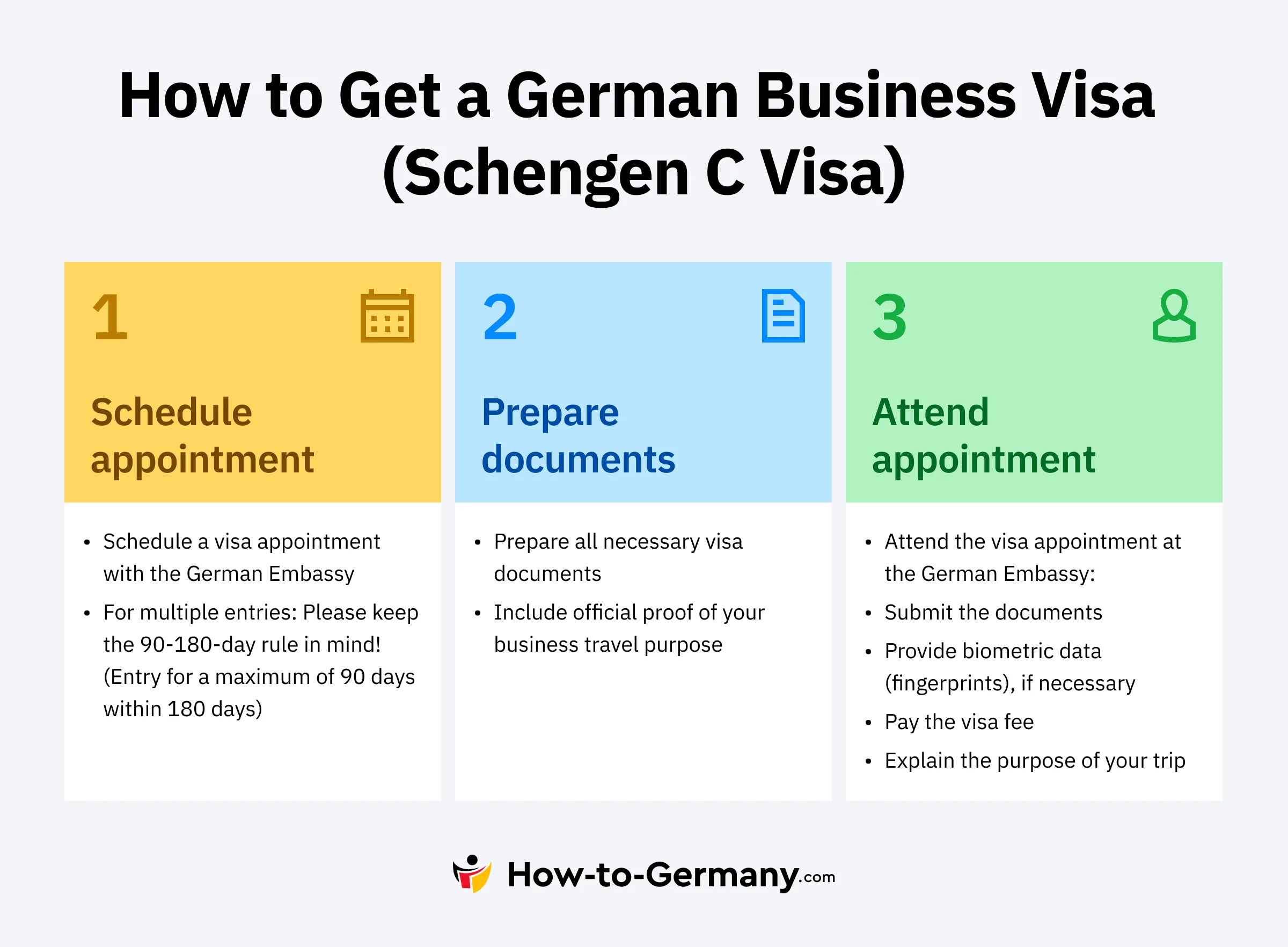
You can apply for a business visa for Germany and the Schengen area for single or multiple entries:
- A single-entry business visa is issued for a specific period that you specify in your visa application. After its expiration, you must leave Germany. For subsequent trips, you will need a new visa.
- With a multiple-entry business visa, you can travel to Germany and other Schengen countries multiple times without having to reapply for a visa. These visas are usually issued for 1, 3, or 5 years. Re-entry is possible if you have not stayed in Germany and other Schengen countries for more than 90 days in the past 180 days.
Visa application process
You apply for a business visa at the German Embassy, a German Consulate, or a visa center commissioned by the Embassy. The service provider depends on your country of application: some German missions work with providers such as VFS Global or TLScontact, while applicants in the United States generally use BLS International for German Schengen visa applications. Atlanta is an exception and manages direct appointment bookings through the responsible German mission. Always check the website of the German mission responsible for your place of residence before booking.
You may not need a personal appointment if you have already obtained a Schengen visa in the past 5 years and submitted biometric data (photograph and fingerprints). In this case, you only need to submit your visa documents to the German Embassy. You can find out from the embassy whether this option is available.
General documents for the visa application
You must enclose all the required documents with your visa application (each in the original and with 2 photocopies). Missing documents will result in the application being rejected or the visa process being extended due to additional requests.
For a business visa for Germany and the Schengen area, the following general documents are required:
| Document | Requirement | Example / Details | Notes |
|---|---|---|---|
| Application Form | Completed and signed. | Schengen short-stay visa (C visa) application form. | Usually submitted with copies. |
| Biometric Photos | 2 recent photos. | German visa photo requirements. | Incorrect format may cause delays. |
| Civil Status Documents | If applicable. | Marriage, birth, or death certificates. | Only required in certain cases. |
| Declaration of Accuracy | Signed statement. | Confirmation that all information is correct. | Often included in application package. |
| Flight Reservation | Travel itinerary required. | Outbound and return flight booking. | Avoid booking non-refundable tickets. |
| Passport | Valid passport. | Issued within last 10 years, valid 3+ months after return. | Must have blank pages. |
| Previous Passports / Visas | If available. | Old passports or copies of Schengen visas. | Supports travel history. |
| Proof of Accommodation | Confirmed stay. | Hotel booking or invitation letter. | Must cover entire stay. |
| Proof of Financial Means | Sufficient funds. | Bank statements, salary slips, sponsorship, or declaration of commitment. | German border authorities commonly use €45 per day of travel as a reference amount, although embassies may request stronger proof depending on the case. |
| Travel Health Insurance | Minimum €30,000 coverage. | Valid for the entire Schengen area and compliant with Germany visa insurance requirements. | Mandatory for visa approval. |
| Visa Fee Payment | Proof of payment. | Receipt for Schengen visa fee (€90). | Usually paid at appointment. |
Proof of financial means
A key point for obtaining a Schengen visa is proving that you have sufficient financial means to finance your stay. As a practical reference, German border authorities typically expect access to at least €45 per day of travel. For a business visa, German embassies may still require more detailed financial documents depending on the applicant’s employment status, travel purpose, and who pays for the trip.
Financing of the stay by the visa applicant
If you are applying for a visa as a self-employed or freelance professional, you will need the following as proof of financing:
- Company registration or proof of self-employment
- A current bank certificate (not older than 2 weeks) stating your account balance, including private bank accounts
- Bank statements from the last 3 months
Financing of the stay by the employer
Employees require the following for their visa application:
- Employment contract with salary information
- Authorization of the employer for business trips
- Commitment of the employer to cover the costs
A declaration of commitment from a German business partner can also serve as proof of financial means. This option is available to self-employed and freelance professionals and employees. The declaration must be submitted to the relevant German immigration office, and the original sent to the visa applicant. If the declaration of commitment is submitted by a legal entity, i.e., a company, the signatory’s signature must be certified by a German authority or a notary.
Proof of business travel
In addition, you must prove your business background and the business purpose of your trip to the German Embassy. To achieve this, you will need an invitation from a business partner in Germany, which must include the following information:
- Name, address, and contact details of the inviting company
- Personal data and position of the signatory of the invitation
- An exact description of the purpose of the business trip with a detailed schedule
The German embassies have the right to demand further documents. These may include, for example, more detailed information on the business activity and the purpose of the trip or proof of the visa applicant’s willingness to return.
Processing time and visa fees
The standard processing time for Schengen business visa applications is up to 15 calendar days after an admissible application has been submitted.
In individual cases, processing can take longer. If further scrutiny, missing documents, high seasonal demand, consultation with other Schengen states, or additional checks are required, the decision period may be extended to up to 45 calendar days.
Special EU visa rules apply to certain passport holders. For Russian and Gambian nationals, visa facilitation has been suspended or restricted, meaning the standard processing period can be longer and may reach 45 calendar days. Multiple-entry visas may also be restricted or assessed more narrowly. Applicants in these groups should avoid relying on short-notice business travel plans.
Some German missions may prioritize genuinely urgent business cases where possible. However, this is not guaranteed, and you must prove the urgency of the business appointment. Even in urgent cases, the decision remains with the German Embassy or Consulate.
If you regularly travel to Germany for business reasons, the embassy may automatically place you in a faster processing category after some time. This does not override nationality-specific restrictions or the legal processing framework.
In countries where German missions cooperate with a visa center, paid services may include earlier appointment access, premium lounges, SMS updates, document handling, or faster courier return of the passport. These services do not fast-track the consular decision itself. The German mission remains responsible for deciding the visa application, and applicants should still plan around the official Schengen processing period.
The visa fee for a business visa for Germany and the Schengen area is €90, regardless of whether the visa is for a single or multiple entries. You pay this fee in cash in your local currency.
Exhibitors at German trade fairs who have an official trade fair pass are exempt from the visa fee.
Conclusion
A business visa for Germany enables professionals from non-visa-exempt countries to attend business meetings, conferences, and trade fairs within the Schengen area. The application process requires proof of business activities, financial means, and accommodation, with additional documentation depending on the applicant’s employment status. Standard Schengen visa processing can take up to 15 calendar days, while individual cases and certain nationality-specific rules can extend the process to up to 45 calendar days. Frequent travelers can apply for multiple-entry visas, but Russian and Gambian passport holders may face additional restrictions.
Business travelers should also prepare for Germany’s updated border procedures. The Entry/Exit System (EES) now registers non-EU travelers digitally at Schengen borders, and ETIAS is scheduled to go live in late 2026 for visa-exempt travelers, with a transitional period before mandatory enforcement in 2027. Careful preparation of all required documents, enough time for visa processing, enough financial proof, and extra time at the border are key to a smooth business trip.
Frequently Asked Questions
Suppose Germany is your country of entry, and you mainly attend business meetings with German partners. You can apply for your Schengen visa for your business trip at the responsible German Embassy. You can travel in all other Schengen countries without restriction with your German business visa.
You need proof of frequent business trips to Germany and the Schengen area for a multiple-entry visa. This may include regular participation in business meetings, trade fairs, or conferences, or long-term business relationships with German partners. The decisive factor in issuing such a visa is a consistent travel history with clearly demonstrable business reasons, without violating visa regulations (e.g., late departure).
Business travelers usually receive their first multiple-entry visa for 1 year; later, visas for 2 or 5 years are also possible. However, this does not affect the 90-180-day rule for length of stay and re-entry.
You can apply for a business visa for Germany and the Schengen area 6 months before the planned entry. The latest date depends on the requirements of the respective German embassy. Normally, the embassies accept applications for C visas and, thus, also for business visas up to 15 days before the date of travel. In some cases, however, the visa application must have been submitted three weeks in advance. During peak periods, there may be longer processing times, which the German embassies provide information about on their websites.