
How we earn our money
We finance our services on how-to-germany.com through affiliate programs.
When a user orders a financial product through our site and their application is approved, we may receive a commission from some providers. It’s important to note that this does not in any way influence our independent ratings and recommendations.
All the products we present on how-to-germany.com are selected for their quality, range of services, and excellent value for money.
Private Health Insurance Plans in Germany
 Written by
Janine El-Saghir
Janine El Saghir is an editor at How-to-Germany.com, where she specializes in the practical aspects of daily life and integration for expatriates. With years of...
Written by
Janine El-Saghir
Janine El Saghir is an editor at How-to-Germany.com, where she specializes in the practical aspects of daily life and integration for expatriates. With years of...
 Reviewed by
Erkan Boga
Erkan Boga is the founder and CEO of qmedia GmbH, the publishing house behind How-to-Germany.com. He established the platform with the clear vision of creating...
Reviewed by
Erkan Boga
Erkan Boga is the founder and CEO of qmedia GmbH, the publishing house behind How-to-Germany.com. He established the platform with the clear vision of creating...
 Edited by
Sadie Voss
Content Lead & Editor
Sadie Voss is the Lead Editor for How-to-Germany.com. As an expat who carved her own way into Berlin from the United States, Sadie is deeply...
Edited by
Sadie Voss
Content Lead & Editor
Sadie Voss is the Lead Editor for How-to-Germany.com. As an expat who carved her own way into Berlin from the United States, Sadie is deeply...
- In Germany, health insurance is mandatory. Health insurance options in Germany are public or private insurance.
- Private health insurance in Germany almost always offers better coverage than public health insurance. However, you must meet certain requirements to take out private insurance.
- Employees with a gross annual salary above €77,400, freelancers, the self-employed, students, and civil servants can choose between statutory health insurance and private health insurance companies.
- Private insurance in Germany allows you to flexibly structure your healthcare benefits by choosing a suitable tariff.
- The cost of private health insurance depends on the tariff you choose and your age and state of health when you take out the policy.
- For expats in Germany, we recommend the policies offered by the private providers ottonova and Feather, which provide high-performance health insurance plans and offer bilingual services in German and English.
Best Private Health Insurance Plans in Germany


What is the difference between public and private health insurance in Germany?
The Two Pillars
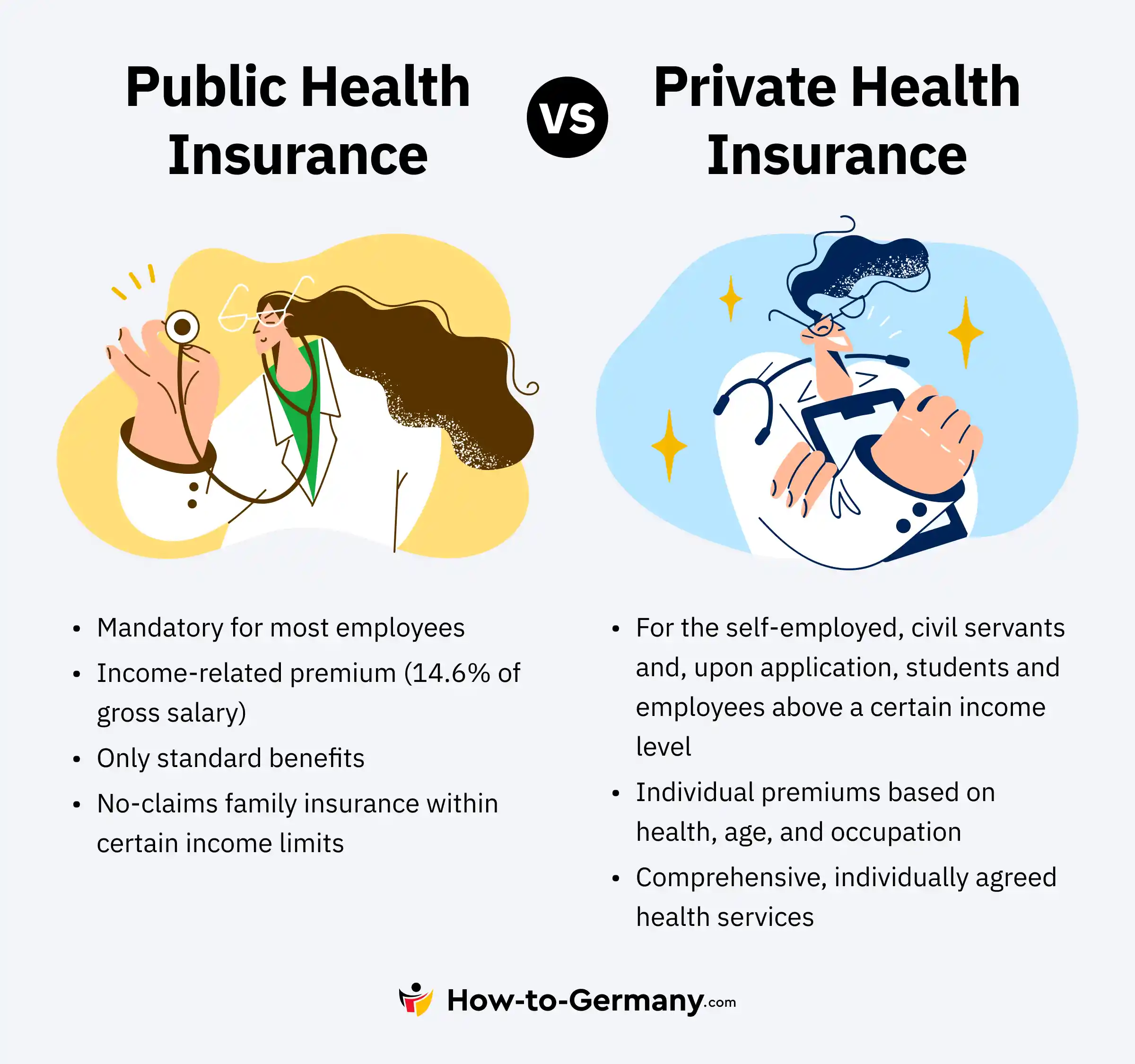
German health insurance is based on two pillars. Currently, roughly 74 million people are covered by statutory health insurance (Gesetzliche Krankenversicherung, GKV), while around 8.7 million policyholders have comprehensive private health insurance (Private Krankenversicherung, PKV).
The public and private branches of German health insurance differ in the requirements for taking out insurance and the scope of benefits.

Statutory Health Insurance in Germany
The compulsory insurance limit for employees is currently a gross annual salary of €77,400. For employees earning less than this, the statutory German healthcare system is mandatory.
Freelancers, the self-employed, civil servants, and students can choose between public and private health insurance options. They are not bound by income limits. Students receive special rates in both public and private insurance.
Contributions to public health insurance depend on income. They currently amount to 14.6% of gross income. For employees, the employer pays half of it.
There are additional contributions to the statutory health insurance providers, averaging 2.9%, and contributions to statutory long-term care insurance.
Under the family insurance scheme, spouses and children with no or low income can be insured at no extra cost in a statutory health insurance scheme.
For spouses, there is no age limit for free family insurance as long as the income and eligibility rules are met. For children, including students and certain vocational trainees, free family insurance is generally possible up to the age of 25.
Statutory health insurance benefits in Germany are identical for all insured individuals and include all standard medical care services, such as ambulatory and hospital treatment, remedies, aids, and medication.
Co-payments are required for certain services, especially for dentures, vision aids and prescription medicine. Medical fees for certain treatments — such as for additional dental care — beyond standard public insurance coverage must be paid for privately.
Private Health Insurance in Germany
Private insurance is the second pillar of the German health care system. It differs from public insurance in the following general respects:
- Provided by private health insurance companies
- Financed through capital cover
- Calculation of private health insurance premiums depending on the selected tariff and the individual risk profile
- Privately agreed scope of benefits, benefit security
- Higher remunerations of doctors and other medical service providers
- Billing through reimbursement of costs to the policyholder, who initially pays for medical services (however, costs for hospital treatment are usually settled directly with the private health insurance company).
How Private Health Insurance Works
When you opt for private health insurance, you conclude an individual contract with the health insurance company tailored to your needs.
Private health insurance companies offer more comprehensive benefits than statutory health insurance.
Young people without pre-existing medical conditions usually pay significantly lower premiums for private insurance policies. However, it’s important to note that, in contrast to statutory health insurance, private insurance does not include non-contributory family insurance.
Private health insurance in Germany is a choice for:
- Civil servants and their family members
- Employees with an income above the compulsory insurance threshold (€77,400 per year, €6,450 per month)
- Freelancers, self-employed people, university students
- People whose income does not exceed the family insurance income threshold of €565 (€603 for mini-jobbers). For employed dependents, the monthly employee lump-sum expense allowance of €102.50 can raise the practical gross income limit to €667.50 in 2026.
Some people cannot be insured in the public health insurance system and must take out private insurance. These include freelancers, the self-employed, and people without health insurance who were previously privately insured.
Returning from private health insurance to statutory health insurance is often possible for younger employees if they become subject to compulsory public insurance again, for example because their salary drops below the annual threshold.
However, once you are 55 or older, returning to GKV is legally blocked in almost all cases if you were not publicly insured in the previous five years and were privately insured, exempt, or self-employed for most of that period. This is one of the most important long-term risks of choosing PKV.
Special Regulations for Expats
For expats with a long-term residence permit of more than 12 months, the same regulations apply as for all other German residents.
Expats with a shorter stay in Germany require international travel insurance, which must be taken out before entering Germany.
This does not apply to EU-citizens, whose medical treatment is also insured via the European Health Insurance Card, and citizens of countries with which Germany has concluded a social security agreement.
Expats from any EU country, Iceland, Norway, Switzerland, and Liechtenstein can use the European Health Insurance Card (EHIC card) to claim medical benefits in Germany and throughout the EU.
In the long term, however, the European Health Insurance Card does not replace the benefits of comprehensive health insurance in Germany.
Some expats require private insurance in Germany. These include, for example, international students may require student private health insurance for those who are completing a language or preparatory course and visiting academics.
Temporary expat health insurance and full German private health insurance are not the same product. Temporary plans are designed for limited stays and often do not build the same aging reserves as permanent PKV contracts.
This can make them cheaper or easier to start with, but they are not a substitute for a long-term German private health insurance strategy if you plan to stay permanently.
Benefits of Private Health Insurance
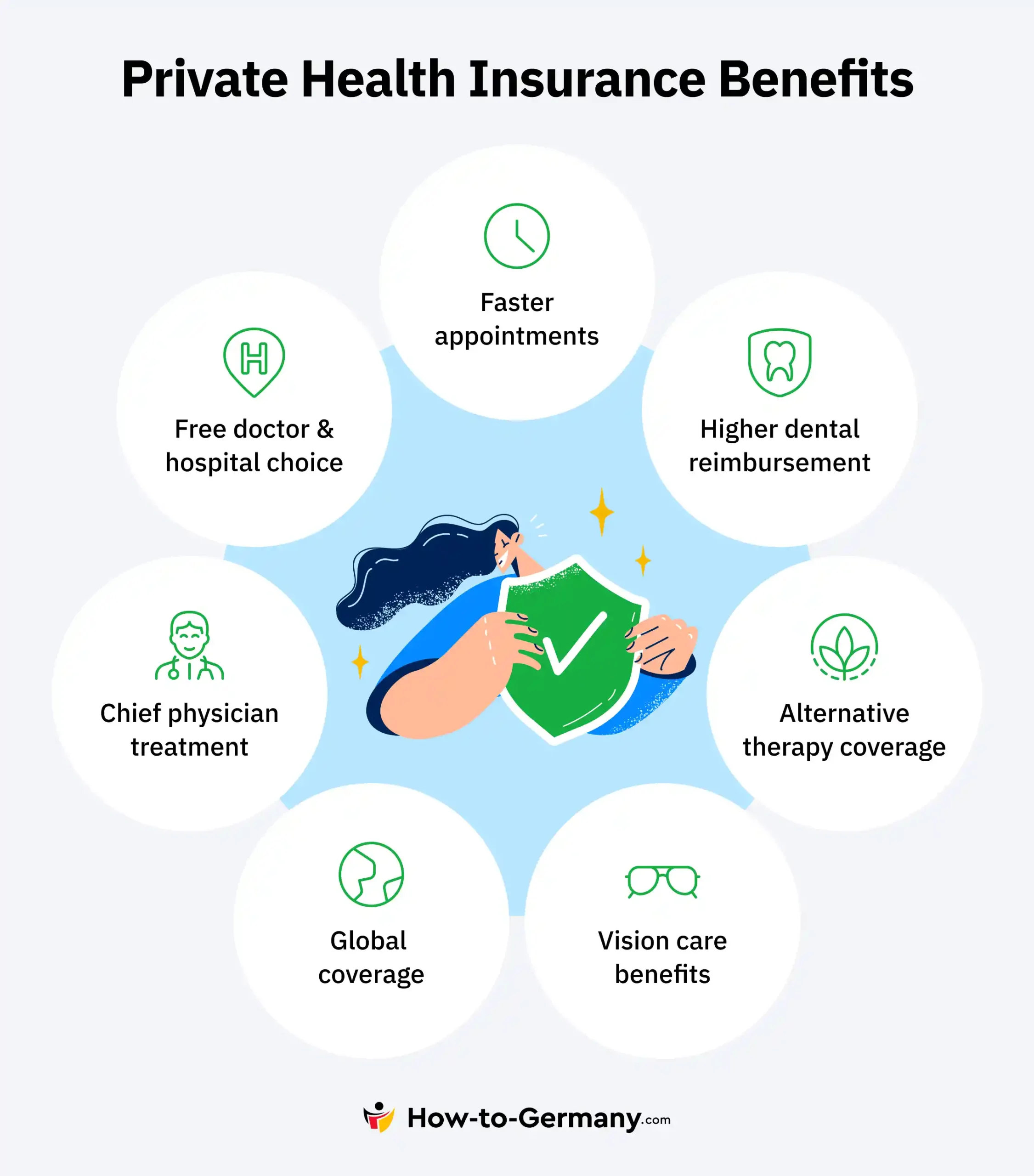
The scope of private health insurance benefits is agreed upon individually in the insurance contract and guaranteed by the private health insurance providers for the entire contract term.
Changes in the scope of benefits are possible by changing tariffs or booking/canceling additional modules.
Privately insured patients can also use the services of private doctors who are not licensed by the public health insurance scheme.
Choosing Private Health Insurance in Germany
The following points are critical for finding good private health insurance providers and tariffs:
- Daily sickness allowance (not automatically included in private insurance)
- Direct access to specialists without referral of a general practitioner
- Free choice of doctor
- Free choice of hospital, 2-bed or private rooms and treatment by chief physician for hospital stays
- Health insurance cover abroad (usually unlimited in the EU, cover abroad should be valid for at least one year in other countries).
- Reimbursement of costs for alternative practitioner treatments (if desired)
- Reimbursement of costs for dental and vision care according to the maximum rates of the medical fee scales (dentures: at least 75%)
- Reimbursement of costs for medical aids — for example, wheelchairs or prostheses — not according to lists, but to medical necessity
Freelancers and self-employed people do not have an employer who continues paying their salary during the first weeks of illness. In private health insurance, daily sickness allowance (Krankentagegeld) is therefore one of the most important optional modules. It pays a daily amount after an agreed waiting period, for example from the 22nd or 43rd day of illness, and helps replace lost income if you cannot work. Freelancers should choose the amount carefully, because too little Krankentagegeld can leave a serious income gap during longer illness.
Costs of Private German Health Insurance
Private health insurance contributions are often cheaper than those for public insurance, especially for young and healthy people.
Factors Influencing the Premium Amount
- Age and health status when conducting the contract
- Deductibles
- Professional and private risk profile
- Scope of benefits of the tariff
In the case of pre-existing conditions, private health insurance companies can refuse insurance, charge risk surcharges, or exclude certain benefits. High-risk professions or hobbies may have the same effect.
Premium refunds are granted by some private health insurance providers if no benefits are claimed over a certain period. They are higher in tariffs with a low deductible.
For salaried employees, the employer pays half of the insurance premium.
Defining Monthly Costs of PKV Benefits in Germany
| Feature / Factor | Entry-Level Monthly Cost | Standard Monthly Cost | Premium Monthly Cost | Comparison with Public Insurance (GKV) |
|---|---|---|---|---|
| Typical Monthly Cost (Germany) | €300–€450 | €450–€800 | €800–€1,200+ | Often cheaper than GKV for young, healthy individuals, but can become more expensive over time as costs rise with age. |
| Coverage Abroad | EU limited | Extended | Worldwide long-term | PKV often includes broader or longer international protection. |
| Deductibles | High deductible | Moderate | Low or none | PKV allows cost control through optional deductibles. |
| Dental & Vision Coverage | Basic | High (≥75%) | Near full coverage | PKV offers significantly higher reimbursement than GKV for dental and vision. |
| Doctor & Specialist Access | Flexible | Direct specialist access | Priority treatment | PKV offers faster, direct specialist access. |
| Eligibility Threshold (Employees) | Income above ~€77,400; basic plans with higher deductibles. | Above threshold; more flexible coverage options. | Above threshold; full access to premium benefits. | Below the threshold, employees must use GKV; self-employed and civil servants can choose PKV. |
| Family Coverage | Separate policies; lower cost via higher deductibles. | Separate policies; balanced coverage per person. | Separate policies; full premium coverage per person. | PKV requires separate premiums for each member. |
| Hospital Treatment | Standard ward | 2-bed room | Private room & chief physician | PKV can include private rooms and treatment by senior physicians. |
When will Insurance Premiums Increase?
Private health insurance companies calculate their premiums for a group whose members are of the same age and have comparable risk profiles at the start of the insurance.
The premiums they pay must cover all insurance expenses for this group. If this balance is no longer achieved, private health insurance companies increase the premiums.
Older comparisons often show that long-term PKV premium development was similar to or lower than GKV contribution development over certain historical periods.
For example, between 2013 and 2023, private health insurance premiums were often cited as increasing by around 2.8% per year, compared with around 3.4% for statutory health insurance.
However, this historical reference should not be read as a 2026 forecast. In 2024, 2025, and 2026, many private insurers announced stronger premium adjustments due to rising medical costs and healthcare inflation.
For 2026, the private insurance association expected contribution increases for a large share of policyholders, with an average adjustment of around 13% among those affected.
Private health insurance companies will not increase individual premiums due to frequent, long-term or serious illness.
To keep premiums stable for older people, private health insurance providers must build up old-age provisions of at least 10% of the monthly premium.
Best Private Health Insurance for Expats in Germany
By comparing different private health insurance providers and tariffs, you can find a policy that best meets your needs.
Expert advice can be helpful here, as there are sometimes significant differences between the benefits and conditions of the various private health insurance companies.
Getsafe
The Berlin-based FinTech Getsafe offers digital advice on choosing the right private health insurance.
The company itself has various insurance products — private liability, legal protection, household contents, dog liability, pet health insurance and private supplementary dental insurance — in its range. Additionally, the private provider is an advisor and broker for private health insurers.
Below, we present the private health insurance policies from ottonova and Feather, which are ideal for expats in Germany.
Both private health insurance providers are high-performance digital insurance companies. All insurance matters can be managed quickly and easily via digital channels. Services and personal support are available in German and English.
ottonova Insurance
The FinTech insurance company ottonova specializes in various health insurance products. In addition to comprehensive private health insurance, the health insurance provider offers supplementary private dental insurance, supplementary hospital insurance, and company health insurance for businesses.
The independent analysis company Morgen & Morgen has given ottonova’s health tariffs top marks. In a test conducted by Money magazine, the health insurance provider was ranked first for its excellent customer service.
ottonova’s private health insurance is available in two versions — regular private health insurance and a temporary incoming expat tariff.
The special expat insurance is First Class Expats, which is capped at a maximum duration of 60 months (5 years). It is designed for temporary stays and does not build aging reserves like permanent German private health insurance. It should therefore not be treated as a permanent PKV solution.
Digital services in the ottonova mobile app
All ottonova services are available in a mobile app. The private health insurance provider offers a so-called concierge service here.
Medical services, doctor’s appointments, and personal consultations can be ordered via app. Medical documents such as doctor’s letters or X-rays are stored in the app, which also has a reminder function for appointments and recommended treatments. Healthcare services are billed directly in the app.
ottonova’s regular offer is open to employees, freelancers, the self-employed, students and civil servants.
On the ottonova website, you can calculate your personal offer and then decide whether you would like personal advice, check the offer, or take out your insurance directly online.
Rates in ottonova’s regular insurance
There are five different tariffs to choose from, which ottonova markets as Premium Economy, Business Class, Business Class Pro, First Class, and First Class Pro+.
Some benefits can be flexibly configured in all tariffs, influencing the monthly premium. These include:
- Daily sickness benefit: between €50 and €100 per day
- Deductible: 10%/maximum €500 per year, 25%/maximum €1,250 per year, 50%/maximum €1,000 per year
- Old-age provisions: between €100 and €460 per month.
Private health insurance prices are often shown as an employee share, because employees receive an employer subsidy of roughly 50% up to the legal maximum. Freelancers and self-employed people do not receive this employer subsidy and must pay the full premium themselves. Always check whether a quoted price is the full monthly premium or only the subsidized employee share.
ottonova insurance for expats who stay in Germany temporarily
ottonova insurance for Third-country nationals with a maximum stay of 5 years is aimed at employees, the self-employed and freelancers, students, post-docs, and researchers. You can insure your whole family under these policies, subject to contributions.
The ottonova expat policy is a temporary incoming plan, not the same as ottonova’s regular long-term PKV tariffs.
Regular ottonova tariffs such as Premium Economy, Business Class Pro, and First Class Pro+ are long-term private health insurance plans, not temporary expat tariffs.
Do not compare temporary expat insurance prices with regular PKV prices without checking the premium basis.
First Class Expats is the temporary expat tariff and is capped at 60 months. Premium Economy, Business Class Pro, and First Class Pro+ are regular long-term PKV tariffs. If a regular tariff price is shown as an employee share, freelancers and self-employed people must budget for the full premium instead.
| ottonova tariff | Plan type | Employee share shown in some comparisons | Approx. full premium for freelancers/self-employed |
|---|---|---|---|
| Business Class Pro | Regular long-term PKV | Approx. €325/month | Approx. €676/month |
| First Class Expats | Temporary expat plan, capped at 60 months | Not a regular employee-share comparison | Starts at approx. €196/month in 2026 |
| First Class Pro+ | Regular long-term PKV | Approx. €352/month | Approx. €730/month |
| Premium Economy | Regular long-term PKV | Approx. €263/month | Approx. €552/month |
Temporary expat insurance can be useful if you are in Germany for a limited stay and need compliant private health insurance for that period. However, if you plan to stay in Germany permanently, you should compare a temporary expat plan with regular long-term private health insurance and statutory insurance before deciding. The long-term impact on aging reserves, family coverage, employer subsidies, and your ability to return to GKV can be more important than the starting price.
Feather Insurance
The Berlin-based FinTech Feather offers various digital insurance products. Its portfolio includes private liability insurance, legal expenses insurance, household contents insurance, supplementary dental insurance, and comprehensive private health insurance.
Feather has specialized strongly in expat private health insurance with its offers.
Feather offers all the benefits of a comprehensive private health insurance provider. The premiums for the insurance can be calculated on the Feather website in the first step, after which an offer is sent by e-mail. Expert advice is also offered as an option.
The insurance is available in three tariffs. Doctor visits and medically necessary treatment by licensed physicians are covered according to the selected tariff.
Coverage for alternative practitioner treatments (Heilpraktiker) depends on the tariff: the Standard plan excludes them, while the Plus plan reimburses 80% up to €1,200 per year and the Premium plan reimburses 80% up to €2,400 per year.
Feather’s long-term private health insurance plans also offer selectable deductibles of €0, €1,200, or €3,000, allowing policyholders to reduce or increase their monthly premium depending on how much cost-sharing they accept. Return transportation is only included in the two higher-priced tariffs. Worldwide cover outside the EU is limited to one month.
How do I Apply for Private Health Insurance?
You can apply for private insurance directly with the private health insurance companies, or seek advice from a health insurance broker. Ideally, this should be an independent insurance consultant. You can almost always apply for private health insurance online.
If you have pre-existing conditions or other high risks, you should always work with a health insurance broker when looking for insurance.
Private health insurers in Germany operate a joint information system in which, among other things, they file rejections of insurance applications. It can then be difficult for those affected to obtain private health insurance at all.
The broker, therefore, anonymously asks various insurance companies whether and on what terms insurance can be taken out. A positive solution is often possible in this way.
Health Questions
The insurance application contains various health questions and questions about professional and private risks relevant to your health insurance. You must answer these questions completely and truthfully. Otherwise, you risk losing your insurance coverage.
Private health insurance companies use the health questions to assess the risk and, therefore, also to calculate the premium.
Waiting Periods
If you have not previously had health insurance in Germany, there is a general waiting period of at least 3 months for private insurance.
An 8-month waiting period applies for dental treatment, childbirth, and psychotherapy. There are no waiting periods after accidents for the subsequent insurance of children or your spouse, and usually also if you already have German health insurance.
Private Health Insurance Deep Dives
Use this page as a starting point. If you already know your situation, the following guides help answer more specific questions:
- Germany private health insurance costs — detailed premium examples, employer subsidies, deductibles, and long-term cost risks.
- Private German health insurance eligibility requirements — who can join PKV, including employees, freelancers, students, civil servants, and expats.
- German private health insurance list — view & compare all major providers, digital insurers, and tariff structures on a deeper level.
- Switching back to GKV Germany — key rules for switching health insurance plans, the 55-year barrier, and when returning to GKV is still possible.
Conclusion: Is private health insurance worthwhile?
Private health insurance is particularly worthwhile if it is taken out at an early age and without pre-existing conditions. The scope of private health insurance benefits almost always significantly exceeds the standard benefits of statutory health insurance.
You can put together your tailor-made insurance cover by choosing the right private health insurance provider and tariff.
If you choose private health insurance, it is essential that you can afford the insurance in the long term. A crucial point is starting a family — private health insurance does not provide premium-free co-insurance for spouses or children.
Expats in Germany can find particularly high-performance private health insurance offers from digital private health insurers such as ottonova or Feather. However, temporary expat tariffs and regular long-term PKV tariffs should not be confused.
Temporary plans can be suitable for limited stays, while permanent residence in Germany requires a long-term insurance decision that accounts for aging reserves, family members, employer subsidies, and future switching options.
Frequently Asked Questions
Compared to the public German healthcare system, private insurance offers a greater choice of benefits. Young, healthy policyholders also benefit from low premiums. However, private insurance companies do not offer non-contributory family insurance.
Returning to a statutory health insurance scheme is usually unavoidable if your income falls below the compulsory insurance threshold. If you foresee that your income will rise again in the future, you can take out qualifying insurance for your private policy and then return to private insurance without new health questions, if you meet the requirements once more.
Termination of a private health policy is not advisable for two reasons. Due to more advanced age and possible previous illnesses, you must usually expect higher premiums and would lose some of your old-age provisions. It is better to switch to a different tariff with your current private health insurer.
Private insurance in Germany also includes compulsory long-term care insurance, the benefits of which correspond to those of statutory nursing care insurance. The policy can be taken out with the same company or other private health insurers.