
German Cultural, Sport & Religious Event Visa
 Written by
Janine El-Saghir
Janine El Saghir is an editor at How-to-Germany.com, where she specializes in the practical aspects of daily life and integration for expatriates. With years of...
Written by
Janine El-Saghir
Janine El Saghir is an editor at How-to-Germany.com, where she specializes in the practical aspects of daily life and integration for expatriates. With years of...
 Reviewed by
Erkan Boga
Erkan Boga is the founder and CEO of qmedia GmbH, the publishing house behind How-to-Germany.com. He established the platform with the clear vision of creating...
Reviewed by
Erkan Boga
Erkan Boga is the founder and CEO of qmedia GmbH, the publishing house behind How-to-Germany.com. He established the platform with the clear vision of creating...
 Edited by
Sadie Voss
Content Lead & Editor
Sadie Voss is the Lead Editor for How-to-Germany.com. As an expat who carved her own way into Berlin from the United States, Sadie is deeply...
Edited by
Sadie Voss
Content Lead & Editor
Sadie Voss is the Lead Editor for How-to-Germany.com. As an expat who carved her own way into Berlin from the United States, Sadie is deeply...
- Cultural, sporting, and religious event participants may require a special visa to enter Germany.
- A visa for cultural, sports & religious events is a short-term Schengen visa for stays of up to 90 days, which entitles the holder to travel throughout the Schengen area.
- The visa can be issued as a single or multiple-entry visa.
- The requirements for granting a visa for cultural, sports & religious events include proof of the travel reason, sufficient financial resources for the stay, and health insurance for the entire Schengen area.
Cultural visa requirements: Germany & Schengen
Most third-country nationals coming to Germany for cultural, sporting, or religious events require a visa for entry and stay under the Germany Schengen visa requirements.
Germany is a Schengen state, together with most other EU countries and the non-EU countries Switzerland, Norway, Iceland, and Liechtenstein. Ireland is an EU member but does not participate in the Schengen Area, while Cyprus has not yet fully implemented the Schengen rules on open internal borders. A valid Schengen visa generally allows travel throughout the Schengen area during its validity, subject to its permitted duration of stay and the requirement to apply through the country that is the traveler’s main destination.
Schengen and national visas are issued in 2 main categories:
- C visa: Short-term Schengen visas for a maximum of 90 days within any 180-day period, issued according to uniform criteria in all Schengen countries. A C visa does not provide a general right to work. However, professional activities directly connected to the approved cultural, sporting, religious, journalistic, or film event may be permitted where they are covered by the visa’s purpose and comply with German employment rules.
- D visa (German national visa): For longer stays in Germany. If the visa does not cover the entire stay, you can apply for a residence permit in Germany. Whether employment is permitted depends on the purpose for which the national visa was issued and the conditions stated on the visa or subsequent residence permit. A national visa issued for employment normally authorizes the approved work, while national visas for study, training, job searches, language courses, family reunification, and other purposes may grant limited, conditional, or no employment rights.
Exemptions from the visa requirement exist for short-term Schengen visas for travelers from about 60 countries and German national visas for citizens of certain countries. These third-country nationals may be able to enter Germany without obtaining a visa in advance, depending on their nationality, purpose, and planned duration of stay. Citizens of EU and EEA countries and Switzerland generally enjoy freedom of movement and do not require visas or residence permits to travel within the Schengen zone.
Visas for cultural, sports, and religious events are short-term Schengen visas for a stay of up to 90 days within any 180-day period. Cultural German visas are tied to their specific purpose and are issued exclusively for event participation. Short-stay visas vary in type, and cultural visas are distinct from other short-term visas like German business visas.
You can receive this visa for single or multiple entries. A single-entry visa is valid for a defined period, which you specify in your visa application, or the maximum permissible stay. A multiple-entry visa entitles you to stay in Germany and other Schengen countries for a maximum of 90 days within 180 days during its validity. Remember, short-stay visas are subject to the strict Schengen limit. Use our 90/180 day German rule calculator to check your allowed days before applying.
If your country is visa-exempt for Germany and the Schengen Area, you do not need to obtain a Schengen visa to attend a cultural, sporting, or religious event for a stay of up to 90 days. However, you must still meet the applicable entry conditions and might need an ETIAS travel authorization once the system becomes operational.
Short-term Schengen visas cannot normally be extended—exceptions apply in the event of force majeure, humanitarian reasons, or serious personal reasons. An extension for a visa for cultural, sports, and religious events may therefore be possible if an unexpected event-related change prevents the traveler from leaving as planned. To request an extension, you must contact the relevant immigration office in Germany. However, there is no guarantee that the visa will be extended.
Who can apply for a cultural Schengen visa?
A visa for cultural, sports & religious events is for people who want to participate in a cultural, sporting, or religious event in Germany. Eligible for this visa category are:
- Artists (musicians, actors, dancers, visual artists, etc.)
- Athletes (individuals and teams)
- Journalists
- Film crews
- Religious representatives (e.g., clergy, preachers, representatives of religious organizations)
- Foreign organizers of such events (including key team members)
Examples of events for which a culture & sport visa can be issued are:
- Concerts
- Music and film festivals
- Theater performances
- Art exhibitions
- Sports competitions (including international qualifying matches)
- Filming for movies
- Special journalistic reporting
- Religious events, conferences, and pilgrimages
Visa application process and visa documents
You can apply for a visa for cultural, sports, and religious events in your home country or the country where you have permanent residence. The following are contact partners for visa applications:
- The local German embassy
- German consulates
- A visa application center commissioned by a German embassy or consulate to receive visa applications
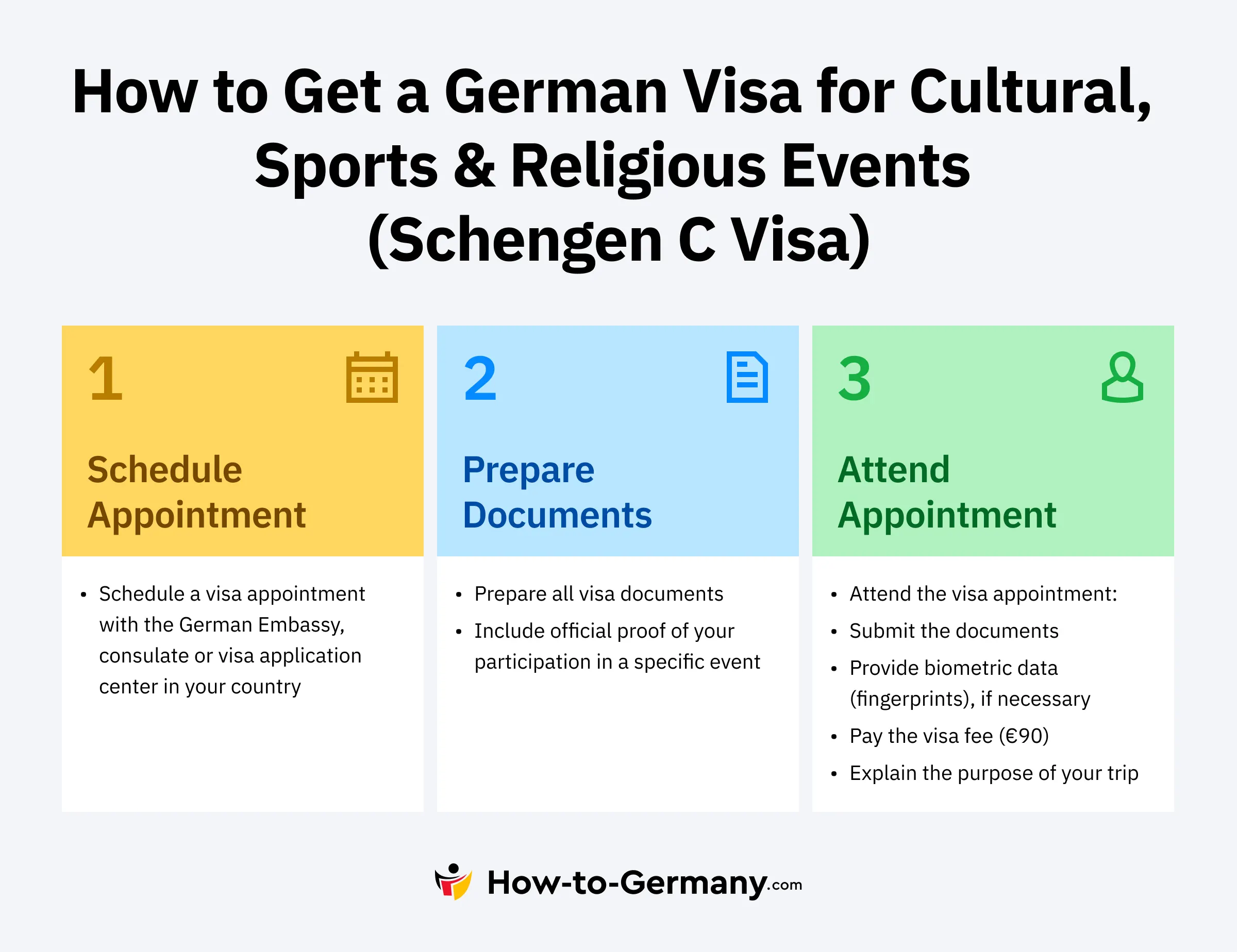
Visa application process
- You must generally appear personally at the embassy, the consulate, or the visa application center. This requires a prior appointment, which you can usually schedule online.
- In advance, you prepare the visa documents.
- During the appointment, you submit your visa documents to the embassy, pay the visa fee using one of the payment methods accepted by that diplomatic mission, and complete a visa interview with an embassy employee. If your fingerprints have not already been collected for a previous Schengen visa application within the applicable retention period, they will normally also be taken.
Required documents
For a visa for cultural, sports & religious events, you need the following documents. The responsible German mission may request originals, photocopies, translations, or additional documents:
| Document | Requirement | Example / Details | Notes |
|---|---|---|---|
| Application Form | Completed visa application form. | Schengen short-stay visa form. | Submit with copies if requested. |
| Biometric Photos | Passport photos. | Must meet visa photo German requirements. | Recent only. |
| Civil Status Documents | If applicable. | Registry extract, marriage or birth certificates. | Required in certain cases. |
| Cover Letter | Personal covering letter. | Explains travel purpose. | Important for context. |
| Declaration of Authenticity | Signed statement. | Confirms documents and information are accurate. | Required if requested by the diplomatic mission. |
| Event Participation Proof | Proof of involvement. | Invitations, tickets, confirmations. | Core requirement. |
| Financial Resources | Proof of sufficient funds. | Bank statements, income proof, sponsor or fee agreement. | Must cover stay. |
| Passport | Valid passport. | Blank pages & copy of data page. | Required for visa sticker. |
| Previous Event Participation | If available. | Proof of similar past events. | Supports application. |
| Professional Activity Proof | If applicable. | Work samples, press card, assignments. | For professionals. |
| Proof of Accommodation | Confirmed stay. | Hotel booking or host confirmation. | Must cover duration. |
| Return Intention Proof | Evidence of ties to home country. | Job, family, assets. | Important for approval. |
| Travel Health Insurance | Minimum €30,000 coverage. | Valid across Schengen and compliant with visa insurance German requirements. | Mandatory. |
| Travel Itinerary | Travel reservation or itinerary. | Outbound and return travel. | A fully paid ticket may not be required before approval. |
| Visa Fee Payment | Proof of payment, unless exempt. | Receipt or confirmation of an applicable fee exemption. | Required where a fee applies. |
Documents for film crews
Film crews require some further documents to be attached to the visa applications of all team members:
- Official proof of registration as a filmmaker in the home country
- A letter from the production company stating the title, content, and shooting locations of the project
- Film permits for all Schengen countries in which filming is planned.
- A list of all members of the film crew, including a description of their tasks
The documents listed are standard documents for granting visas. However, German embassies are entitled to request additional documents if necessary. The responsible embassy will provide information about all required documents and possible necessary notarizations. There may be differences between countries and individual visa applicants.
Processing time and visa fees
A decision on an admissible culture, sports, or religious-event Schengen visa application is normally made within 15 calendar days from the date the application is lodged. In individual cases, particularly when further examination or additional documents are required, the processing period may be extended to a maximum of 45 calendar days. Appointment waiting times are separate and can make the overall application process longer, so you should apply well before the planned event.
Some German embassies may process urgent visa applications for cultural, sports & religious events more quickly when the urgency is sufficiently demonstrated. However, accelerated processing is discretionary and cannot be guaranteed. Previous lawful travel to Germany or the Schengen Area may support an application but does not create a right to a faster decision.
The visa fee for adults and minors aged 12 and over is generally €90. Children aged 6 to under 12 generally pay a reduced fee of €45. Children under 6 years of age are completely exempt from the Schengen visa fee and pay €0.
Representatives of non-profit organizations who are 25 years old or younger are also exempt from the visa fee when participating in seminars, conferences, sports, cultural, or educational events organized by non-profit organizations. This exemption may apply, for example, to eligible members of youth sports teams, charity organizations, cultural associations, and religious or church youth groups.
Other exemptions or reductions may apply based on the applicant’s nationality, the purpose of the visit, an applicable visa-facilitation agreement, or a decision by the responsible German diplomatic mission. External visa application centers may charge a separate service fee even when the applicant is exempt from the official Schengen visa fee.
Conclusion
A visa for cultural, sports & religious events provides a straightforward way for artists, athletes, journalists, and religious representatives to attend events in Germany and the Schengen Area for up to 90 days. This short-term visa enables participation in cultural performances, sports competitions, and religious gatherings. Professional activity directly related to the approved event may be permitted, but it must remain compatible with the purpose and conditions of the visa and the applicable German employment rules.
While Schengen visas generally cannot be extended, exceptions exist in limited circumstances. Multiple-entry options are available for frequent travelers. Understanding the specific requirements, processing period, fee exemptions, and application process is key to ensuring a successful visa application and a smooth experience in Germany.
Frequently Asked Questions
No. There are special visas for international student exchange. In most cases, this is a German national visa that entitles the holder to a longer stay and to obtain a residence permit in Germany. Visa applicants must fulfill special requirements for this. These include a contract with the institution organizing the student exchange, a school enrollment certificate, and — if applicable — a declaration of commitment from host parents in Germany.
Yes. Suppose their participation is necessary to attend an event or for an artistic or cultural project, such as a film shoot. In that case, they can also get a visa for cultural, sporting, and religious events. They must submit a separate visa application and the required documents to the German embassy.
In principle, yes, as long as the maximum validity period of 90 days is not exceeded. If you come to Germany more often for professional reasons, you can apply for a multiple-entry visa. Depending on the reason for your travels and your travel history in the Schengen Area, it will be issued for periods between 1 and 5 years.
The visa allows you to work in direct connection with the purpose of your trip. This includes, for example, participating in competitions, performances, and other events or shooting films. Taking up any other work activity is not allowed.
You can apply for a freelance visa (national visa). In addition to the general requirements for a visa (proof of financial means, health insurance), you must also provide evidence of financially viable plans for your freelance work in Germany or – ideally – letters of intent or contracts with specific clients. With a freelance visa, you will receive a residence permit for a maximum of 4 years, which can be extended. If you are successful with your projects in Germany, you can receive a permanent settlement permit. It is possible to obtain a work visa if you are an artist, journalist, or other creative professional and have an employment contract with a German institution (theater, orchestra, publishing house, etc.).