
German Visa Photo Requirements
 Written by
Janine El-Saghir
Janine El Saghir is an editor at How-to-Germany.com, where she specializes in the practical aspects of daily life and integration for expatriates. With years of...
Written by
Janine El-Saghir
Janine El Saghir is an editor at How-to-Germany.com, where she specializes in the practical aspects of daily life and integration for expatriates. With years of...
 Reviewed by
Erkan Boga
Erkan Boga is the founder and CEO of qmedia GmbH, the publishing house behind How-to-Germany.com. He established the platform with the clear vision of creating...
Reviewed by
Erkan Boga
Erkan Boga is the founder and CEO of qmedia GmbH, the publishing house behind How-to-Germany.com. He established the platform with the clear vision of creating...
 Edited by
Sadie Voss
Content Lead & Editor
Sadie Voss is the Lead Editor for How-to-Germany.com. As an expat who carved her own way into Berlin from the United States, Sadie is deeply...
Edited by
Sadie Voss
Content Lead & Editor
Sadie Voss is the Lead Editor for How-to-Germany.com. As an expat who carved her own way into Berlin from the United States, Sadie is deeply...
- Visa photos for Germany and the Schengen area must meet the guidelines of German and European authorities.
- An already existing photo must not be older than 6 months to reflect the current appearance of the visa applicant.
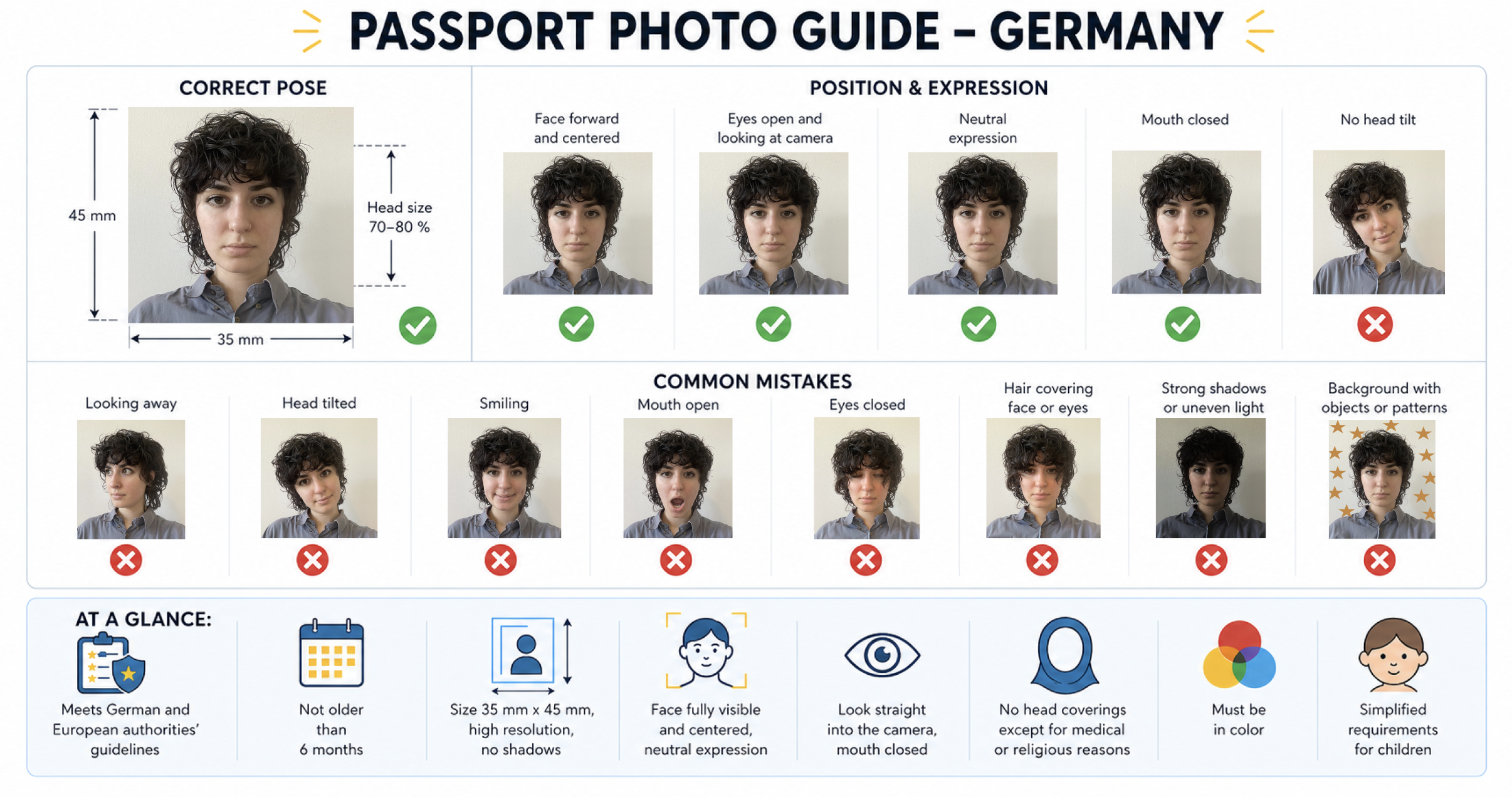
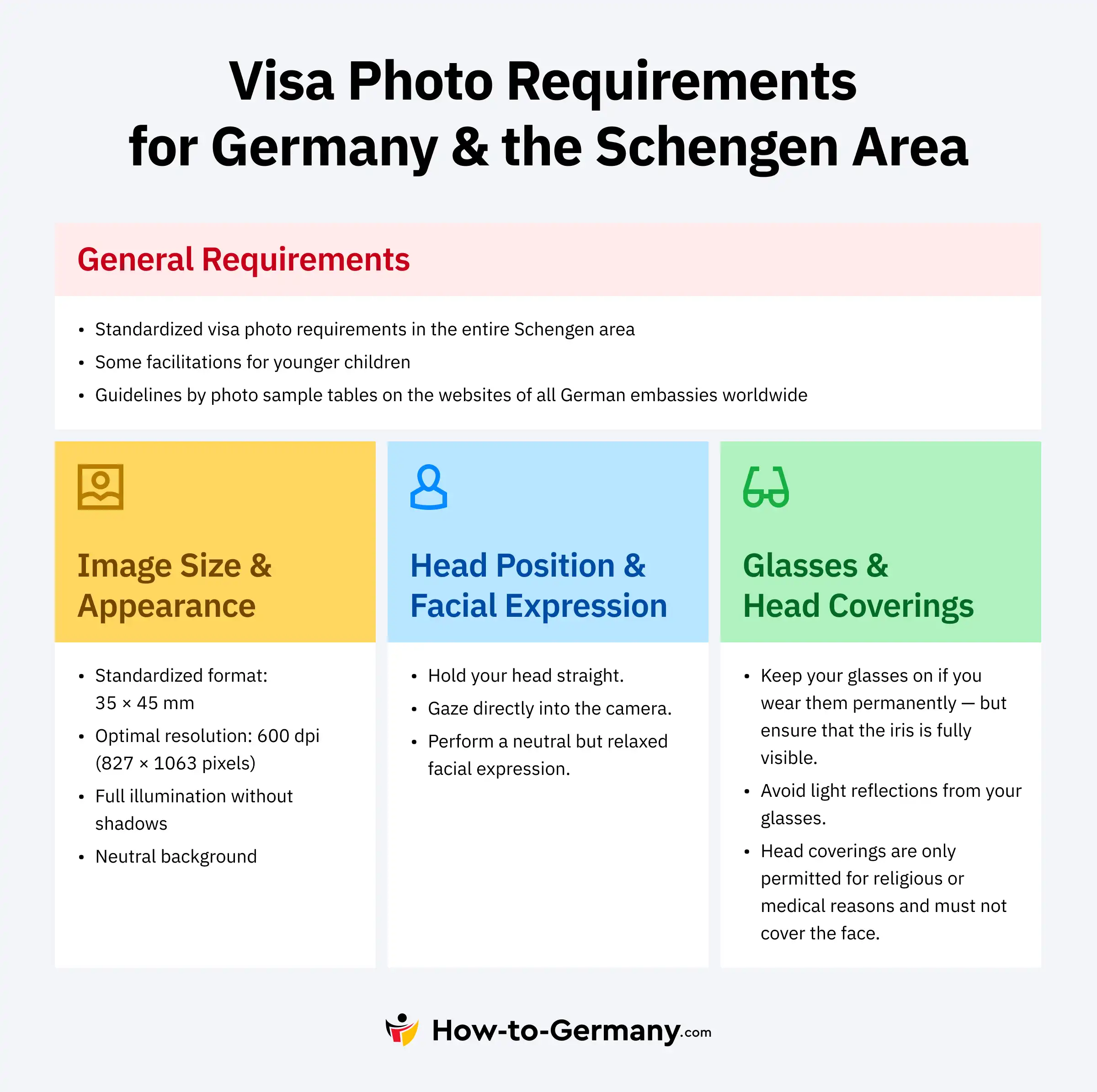
- Visa photos must be taken in a strictly prescribed format. This includes a standardized image size of 35 mm x 45 mm, high resolution, no shadows, no overexposure or underexposure.
- The face of the person photographed must be fully visible and centered. It must show a neutral expression. The gaze must be directed straight into the camera, and the mouth must be closed. No head coverings are allowed except for medical and religious purposes.
- For visa applications abroad, German embassies and visa centers usually still require printed biometric photos. For residence permit and eAT appointments inside Germany, paper passport photos are generally no longer accepted in 2026.
- Schengen visa photos must be in color. Black-and-white photos are not accepted for Schengen visa applications and can lead to rejection.
- There are some simplified requirements for children, depending on their age.
Biometric passport photos are mandatory for German visa applications
Biometric passport photos, which are special and meet strict requirements, are designed to enable clear identification. These photos must be a certain size and show a neutral facial expression, with a closed mouth and a direct gaze into the camera. The background must be monochrome and bright, with no shadows or reflections on the face. These clear and straightforward standards facilitate automatic facial recognition during passport and visa checks.
The German Federal Ministry of the Interior and the Federal Foreign Office, in cooperation with the authorities of the European Union, the Schengen countries, and the International Civil Aviation Organization (ICAO), define the standards for biometric photos.
For many German visa applications submitted abroad, you still need printed passport photos that meet these standards. Otherwise, your application may be rejected. As outlined by German Schengen visa requirements, German embassies do not accept applications with faulty visa photos.
Do not assume that every German visa or residence appointment uses the same photo workflow. If you apply for a visa at a German embassy or visa center abroad, you may still be asked to bring printed biometric photos. If you apply for or renew a residence permit, electronic residence permit (eAT), travel document, or similar document inside Germany, paper photos are generally no longer accepted in 2026. Instead, the photo must usually be taken at the authority or transmitted digitally by a certified photo studio or approved provider through a secure cloud/QR-code process.
Paper or digital photo checker
- Applying at an embassy abroad: Check the embassy or visa center checklist. Printed biometric photos are still commonly required.
- Applying at an Ausländerbehörde in Germany: Check whether the authority requires a digital photo, QR code, or on-site photo terminal.
- Applying for an eAT or residence permit renewal: Expect a digital biometric photo workflow rather than paper prints.
- Applying for a German passport or ID document inside Germany: Expect a digital biometric photo workflow through the authority or certified provider.
- Unsure which rule applies: Follow the checklist from the exact embassy, visa center, Bürgeramt, or Ausländerbehörde handling your appointment.
Orientation by a photo sample table
On the websites of German embassies abroad, you will find a photo sample table summarizing the requirements for biometric passport photos for visa applications and showing photo examples. You can print it out and present it to a photographer to obtain images that meet the official requirements. Many embassies also recommend local photo studios that provide good biometric visa photos. You can also compare your photo with the official German biometric photo sample table from Bundesdruckerei.
[/info]
Visa photo requirements
Passport photos for a German Schengen visa must meet the following requirements:
| Rule | Do | Don’t | Notes |
|---|---|---|---|
| Background | Use a plain, single-color background with strong contrast to face and clothing. | Avoid patterns, objects, shadows, or visible structures. | Light grey works for dark hair; darker background for light/grey hair. |
| Color | Use color photos for Schengen and embassy visa applications. | Do not submit black-and-white photos for Schengen visa applications. | Schengen visa photos must be in color. Black-and-white photos can cause rejection. |
| Expression | Keep a neutral, relaxed facial expression with mouth closed. | No smiling, laughing, or exaggerated expressions. | Face should still look natural, not stiff. |
| Face Position | Keep head straight and centered, looking directly into the camera. | No tilted head, side profile, or looking away. | Full face must be clearly visible. |
| Glasses | Wear glasses only if normally used; eyes must be clearly visible. | No tinted lenses, reflections, or frames covering eyes. | Avoid glare from lighting or flash. |
| Head Coverings | Only allowed for religious or medical reasons. | No hats or casual headwear. | Must not obscure the face and should contrast with background. |
| Image Quality | Use high-resolution, sharp images with proper lighting. | No blur, overexposure, underexposure, or shadows. | Recommended: 600 dpi (approx. 827 × 1063 pixels). |
| Lighting | Ensure even lighting across the face. | No shadows, reflections, or dark spots. | Face must be fully visible for recognition. |
| Photo Age | Use a recent photo (within 6 months). | No outdated photos. | Must reflect current appearance. |
| Photo Format | Use the format required by your application route: printed photos abroad or digital photo/QR code inside Germany. | Do not bring paper prints to a German authority appointment if that office requires digital photos. | Since 2025, many German residence and ID-document appointments use secure digital photo transmission. |
| Photo Size | Use standard size 35 mm × 45 mm. | No incorrect dimensions or cropped images. | Face should cover about 70–80% of the image. |
| Print Quality | For embassy applications requiring paper photos, print on high-quality photo paper. | No damaged, dirty, or low-quality prints. | This applies when the embassy or visa center still asks for printed biometric photos. |
Visa photo checklist
- Application route: Confirm whether you are applying abroad at an embassy or inside Germany at an Ausländerbehörde, Bürgeramt, or similar authority.
- Background: Use a plain, bright, single-color background with no patterns, objects, or shadows.
- Certification: For applications inside Germany, use an on-site authority terminal or a provider that can issue a secure QR code for digital photo retrieval.
- Children: Follow age-based exceptions, and make sure no adult support is visible in baby photos.
- Color: Use color photos for Schengen visa applications. Do not submit black-and-white photos for Schengen visas.
- Digital workflow: For residence permits and eAT appointments inside Germany, expect a digital photo or QR-code process rather than paper prints.
- Dimensions: Use 35 mm × 45 mm with the face taking up about 70–80% of the image.
- Expression: Keep a neutral facial expression with eyes open, mouth closed, and gaze directed at the camera.
- Glasses: Avoid reflections, tinted lenses, and frames covering the eyes.
- Photo age: Use a photo taken within the last 6 months.
- Print quality: For embassy applications requiring paper photos, use clean, undamaged, high-quality photo paper.
Size & Format
Biometric passport photos are prescribed to be a uniform size of 35 mm x 45 mm. For Schengen visa applications abroad, the photo is usually submitted as a printed biometric photo. For residence permits, electronic residence permits, and many official ID-document applications inside Germany, the photo is now usually submitted digitally through an official on-site terminal or secure provider upload.
The face and head, from the chin line to the top of the head, must take up approximately 70 to 80% of the image. The forehead and top of the head must also be fully visible and not “cut off” when the picture is taken. Official German visa passport requirements indicate photos must be taken from the front and centered.
Digital photo rules inside Germany since May 2025
Since 1 May 2025, Germany has moved many official document applications to a digital biometric photo process. This affects residence permits, electronic residence permits (eAT), travel documents for foreign nationals, German passports, and German ID cards handled inside Germany.
For these applications, you generally have 2 options:
- Certified provider upload: A certified photo studio or approved provider takes the biometric photo and uploads it through a secure cloud. You receive a QR code to bring to your appointment.
- On-site photo terminal: The authority takes the photo during your appointment or shortly before it, often using a self-service terminal for an extra fee.
Paper photos brought to the appointment are generally no longer accepted for these digital workflows. Some exceptions may still exist for specific residence documents, transitional cases, or local authority rules, so always check the exact appointment instructions from your Ausländerbehörde or Bürgeramt.
How to verify a certified photo provider
For applications inside Germany, a normal photo studio is not always enough. The provider must be able to transmit your biometric photo through the approved secure digital system and give you a QR code or retrieval code for your authority appointment.
Before paying for photos, ask the studio or provider:
- Can you create a digital biometric photo for German authorities?
- Do you transmit the photo through the secure cloud system used by German authorities?
- Will I receive a QR code or retrieval code for my appointment?
- Is this accepted for residence permits, eAT cards, passports, or ID cards?
A suitable provider should clearly advertise digital biometric photos for German official documents and should not only hand you printed passport photos. If the provider cannot issue a QR code or confirm secure digital transmission, use an on-site authority terminal or another provider.
Sharpness, contrast & illumination
A visa photo only meets the official requirements if it is sharp, has sufficient contrast, and is not blurred.
The optimal resolution of the image is 600 dpi (827 × 1063 pixels).
The face must be fully illuminated and not too dark so that facial details are visible and automatic recognition and evaluation of the image is possible. Therefore, over- and underexposure should be avoided, as these can lead to either reflections or dark spots caused by shadows.
Background
The background plays a crucial role in biometric passport photos — it must be designed to facilitate automatic evaluation of the images. The background must contrast well with the face, hair, and visible clothing. The photographer should use a dark background for individuals with light or grey hair; a medium or light grey background is optimal for those with dark or black hair. It must be a single color and not contain any patterns or visible structures. Objects such as pictures or furniture must not be visible in the photo either.
Photo quality
High photo quality is essential for biometric passport photos. The photos must appear natural and accurately reflect the real visual impression of the person depicted.
For embassy visa applications abroad, photos usually need to be printed on high-quality photo paper. For residence permit and eAT applications inside Germany, the photo is usually stored and transferred digitally instead of being printed, scanned, and uploaded again.
Schengen visa photos must be in color. Black-and-white photos are not accepted for Schengen visa applications and can result in rejection. German passport and ID photo templates may allow black-and-white photos in some official-document contexts, but this does not apply to Schengen visa photo submissions.
Head position, line of vision, and facial expression
For a biometric passport photo, the head must be held straight, and the gaze must be directed straight into the camera. Photographs with the head tilted to the side, forward or backward, pictures in half profile, or with the gaze directed sideways do not fulfill the associated requirements.
The eyes must be open, hair must not cover the face or eyes, and red-eye effects must be avoided when taking the photo.
Another requirement is a neutral facial expression. The mouth must be closed, so smiling or laughing is prohibited. To ensure the photos still look appealing and aesthetic, keep your face relaxed, open, and friendly. Avoid any exaggerated facial expressions or frowns.
Whether the hairstyle is completely visible in the picture is not relevant.
You are not fulfilling the photo requirements — only with a medical certificate
Individuals who cannot meet these requirements for physical or medical reasons require a medical certificate to obtain a Schengen visa, as explained in the German visa application process requirements.
Glasses and head covering
You should keep glasses on for your passport photos if you constantly wear them. The iris must be clearly and completely visible despite the glasses. Therefore, when taking passport photos with glasses, it is important to observe the following requirements:
- Dark or tinted lenses are not allowed.
- The frame of the glasses must not cover the eyes.
- When taking the picture, care must be taken to ensure that the lenses do not reflect the camera flash or light from other sources.
Usually, hats and other head coverings are not allowed on biometric passport photos. Exceptions are made when a head covering is worn for religious or medical reasons. Such head coverings must be plain and monochromatic, contrasting with the photo’s background.
Babies and children up to 5 years of age
Babies and toddlers also require biometric passport photos to obtain a German Schengen visa. However, some simplifications are provided for them.
- Children up to 5 years do not have to show a neutral expression. They are also not required to center their heads strictly and look directly at the camera.
- If a baby or small child is supported or held while the photo is taken, the adult’s hands, arms, body, or other visible support must not appear in the photo.
- The eyes may be closed for babies up to 1 year of age.
From the age of 6, the same passport photo requirements apply to children as to adults, with one exception: up to the age of 9, the face and head only have to take up 50 to 80% of the image area (and not 70 to 80% as for adults).
Conclusion
Meeting the strict photo requirements for a German Schengen visa is essential to ensure a successful application. The biometric standards set by German and European authorities aim to facilitate clear identification through automated facial and iris recognition. Any deviation from these guidelines, such as incorrect size, lighting issues, or improper facial expression, can lead to application rejection.
The most important 2026 distinction is the application route. If you are applying for a visa at a German embassy or visa center abroad, printed biometric photos may still be required. If you are applying for or renewing a residence permit, electronic residence permit, German passport, or German ID document inside Germany, paper photos are generally no longer accepted. In these cases, the photo is usually taken at the authority or uploaded securely by a certified provider, and you may need to bring a QR code to the appointment.
For a broader overview, refer to the German visa guide. It is advisable to use a professional photographer or certified provider familiar with the exact German biometric photo rules for your application type. Ensuring compliance with these rules will help streamline the visa application process and prevent unnecessary delays.
Frequently Asked Questions
The images must be machine-readable so automatic facial and iris recognition can identify the person depicted clearly. Today, AI is also frequently used for this purpose. In automatic facial recognition, a digital system analyzes facial features such as the distance between the eyes, the nose’s shape, and the chin’s contour. It compares the recorded features with images that may already have been stored. Iris recognition is used to capture the unique structure of the iris in each person – the process is particularly accurate and is now the global standard at airports.
This depends on the age of the photo in your travel document and whether it meets the German Embassy’s requirements for biometric passport photos.
The passport photos for the visa application must be no older than 6 months and reflect your current appearance. Whether they are identical to the photo in your travel document is irrelevant to the embassy’s acceptance of the images.
Yes, biometric photos can be taken digitally, but the accepted format depends on where you apply. For German embassy or visa center applications abroad, printed biometric photos may still be required. For applications processed inside Germany, such as residence permits, electronic residence permits (eAT), travel documents, German passports, and German ID cards, paper passport photos are generally no longer accepted. Since May 1, 2025, these applications usually require a digital biometric photo taken at the authority or transmitted securely by a certified provider through a cloud/QR-code workflow.
Legally, there is nothing to prevent you from taking your passport photos as long as they meet the requirements of the German authorities for photos for visa applications. However, self-taken pictures are not recommended since biometric passport photos for visa applications must meet high and complex requirements. With a professional photographer, you are on the safe side here.