
Phone Numbers in Germany
 Written by
Janine El-Saghir
Janine El Saghir is an editor at How-to-Germany.com, where she specializes in the practical aspects of daily life and integration for expatriates. With years of...
Written by
Janine El-Saghir
Janine El Saghir is an editor at How-to-Germany.com, where she specializes in the practical aspects of daily life and integration for expatriates. With years of...
 Reviewed by
Erkan Boga
Erkan Boga is the founder and CEO of qmedia GmbH, the publishing house behind How-to-Germany.com. He established the platform with the clear vision of creating...
Reviewed by
Erkan Boga
Erkan Boga is the founder and CEO of qmedia GmbH, the publishing house behind How-to-Germany.com. He established the platform with the clear vision of creating...
 Edited by
Sadie Voss
Content Lead & Editor
Sadie Voss is the Lead Editor for How-to-Germany.com. As an expat who carved her own way into Berlin from the United States, Sadie is deeply...
Edited by
Sadie Voss
Content Lead & Editor
Sadie Voss is the Lead Editor for How-to-Germany.com. As an expat who carved her own way into Berlin from the United States, Sadie is deeply...
- Germany’s country code is +49, which you must dial before the area code when calling from abroad.
- German phone numbers have geographical area codes that vary depending on the region. For example, Berlin’s area code is 30 in international format or 030 in domestic format.
- A German mobile phone number typically starts with 15, 16, or 17 after the country code, followed by the customer number.
- Be cautious of premium-rate telephone numbers in Germany, as they can result in high charges if called.
- Local Number Length: Germany uses variable-length phone numbers. Newly assigned landline numbers usually have 11 digits domestically including the area code and leading zero, while Berlin, Hamburg, Munich, and Frankfurt commonly use 10-digit formats. German mobile numbers usually have 11 to 12 digits domestically including the leading zero, or 11 to 13 digits internationally when written with +49.
German Phone Numbers: Structure & Length
Each national German phone number is part of a larger system that includes country and area codes, ensuring calls are directed to the correct location or subscriber. Each German phone number is registered within a specific geographic area code, also known as a local network.
In Germany, phone numbers are assigned by a governmental body, similar to many other European countries. In Germany, this responsibility falls to the Bundesnetzagentur (Federal Network Agency).
In landline networks, the German telephone number structure consists of the following components:
- Country Code (CC)
- Area Code (AC)
- Subscriber Number (SN) or the extension number (see image below)
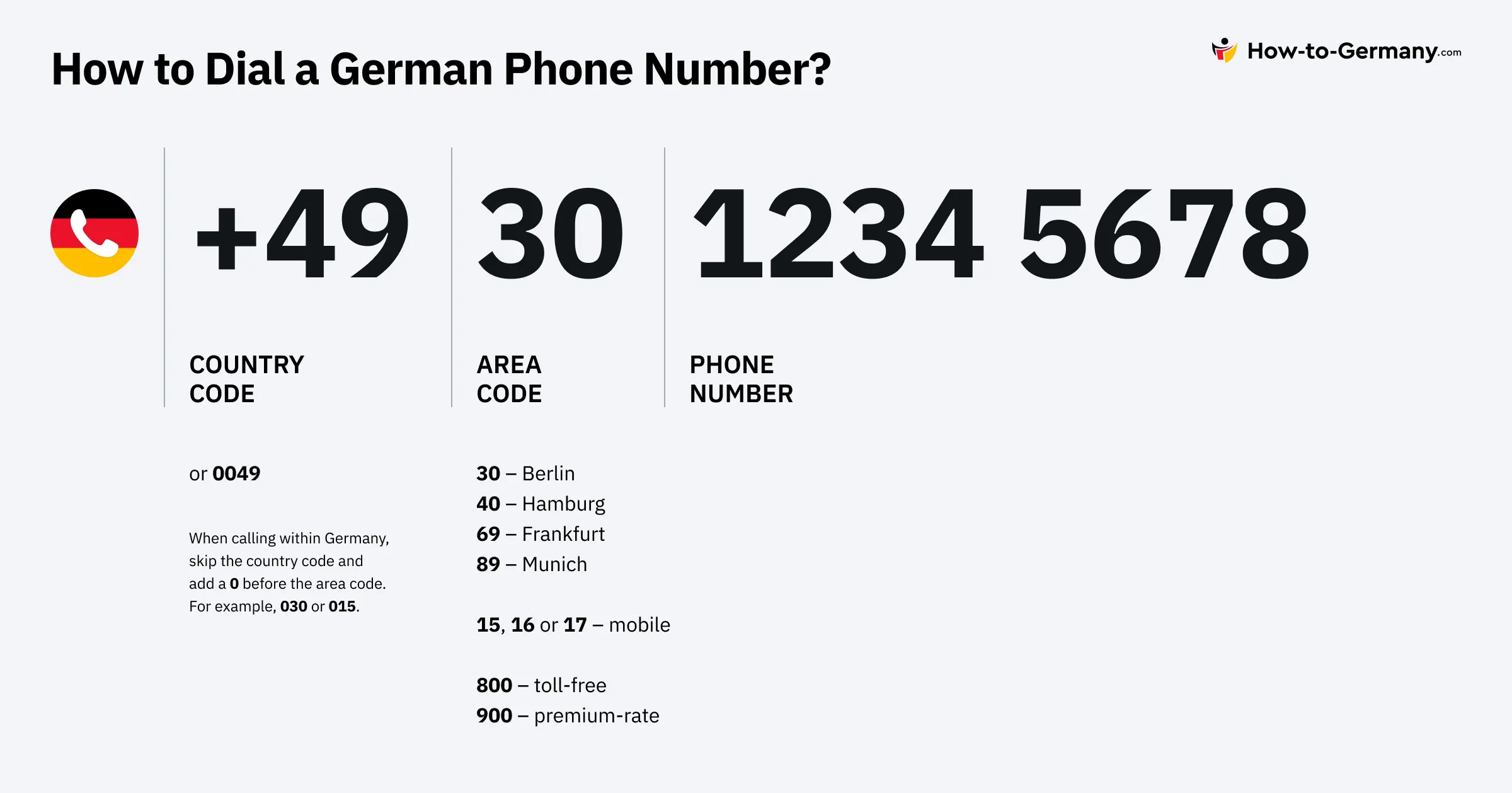
The Critical “Drop the Zero” Rule
+49 30 1234567
+49 0 30 1234567
The leading ‘0’ is for domestic calls within Germany only and must be removed when using the +49 country code.
Avoid the confusing +49 (0) notation
You may still see German phone numbers written as +49 (0)30 1234567 on business cards or websites. This notation means that callers inside Germany should dial 030 1234567, while international callers should dial +49 30 1234567. Do not dial the zero after +49. For websites, emails, and smartphone click-to-call links, it is clearer to write separate national and international formats instead of using +49 (0).
Quick Reference Prefix Numbers
| City | Area Code (Domestic) |
|---|---|
| Berlin | 030 |
| Hamburg | 040 |
| Munich | 089 |
| Frankfurt | 069 |
| Cologne | 0221 |
| Country/Region | Exit Code |
|---|---|
| USA & Canada | 011 |
| UK & Most of Europe | 00 |
| Australia | 0011 |
| Japan | 010 |
| China | 00 |
Length of a German Phone Number
A German phone number consists of several parts and cannot be infinitely long. The maximum length of a phone number was officially defined with the E.164 standard. According to this, a phone number in international traffic may contain a maximum of 15 digits including the country code but excluding the international access code.
The term “international access code” refers to the + or the double 0 (00) before the country code, for example: 0049 / +49 for the German country code.
Germany has an open numbering plan, so older phone numbers can vary in length. For newly assigned landline numbers, the standard length is usually 11 digits in domestic format including the area code and leading zero.
The main exceptions are Berlin, Hamburg, Frankfurt, and Munich, where newly assigned landline numbers usually have 10 digits in domestic format because these cities have short two-digit area codes after the leading zero.
German mobile numbers are also not all the same length. A common domestic mobile number such as 0170 1234567 has 11 digits including the leading zero.
A longer domestic mobile number such as 0151 98765432 has 12 digits. In international format, the leading zero is removed and replaced with +49, for example +49 170 1234567 or +49 151 98765432. Excluding the plus sign, German mobile numbers therefore usually have 11 to 13 digits internationally.
Cracking the Codes: German Phone Number Formats
Understanding the German phone number system is essential for effective communication within and outside the country. This system encompasses international dialing codes, German area codes, German mobile phone numbers, and special numbers (premium-rate service numbers and toll-free numbers).
Special provider-specific prefixes were created at the introduction of mobile telephony, such as 015X and 017X. These prefixes once indicated which mobile network the called party belonged to. With the introduction of phone number portability in 2002, this is no longer reliable. Many people keep their mobile number when switching providers, so the prefix alone no longer proves the current network.
International Dialing Codes
International dialing codes are essential for making calls from one country to another. For callers outside Germany, dialing a German phone number requires adding the country code 0049 before the actual phone number.
Similarly, callers dialing into other countries like Switzerland would use the country code 0041, while those calling into Austria would use 0043. These codes, also known as international access codes, ensure that calls are properly routed to the correct country.
Making international phone calls in Germany requires the right electronics. You may find it easier to pick up a German Sim card or German eSim card.
You can also find a German internet provider that will help you stay connected at home.
German Area Codes
Local or geographic area codes in Germany are initiated with 02xx, 03xx, 04xx, 05xx, 06xx, 07xx, 08xx, or 09xx.
After the area code, the individual subscriber number follows. Germany has thousands of local networks and geographic area codes, so landline numbers vary depending on the city or region.
Different cities have different area codes:
- For the city of Hamburg, the area code is 040. Therefore, a local number in Hamburg would start with 040, followed by the individual phone number of the connection.
- For Frankfurt, the area code is 069. So, a local number in Frankfurt would start with 069, followed by the individual phone number.
Mobile Phone Numbers
Mobile phone numbers (Mobilfunknummern) in Germany are reserved within several number ranges. When analyzing a mobile phone prefix, one will find a leading zero in domestic format, a service code such as 15, 16, or 17, and a customer number.
Originally, it was possible to determine the provider of German mobile phone numbers based on the mobile phone prefix.
However, it has become increasingly difficult to do so. This is because, nowadays, when switching providers, most people take their mobile phone numbers with them. As a result, the boundaries between different providers are becoming increasingly blurred.
If you want to find out the current mobile network for a specific number, do not rely only on the prefix and avoid outdated premium-rate lookup numbers. In 2026, consumers can use free carrier lookup options instead. One free universal option is Vodafone’s network lookup hotline at 0800 5052090, which can be used from all German networks.
Depending on your own provider, you may also be able to use free carrier shortcodes, such as 4387 on Telekom or an SMS with NETZ and the phone number to 4636 on O2. You can also use free online network lookup databases, such as netz-abfrage.de.
Special Numbers
Special phone numbers (Sonderrufnummern) in Germany include both toll-free numbers and premium-rate numbers, distinguished by their prefixes. These numbers can be split into a prefix (“0”), a code for the specific service, and a tariff identifier.
Toll-Free Numbers
- Prefix 0800: Indicates toll-free numbers, meaning that the caller does not incur any charges for the call. A toll-free number is often used for customer service and support hotlines.
Premium-Rate Numbers
- Prefixes 0180 or 0190: These indicate premium-rate numbers, where callers are charged a higher rate than standard calls. These service numbers are typically used for premium-rate services like voting lines, adult content & entertainment, TV and radio shows, or information hotlines.
It’s significant to note that the charges for calling premium-rate numbers can vary, so it’s advisable to check the specific tariffs before making a call.
Short Numbers
Short numbers (Kurznummern) in Germany are typically used for emergencies (emergency phone numbers).
The most well-known short number is the European emergency number, 112, which can be used to contact the police, ambulance services, and fire brigade / fire department.
The police can also be reached directly using the national number 110. The unified government service number 115 connects callers with public administration services. It started as a pilot project in March 2009 and entered regular operation in 2011, so by 2026 it has been in use for about 17 years.
Universal Emergency Number 112
The emergency number “112” for rescue services is not only valid in Germany but also in many other European countries, including all EU states.
Additionally, 112 is recognized in some countries outside Europe, at least by modern smartphones.
In these cases, the caller is either redirected to the local emergency number or the 112 operates parallel to the local emergency numbers. For example, the 112-emergency number is valid in the following countries:
- Africa: Egypt, Ghana, South Africa
- Asia: China, India, Indonesia, Iran, Malaysia, Saudi Arabia, South Korea, Taiwan, UAE
- North America: Canada, USA
- Oceania: Australia, New Zealand
- South America: Brazil, Chile, Colombia
Additionally, the number range 116xxx is reserved for social services. These numbers have specific extensions for different services, such as medical on-call services and telephone counseling services.
Directory assistance can be reached at 118xx.
Short numbers in Germany serve various purposes:
- Emergency Services: 112 is the European emergency number for police, ambulance, and fire department.
- Direct Police Contact: 110 is the direct line to the police.
- Unified Government Service Number: 115 is the unified number for government services in Germany.
- Social Services: 116xxx numbers are reserved for social services, with specific extensions for different services.
- Directory Assistance: 118xx are numbers for directory assistance.
Ärztlicher Notdienst 116 117
In Germany, next to the above listed emergency numbers, there is a medical on-call service available outside regular hours. It is called “Ärztlicher Bereitschaftsdienst” or “Ärztlicher Notdienst” and can be reached by calling the full six-digit number 116 117.
It is for urgent medical issues that cannot wait until regular office hours but are not life-threatening emergencies.
Do not split the number into 116 and 117: 116 alone is incomplete, and 117 is not a German emergency number. For life-threatening emergencies, call 112.
How to Write a Phone Number Correctly
The correct number format for writing a phone number is governed by a standard, DIN 5008. The German standard DIN 5008 provides guidelines for formatting written communication in Germany. This includes specifying how to write phone numbers, ensuring they are clear and consistent.
DIN in Germany
The German DIN, or Deutsches Institut für Normung (German Institute for Standardization), is the national organization responsible for developing and publishing technical standards in Germany.
DIN standards cover a wide range of topics, including manufacturing, engineering, and technology, as well as aspects of daily life such as typography, paper sizes, and even how to brew a cup of tea. These standards ensure quality, safety, and efficiency in products and processes across various industries.
Writing a Landline Number Correctly
- National Use: According to DIN 5008, the number format for a national number is 030 12345678.
- Extensions: For a landline number with extensions, the extension can be indicated with a hyphen, for example: 030 123456-78
- International Calls: For international use from anywhere in the world, the country code along with the international access code is represented, for example: +49 30 12345678 or +49 30 123456-78.
- International Format: In international usage, the double zero is often used instead of the plus sign, for example: 0049 30 12345678.
Writing a Mobile Phone Number Correctly
- National Use: In national use, mobile numbers are separated after the mobile prefix, for example: 0170 1234567 or 0151 98765432.
- International Use: For international use, the leading zero is removed, and the country code is added. For German mobile numbers, this looks like: +49 170 1234567 or +49 151 98765432.
When it comes to mobile phones, the plus symbol can be selected by holding down the 0 key, which is different from landline phones.
If calling a German number from abroad using a landline, you can usually use the international access code 00 instead of the plus sign.
Conclusion
German phone numbers can look confusing at first because the length varies, area codes differ by city, and the leading zero changes depending on whether you are calling domestically or internationally. The most important rule is simple: use +49 when calling Germany from abroad and remove the first 0 from the area code or mobile prefix.
Once you understand the difference between landline, mobile, toll-free, premium-rate, and emergency numbers, it becomes much easier to call, save, and write German phone numbers correctly.
FAQ: German Telephone Numbers
To get a German phone number, resp. a national number in Germany, you can contact a telecommunications provider in Germany. They will offer various local number options, including mobile and landline phone numbers. You can choose a phone number in Germany based on your personal needs.
To get phone numbers in Germany, typically, you will need to provide some personal information and identification documents, such as a passport or ID card, to set up a phone number in Germany.
use case:
If you’re looking for a phone number in Germany, the easiest place to look first would almost certainly be the internet and local directories. Most businesses in Germany will have their German numbers listed on search engines, but alternatively to find a local number, you could also consult dastelefonbuch.de, the online version of the old school telephone book.
No, generally not. Even if you use Germany’s country code, the telephone network will recognize that it is a national call and will bill accordingly based on the German tariff / phone plan.
In Germany, a complete telephone number consists of two parts: the area code (Ortsvorwahl) and the customer number (Teilnehmernummer).
Geographic Area Codes: The area code is a geographic area code that identifies a specific region or city within Germany. Each area code corresponds to a particular geographic area. For example, Berlin has the area code 030, while Munich has the area code 089.
Subscriber Number: The customer number is the unique number assigned to an individual phone line within the specified area code. It is used to identify a specific phone line within the area.
To dial German phone numbers, e.g., a local number within Germany, you need to dial the area code followed by the subscriber number. If you are dialing from outside Germany, you need to dial the country code (0049 for Germany), followed by the area code (without the leading zero) and the subscriber number.
During every emergency call:
- Keep calm and let the call guide you. To prepare for the emergency call, you can answer the following questions:
- Who is calling? (Name, location, local phone number)
- Where did it happen? (Location of the incident, address)
- What happened? (Description of the incident, traffic accident, fire, domestic accident, etc.)
- How many injured/affected people are there? (Number of affected persons, their condition, and injuries
Wait for further questions. Please only end the emergency call when asked to do so.
If necessary, you will receive information at the end of the emergency call on how to administer first aid or what behavior is recommended. Please wait for the arrival of the rescue services, guide them if necessary, and share any important observations with them.
To dial German phone numbers, you need to follow these steps:
For a Local Number:
- If you are dialing from within Germany, simply dial the local area code (e.g., 030 for Berlin) followed by the subscriber number. Example: 030 12345678 (for a Berlin number).
- If you are dialing from outside Germany, dial the country code for Germany (0049) followed by the local area code and subscriber number. Example: +49 30 12345678 (for a Berlin number).
For a German Mobile Number:
- If you are dialing from within Germany, simply dial the mobile number, starting with the digit ‘0’. Example: 0170 1234567 (for a German mobile number).
- If you are dialing from outside Germany, dial the country code for Germany (0049) followed by the mobile number, omitting the leading ‘0’. Example: +49 170 1234567 (for a German mobile number).
A virtual phone number is a telephone number that is not directly associated with a traditional phone line. Instead, a virtual phone number is typically used to receive calls for call forwarding of incoming calls to a pre-set destination, which could be a mobile phone, landline, or VoIP service. Virtual phone numbers are often used by businesses to establish a local presence in different areas without the need for physical offices or phone lines. A virtual number can also provide flexibility, despite the time zone, and cost savings, as they can be easily set up, managed, and redirected as needed.
Final thoughts: advantages of a virtual phone number:
- make and receive calls to phone numbers in Germany
- call forwarding of incoming calls to a number in Germany
- use of power dialers to make more calls to numbers in Germany