
Trade Fair & Exhibition Visa for Germany
 Written by
Janine El-Saghir
Janine El Saghir is an editor at How-to-Germany.com, where she specializes in the practical aspects of daily life and integration for expatriates. With years of...
Written by
Janine El-Saghir
Janine El Saghir is an editor at How-to-Germany.com, where she specializes in the practical aspects of daily life and integration for expatriates. With years of...
 Reviewed by
Erkan Boga
Erkan Boga is the founder and CEO of qmedia GmbH, the publishing house behind How-to-Germany.com. He established the platform with the clear vision of creating...
Reviewed by
Erkan Boga
Erkan Boga is the founder and CEO of qmedia GmbH, the publishing house behind How-to-Germany.com. He established the platform with the clear vision of creating...
 Edited by
Sadie Voss
Content Lead & Editor
Sadie Voss is the Lead Editor for How-to-Germany.com. As an expat who carved her own way into Berlin from the United States, Sadie is deeply...
Edited by
Sadie Voss
Content Lead & Editor
Sadie Voss is the Lead Editor for How-to-Germany.com. As an expat who carved her own way into Berlin from the United States, Sadie is deeply...
- German trade fairs & exhibitions visas are a special type of business visa.
- These visas can be issued to exhibitors and visitors at trade fairs and exhibitions in Germany.
- To obtain a trade fair visa, the purpose of the trip must be proven by appropriate documents, including an official exhibitor pass or exhibitor badge for exhibitors, or a paid trade fair visitor pass for visitors. However, since 2013, an official invitation letter from the trade fair organizer has not been required to grant a visa.
- Further visa granting requirements are proof of Schengen travel health insurance and sufficient financial means to stay in Germany.
- Exhibitors with an official exhibitor pass or exhibitor confirmation are exempt from paying visa fees. Exhibition stand constructors and stand builders must usually pay the standard Schengen visa fee.
Trade fair visa obligation in Germany
The Schengen Agreement regulates the visa requirement for entry and residence in Germany. The 29 Schengen countries apply uniform criteria for issuing visas. A visa issued by a German embassy entitles the holder to stay in Germany and travel to all other Schengen states. The Schengen Agreement regulates the visa requirement for entry and residence in Germany, based on the Schengen visa German requirement.
Except for Cyprus and Ireland, the Schengen member states include all EU countries, Switzerland, Liechtenstein, Norway, and Iceland. The absence of border controls between these countries makes travel within the Schengen area convenient. Travelers from third countries that require a visa only need a visa for one Schengen country but can freely travel in all other Schengen states.
Different visa types are issued for travel to Germany and the Schengen area. Short-term Schengen visas (C visas) entitle the holder to a maximum stay of 90 days and typically cannot be extended. In addition, there are national visas (D visas) for longer-term stays. The German Foreign Office defines the criteria for a D visa. Remember, German short stay visas are subject to the strict Schengen limit. Use our Germany 90/180 day rule calculator to check your allowed days before applying.
Exemptions from visa obligation
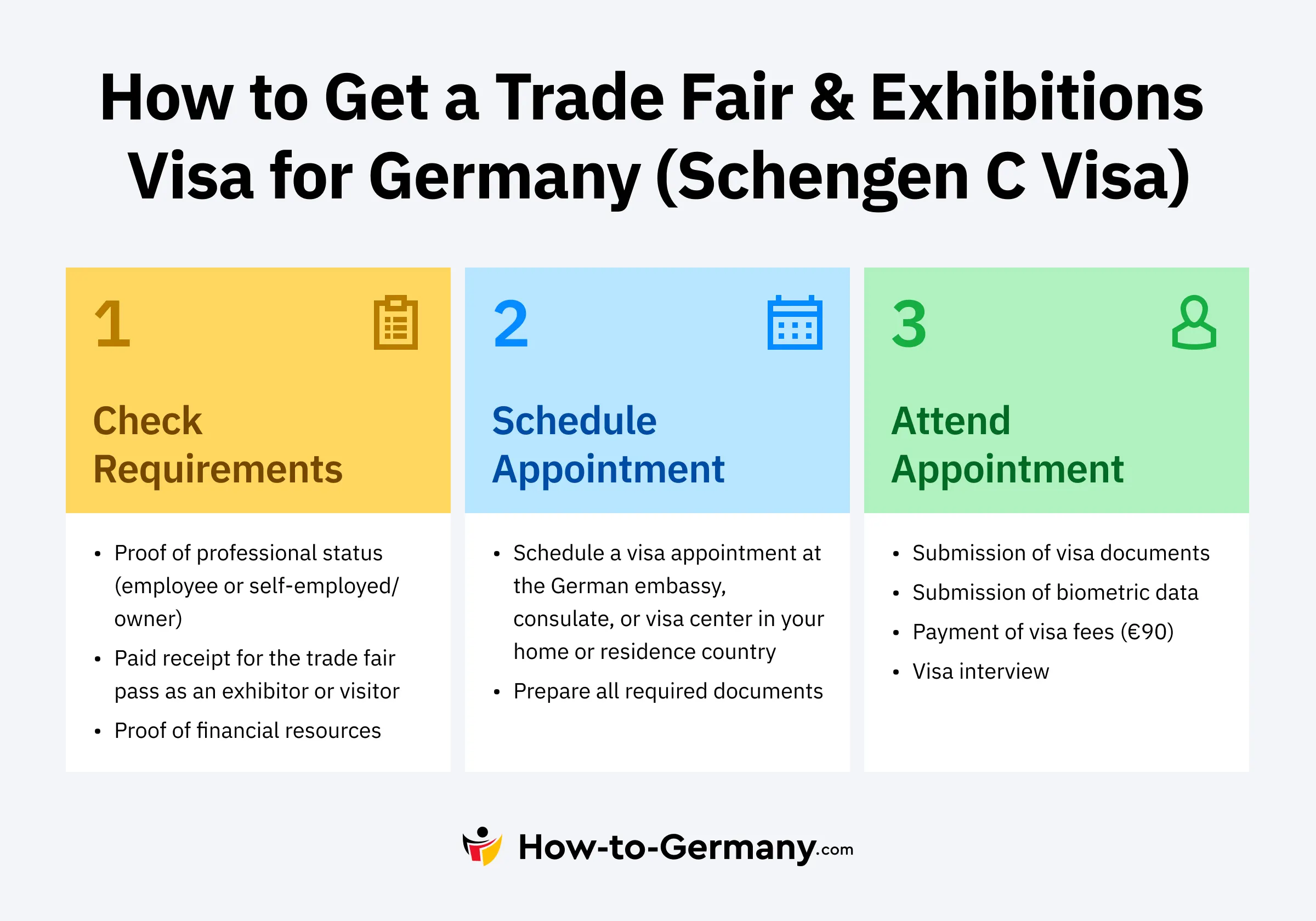
Most visitors from third countries require a visa to travel to Germany. Exceptions apply to:
- Citizens of the European Union and other Schengen countries and foreign nationals with a residence permit for one of these countries.
- Citizens of third countries with a visa waiver. Travelers from around 60 countries do not need a visa for short-term trips to the Schengen Area. ETIAS is scheduled to launch in the last quarter of 2026, with mandatory registration expected to roll out in 2027. Once mandatory, visa-exempt travelers must obtain a digital ETIAS travel authorization before entering the Schengen Area.
German trade fair visa — Schengen visa for short-term stays
A German trade fair visa is a C visa and, thus, a Schengen visa for short-term stays of up to 90 days. Due to the reason for the travel, specific document requirements apply.
It is issued either as a single-entry visa or — if the visa applicant meets certain requirements — as a multiple-entry visa.
A single-entry trade fair visa is issued for a specific period, for example, 1 week or 14 days. After it expires, you must leave Germany and the Schengen Area and apply for a new visa for future travels.
You can get a multiple-entry visa if you can prove frequent participation in fairs or exhibitions. Such a visa entitles you to a stay of a maximum of 90 days within 180 days in Germany or other Schengen countries.
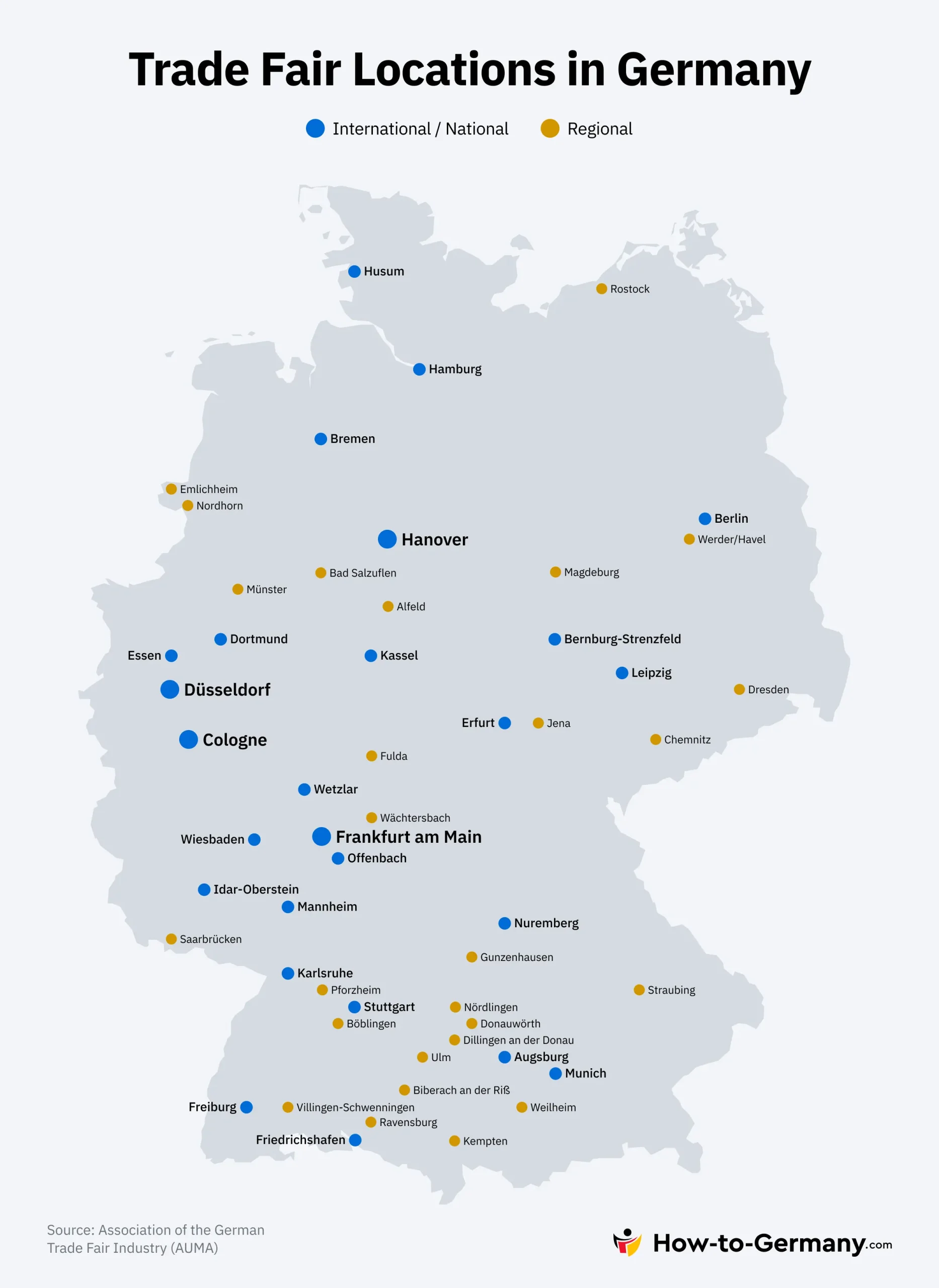
Germany has a reputation as the world’s largest organizer of business fairs and exhibitions. Several German cities are among the top 10 global trade fair locations. The German trade fair industry thus mirrors the global market for many industries. The German government places a high value on market participants having the most free access possible to these trade fairs, which is also reflected in Germany’s high number of trade fair visas.
Visa application process
The German Embassy or a German Consulate in your home country is responsible for issuing German trade fair visas.
You should check the website of the responsible German mission before applying, because trade fair visa checklists can differ by country. Applicants usually complete the Schengen visa form through VIDEX, the official German online visa application form system, and print the generated form with barcodes for the appointment.
Official information is also available through the German Federal Foreign Office and, for trade fair industry information, through AUMA.
In some countries, German missions work with external visa centers to assist them with processing visa applications. In this case, the visa center is your first contact for the visa application. The German Embassy’s website provides all the relevant information about procedures with a visa center.
The application process involves a visa appointment to submit the visa documents and a visa interview, which can usually be arranged online. You must submit true and complete information for a successful visa application.
| Step | What to do | Why it matters |
|---|---|---|
| Check the embassy checklist | Use the checklist from the German mission or visa center responsible for your place of residence. | Country-specific requirements can differ. |
| Complete VIDEX | Fill out the Schengen visa form in VIDEX and print the signed form with barcodes. | German missions usually require the official VIDEX-generated form. |
| Prepare trade fair proof | Collect your exhibitor pass, visitor ticket, fair registration, company documents, and travel plan. | The embassy must see that the purpose of travel is genuinely trade fair-related. |
| Attend the appointment | Submit your documents, provide biometrics if required, answer questions, and pay the visa fee if applicable. | The application is only processed after it is properly lodged. |
| Wait for the decision | Track your application through the mission or visa center if tracking is available. | Standard processing can take up to 15 calendar days and longer in individual cases. |
General visa documents
To apply for a short-term Schengen visa, you will need the following documents (each in the original and with 2 copies):
| Document | Requirement | Example / Details | Notes |
|---|---|---|---|
| Application Form | Completed form. | Schengen visa application form generated through VIDEX. | Print, sign, and submit with the barcode pages. |
| Biometric Photos | 2 current photos. | Must meet German photo visa requirements. | Recent only. |
| Declaration of Authenticity | Signed statement. | Confirms submitted information is correct. | Mandatory. |
| Financial Means Proof | Sufficient funds. | Bank statements, income proof, or company cost assumption. | Must cover entire stay. |
| Passport | Valid passport. | Must meet Schengen passport requirements. | Required for visa. |
| Passport Copies | Copies of data pages. | Travel document data page copies. | Submit with application. |
| Previous Passports & Visas | If applicable. | Expired passports, previous Schengen visas. | Supports travel history. |
| Proof of Accommodation | Confirmed stay. | Hotel booking or private invitation. | Must cover stay. |
| Proof of Marital Status | If applicable. | Marriage certificate, children’s birth certificates. | Registry extract may be required. |
| Travel Health Insurance | Minimum €30,000 coverage. | Valid across the Schengen area and compliant with visa insurance German requirements. | Mandatory. |
| Travel Tickets | Travel reservations. | Flight, train tickets for outward & return journey. | No purchase required. |
| Visa Fee Payment | If applicable. | Proof of visa fee payment. | Required in most cases. |
Proof of financial means
Depending on your professional status, you can prove that you have sufficient financial means for your stay in different ways:
Employees
- Employment contract
- Salary statements from the last 3 months
- Bank statements from the last 3 months
Entrepreneurs and self-employed individuals
- Proof of ownership or proof of self-employment/freelance work
- Current tax assessments
- Personal bank statements from the last 3 months
Declaration of Commitment from a German sponsor
The German embassies accept the Declaration of Commitment from a sponsor in Germany as proof of financing. This sponsor can be a company or a private individual who declares this to the responsible German immigration office.
For trade fair travel, applicants more commonly use a company declaration of cost assumption instead of a personal sponsor declaration. This is usually a letter on official company letterhead confirming that the employer, exhibitor, or business partner covers travel, accommodation, health insurance, and living expenses during the stay. The responsible German mission decides which form of financial proof is accepted.
Specific visa documents for fair and exhibition participants
You will need additional documents to prove your planned trip’s purpose and professional status to get a visa to attend German business fairs and exhibitions. These include:
- Paid receipt for the official exhibitor pass or exhibitor badge, or a paid trade fair visitor pass
- Marketing materials for the event and information about the visa applicant’s activities in it
- Documents showing the connection between your company profile and the topic of the fair
In addition, some specific requirements depend on whether you are an employee or self-employed:
Employees
- Leave letter from the employer with details of the period of leave
- Information on the purpose and aim of the visit
- Period of desired validity of the visa (if applicable, request for a multiple entry visa)
- Declaration of cost assumption by the employer on official company letterhead, if the employer covers the trip
- Personal income tax return
Entrepreneurs and self-employed individuals
- If applicable: certificate of ownership or company registration
- For companies: bank statements of the company bank account for the last 3 months, bank certificate stating that and to what extent the visa applicant is entitled to withdrawals from this account, profit tax declaration
German embassies are authorized to demand additional or country-specific documents for visa issuance. Before you apply for the visa, you should check with the embassy about the required documents.
Processing time and visa fees for trade fair visa
German embassies usually decide on Schengen visa applications within 15 calendar days after the application has been lodged. In individual cases, processing can be extended to up to 45 calendar days, for example if further checks or additional documents are required. The embassy’s website provides exact information about the local processing time.
In urgent cases, quick processing of your visa application is possible in some—but not all—countries, provided that you can prove with appropriate documents that you or your employer have only decided to participate at short notice. Visa centers offer priority visa services for an additional fee to business people and, thus, also to professional trade fair visitors.
For a trade fair visa, as for other Schengen short-term visas, you pay a fee of €90. No visa fee applies to exhibitors who present an official exhibitor pass or comparable proof of exhibitor status. Exhibition stand constructors, stand builders, service providers, visitors, and other business travelers must usually pay the standard €90 Schengen visa fee unless another fee exemption applies.
After the appointment, the embassy or visa center checks whether your file is complete and whether your travel purpose, finances, insurance, and return intention are sufficiently documented. If the visa is approved, your passport is returned with the visa sticker showing the validity period, number of entries, and allowed days of stay. A trade fair visa is often issued only for the event period plus reasonable travel days, but frequent exhibitors or business travelers may request a multiple-entry visa if they can prove repeated travel needs.
Conclusion
Germany’s trade fair visa is essential for exhibitors and visitors from non-EU countries who wish to participate in one of the world’s leading trade fair industries. With streamlined requirements, visa fee exemptions for exhibitors, and the possibility of multiple-entry visas for regular participants, Germany facilitates business networking and global market access. However, applicants must meet all documentation and financial requirements, use the official Schengen visa process, and check the responsible German mission’s checklist before applying. Those who don’t meet requirements can consider alternative short-term visa types, such as German business visas. In any case, planning ahead and submitting a complete application is key to a smooth visa process.
Frequently Asked Questions
In principle, yes. However, there may be country-specific differences in the documents required to prove the purpose of the trip, as well as the registration and tax status of companies and self-employed individuals. The requirements of the embassies are also based on the legal regulations of the respective country.
In this case, the German Embassy requires proof that you regularly travel to business fairs and exhibitions in Germany. With the application for a multiple-entry visa, you must submit documentation of your travel history with previous Schengen visas and proof of your fair and exhibition visits. If you or your employer has long-term business relations with German business partners, consider alternatively applying for a regular business visa for multiple entries.
You also must apply for a business fair & exhibitions visa. In this case, a few more documents are required for the visa application:
- Contract between the exhibiting company and the company that was commissioned with the stand construction (i.e., your company or your employer)
- Documents about the exhibiting company: exhibitor pass, stand confirmation, and proof of payment of the stand fees or a letter of confirmation from the exhibiting company (with a confirmation from the trade fair organizer or a foreign representative)
In principle, yes, if visiting the trade fair is the sole reason for their trip. However, it makes more sense for them to apply for a tourist visa, as significantly less documentation is required for this. Minor applicants require the consent of both parents.