
European Travel Information & Authorisation System | ETIAS
 Written by
Janine El-Saghir
Janine El Saghir is an editor at How-to-Germany.com, where she specializes in the practical aspects of daily life and integration for expatriates. With years of...
Written by
Janine El-Saghir
Janine El Saghir is an editor at How-to-Germany.com, where she specializes in the practical aspects of daily life and integration for expatriates. With years of...
 Reviewed by
Erkan Boga
Erkan Boga is the founder and CEO of qmedia GmbH, the publishing house behind How-to-Germany.com. He established the platform with the clear vision of creating...
Reviewed by
Erkan Boga
Erkan Boga is the founder and CEO of qmedia GmbH, the publishing house behind How-to-Germany.com. He established the platform with the clear vision of creating...
 Edited by
Sadie Voss
Content Lead & Editor
Sadie Voss is the Lead Editor for How-to-Germany.com. As an expat who carved her own way into Berlin from the United States, Sadie is deeply...
Edited by
Sadie Voss
Content Lead & Editor
Sadie Voss is the Lead Editor for How-to-Germany.com. As an expat who carved her own way into Berlin from the United States, Sadie is deeply...
- The European Travel Information and Authorisation System (ETIAS) has not yet been launched. It was previously expected in the last quarter of 2026, but July 2026 reports indicate that its introduction is being postponed until 2027. A firm launch date has not yet been announced.
- This digital pre-travel authorisation will apply to visitors who can enter the Schengen area visa-free for up to 90 days. Citizens of 59 visa-exempt countries and territories will need an ETIAS.
- The ETIAS application process will be entirely online, requiring travelers to apply before departure. Once implemented, ETIAS will be mandatory for visa-exempt travelers.
- The authorisation will be valid for up to 3 years or until the passport expires—whichever comes first—and allows multiple entries.
- An ETIAS will only be issued for short stays of up to 90 days within a 180-day period.
- ETIAS will generally cost €20, but applicants under 18 or over 70 will be exempt from the fee. They must still submit an application and obtain a valid ETIAS before traveling.
What is ETIAS?
ETIAS is a digital travel information and authorisation system for participating European countries. It was previously expected to launch in the last quarter of 2026, but July 2026 reports indicate that its introduction is being postponed until 2027. A firm launch date has not yet been announced. An ETIAS travel authorisation will allow visa-exempt travelers to explore participating European countries for up to 90 days.
The participating states have already defined the details of the ETIAS process.
With ETIAS, the European Union and participating European states are introducing a travel authorisation system that has been standard in other countries – such as the USA (ESTA), Australia (ETA), or Canada (eTA) – for some time.
ETIAS will be required for travel to 30 European countries. These include all EU countries except Ireland, as well as Iceland, Norway, Liechtenstein, and Switzerland. Cyprus will require ETIAS even though it is not yet a full member of the Schengen Area. Travelers from visa-exempt third countries without a qualifying residence permit will therefore need a European travel authorisation for these participating countries.
Objectives of the ETIAS introduction
The EU decided to create a digital travel information and authorisation system as early as 2016, mainly due to the globally increasing threat of terrorism.
ETIAS is intended to strengthen security within the EU and the Schengen area, address illegal immigration, reduce security challenges, including epidemic risks posed by international travel, and limit the security risks associated with global mobility, including threats to public health.
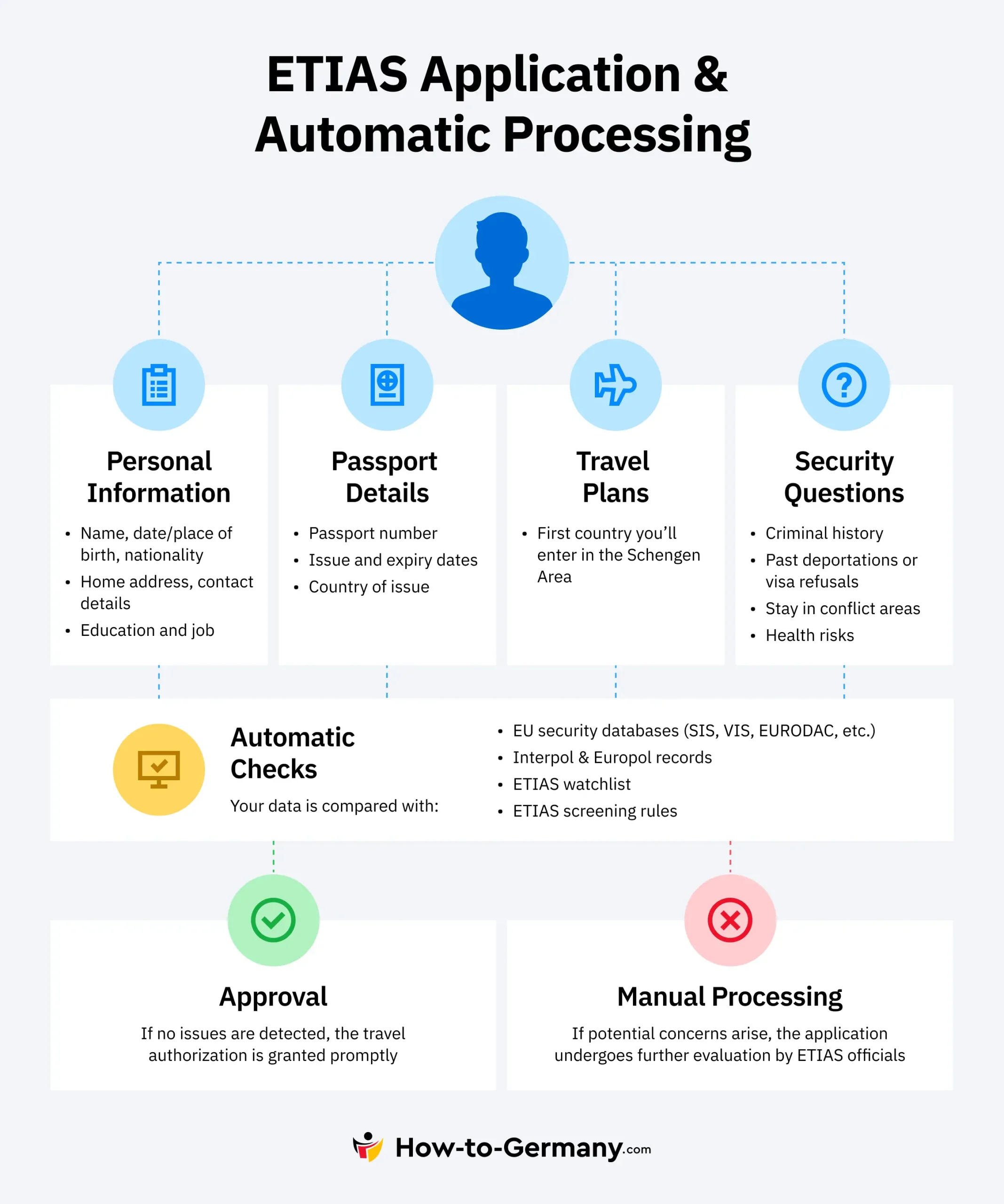
The data from an ETIAS application will be checked against various European security systems and the Europol and Interpol databases. Europol has set up an ETIAS watch list, listing individuals with a history of serious crimes or a high probability of committing them.
ETIAS works alongside the EU’s Entry/Exit System (EES), which became fully operational across participating Schengen countries on April 10, 2026. EES records border crossings and biometric information for short-stay non-EU travelers, while ETIAS provides pre-travel authorisation for eligible visa-exempt visitors.
ETIAS – only for visa-free travelers and for a maximum of 90 days
An ETIAS travel authorisation can only be obtained by visa-free travelers who want to visit a participating European country.
Visa-free travel to participating European countries is currently possible for citizens of 59 countries and territories, including the USA and Canada, the United Kingdom, Japan, and Australia. Once the system is in place, travelers from these countries and territories will be subject to ETIAS. Visitors from all other countries will need a Schengen visa to enter the country.
An ETIAS travel authorisation can only be issued for trips of up to 90 days within a 180-day period. However, as long as the 90-180-day rule is observed, any number of trips to participating European countries are possible during the validity period of the authorisation.
For longer stays in the Schengen Area – for example, for work, study, or family reunification – you do not need an ETIAS travel authorisation but a national visa (Schengen visa type D) for the country in which you will be spending most of your time. However, special national regulations of European countries may apply for a D visa. For example, Germany allows citizens of currently 14 third countries to enter the country without a visa, even if they are planning a long-term stay.
ETIAS application process
You will be able to apply for an ETIAS travel authorisation quickly and easily online once the system becomes operational. The official EU information portal is:
https://travel-europe.europa.eu/etias
The official ETIAS application website and mobile application are not yet accepting applications. Travelers should not submit passport details or pay an “ETIAS fee” to any website claiming that it can currently issue, reserve, pre-approve, or process a valid ETIAS travel authorisation.
Some private websites may offer general information or commercial assistance, but they are not the official EU portal and cannot submit a real ETIAS application before the system opens. Any website presenting itself as the official ETIAS application service or claiming to collect the official €20 fee before applications begin should be treated as potentially fraudulent.
Requirements of ETIAS application
To receive an ETIAS travel authorisation, you submit the following information through the digital application form:
- Personal data (name, date of birth, address, marital status)
- Passport number and other passport details
- Email address and telephone number
- Country of entry into the EU/Schengen area
- Questions about education and professional experience
- Questions about your state of health
- Questions about previous trips to war and conflict zones, previous expulsions and deportations, and entries in your criminal record
Your legal guardian must apply for the ETIAS travel authorisation if you are a minor.
Processing the application
Most ETIAS applications are expected to be processed within minutes. However, if further checks are required, a decision can take up to 4 days or 96 hours. In less common cases involving requests for additional information or an interview, processing may take longer.
Travelers should therefore apply before departure rather than relying on immediate approval.
If the information submitted for ETIAS and passport details correspond with data stored in European security systems and travelers thus do not meet the entry conditions, the application will be rejected. The reasons for this will be communicated by email. Those affected have the right to appeal, which will be dealt with by national law. The email will also provide information on which countries you can appeal to and how the objection process works.
Cost and validity of an ETIAS travel authorisation
A fee of €20 will generally be charged for issuing the travel authorisation once ETIAS launches. The European Commission approved the increase from €7 to €20 in July 2025 to account for inflation and the system’s expanded technical and operational scope. The fee can be paid online by credit or debit card.
Applicants who are under 18 years old or over 70 years old will not have to pay the ETIAS application fee. They must nevertheless complete the application process and obtain an approved ETIAS travel authorisation before departure.
Certain family members of EU citizens or other people who enjoy rights of free movement may also be exempt from the fee, provided they meet the relevant conditions.
The document is valid for up to 3 years or until the registered passport expires, whichever comes first. You can travel to participating European countries multiple times without reapplying, provided you continue to observe the 90-day limit within each 180-day period.
The authorisation is only valid with the passport for which it was issued. You will also need a new ETIAS travel authorisation if you get a new passport.
Entering the Schengen Area
Travelers with an ETIAS travel authorisation can enter via any participating European country. However, they should provide accurate information about their intended first destination when applying. Before departure, carriers will check whether the traveler has a valid ETIAS, while border authorities retain the final decision on entry.
Conclusion
ETIAS is an important step towards making travel to participating European countries safer and more efficient. Although it is an additional formality, the visa waiver for trips of up to 90 days remains in place, and applying for a European travel authorisation will be substantially simpler than applying for a visa.
ETIAS will generally cost €20 once it becomes operational, although applicants under 18 or over 70 will be exempt from paying the fee. They will still need to apply and receive authorisation before traveling.
Although ETIAS was previously expected to launch in the last quarter of 2026, July 2026 reports indicate that implementation is being postponed until 2027 because of complications surrounding the EES rollout. A firm launch date has not yet been announced. Most applications should be processed within minutes, although additional checks can extend processing to 96 hours or longer.
Visa-exempt travelers should use only the official EU portal at https://travel-europe.europa.eu/etias or the official mobile application once the system becomes operational. The official application service is not currently open, so travelers should not pay any website that claims it can already issue or process a valid ETIAS authorisation.
Frequently Asked Questions
No. Citizens of the European Union and non-EU Schengen countries (Iceland, Norway, Liechtenstein, and Switzerland) do not need an ETIAS travel authorisation to enter the EU or the entire Schengen area.
Travelers from the UK will require an ETIAS authorisation to enter the Schengen area. After Brexit, the United Kingdom became a third state. Furthermore, the UK has not signed the Schengen agreement, so it also falls under the ETIAS regulations.
You apply for an ETIAS travel authorisation centrally on a digital EU platform. It is issued digitally. The application only takes a few minutes, and no documents are required. By contrast, travelers must apply for a Schengen visa at the embassy of a Schengen state abroad. Proof of financing and numerous other documents are needed for a Schengen visa to be issued.
No. Unlike a Schengen visa, travel health insurance is not required for an ETIAS authorisation. Nevertheless, taking out such a policy is recommended so that you are fully covered while traveling in European countries.