
Work Visa (Employment Visa) for Germany
 Written by
Janine El-Saghir
Janine El Saghir is an editor at How-to-Germany.com, where she specializes in the practical aspects of daily life and integration for expatriates. With years of...
Written by
Janine El-Saghir
Janine El Saghir is an editor at How-to-Germany.com, where she specializes in the practical aspects of daily life and integration for expatriates. With years of...
 Reviewed by
Erkan Boga
Erkan Boga is the founder and CEO of qmedia GmbH, the publishing house behind How-to-Germany.com. He established the platform with the clear vision of creating...
Reviewed by
Erkan Boga
Erkan Boga is the founder and CEO of qmedia GmbH, the publishing house behind How-to-Germany.com. He established the platform with the clear vision of creating...
 Edited by
Sadie Voss
Content Lead & Editor
Sadie Voss is the Lead Editor for How-to-Germany.com. As an expat who carved her own way into Berlin from the United States, Sadie is deeply...
Edited by
Sadie Voss
Content Lead & Editor
Sadie Voss is the Lead Editor for How-to-Germany.com. As an expat who carved her own way into Berlin from the United States, Sadie is deeply...
- Qualified employees can apply for a work visa for Germany.
- The visa is available in 2 main variants: a regular work visa and an EU Blue Card.
- A German work visa is usually issued as a national D visa for several months, often 6 to 12 months, allowing you to enter Germany and obtain the relevant residence title.
- Important requirements for granting a visa are a work contract with a German employer, proof of qualifications, recognition if required, and a professional license for regulated professions.
- For the entry visa, proof of health insurance is also required.
- The employment contract is important proof of financing, but applicants should also be prepared to show liquid funds for first-month costs in Germany.
German Work visa: Types & requirements
A work visa for Germany is a national visa (D visa), alongside other long-stay options such as the Germany job seeker visa or the Germany Opportunity Card for entering the country to find employment. The German Federal Foreign Office sets the criteria for granting D visas in line with the German visa requirements. A work visa is usually issued for several months, often 6 to 12 months, depending on the embassy, employment contract, and individual case. During this time, you must apply for a residence permit at the local immigration office. It is issued for the duration of your employment contract or a maximum of 4 years and can be extended.
German work visa — for employees and self-employed
Employees, freelancers, and self-employed people can obtain a work visa and a residence permit for Germany, while independent professionals may instead apply for a Germany freelance visa. However, different documents are required for a self-employed and freelance visa, which must include proof of the prospects of self-employment success in Germany.
Visa obligation for Germany
The German Residence Act regulates the visa requirement for Germany as follows:
- Citizens of the European Union and other Schengen states that are not EU members (Iceland, Liechtenstein, Norway, Switzerland) do not require a visa or residence permit to work in Germany. Their stay is covered by freedom of movement within the EU and the Schengen Area.
- Most third-country nationals require a visa to enter Germany. However, visa exemptions are provided for citizens of certain countries.
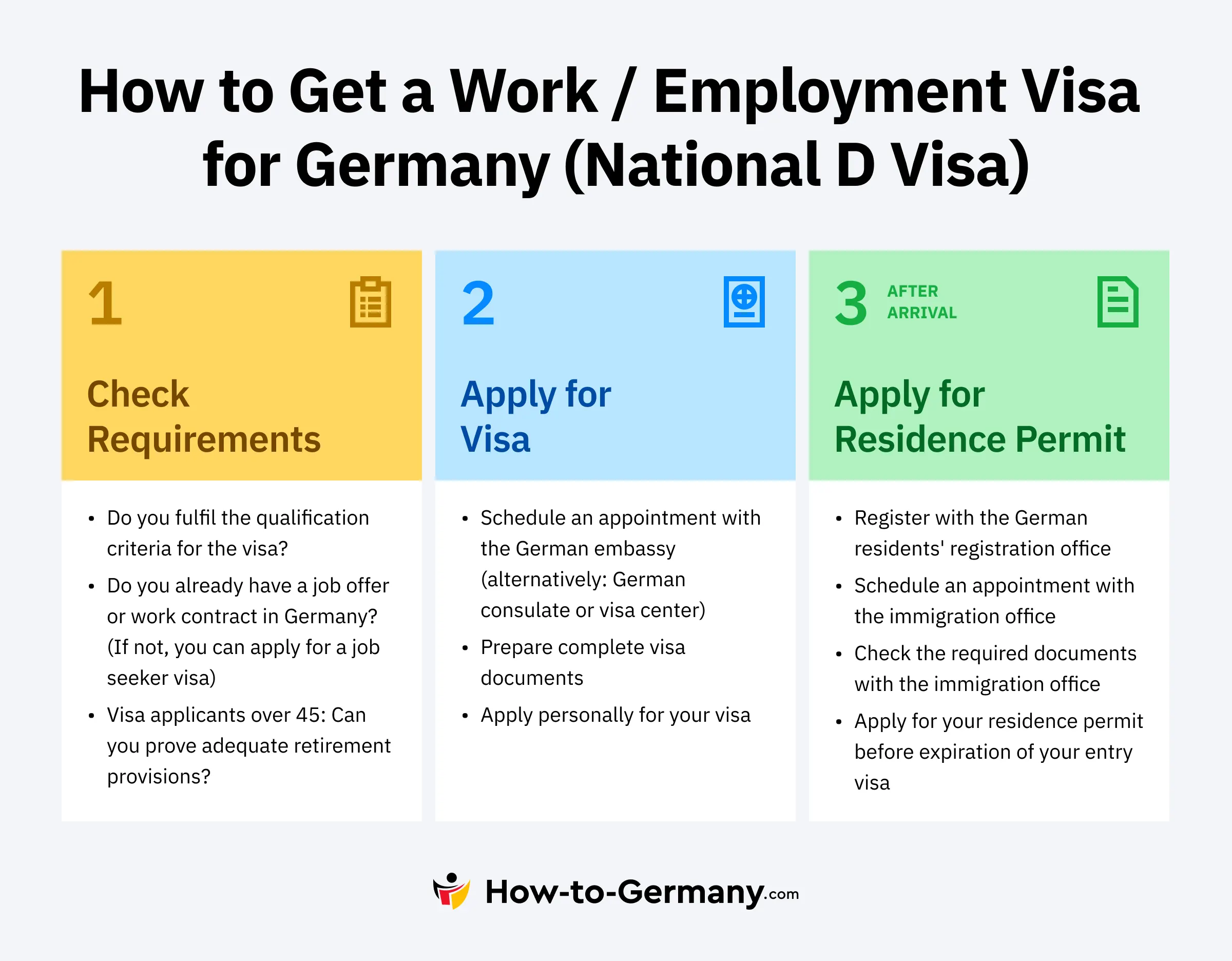
There are 2 types of work visas for Germany: the regular work visa for skilled workers and the EU Blue Card. Both allow you to stay in the country for the duration of your employment contract or a maximum of 4 years. Residence permits can be extended or converted into permanent settlement permits if certain requirements are met.
The EU Blue Card is a special residence title for academics and employees with comparable qualifications — for example, skilled workers who have gained further qualifications after completing their vocational training or college graduates with social and educational professions.
The gross annual salary for an EU Blue Card in Germany must be at least €50,700 in 2026. A reduced threshold of €45,934.20 applies to shortage occupations, recent graduates, and eligible IT specialists. Shortage occupations include, for example, doctors, pharmacists, teachers, educators, managers in nursing, and IT experts. IT specialists can also obtain the Blue Card without formal qualifications if they have university-level professional experience.
Benefits of the Blue Card
Important advantages of the Blue Card include easier access to a permanent settlement permit and naturalization in Germany. Conversion to a settlement permit is possible after 27 months with language skills at the A1 level and after 21 months at the B1 level. With a regular skilled worker visa under §18a or §18b AufenthG, settlement may be possible after 3 years if the legal conditions are met. Workers on the non-degree experienced pathway under §19c AufenthG and §6 BeschV usually follow the standard 5-year settlement route.
Your spouse and minor children can usually join you in Germany under simplified family reunification rules. Under the updated Skilled Immigration Act, skilled workers including Blue Card holders who receive their residence permit for the first time on or after March 1, 2024 may also be able to bring their parents, and parents-in-law if the spouse also lives in Germany, without proving exceptional hardship.
If you lose your job while holding an EU Blue Card, you must inform the immigration authority. The standard grace period to find a new qualifying job is usually 3 months. If you have held the Blue Card for more than 2 years, the authority may extend this period to 6 months. There is no automatic 12-month job search period.
Changing jobs with an EU Blue Card
During the first 12 months of Blue Card employment, a job change is handled through a notification-based process. You must inform the Ausländerbehörde, and the authority has 30 days to object to or suspend the change. After the first 12 months, Blue Card holders generally do not need formal pre-approval or notification for a job change, provided the Blue Card conditions continue to be met.
Requirements for a German Work visa
To obtain the visa, international professionals must meet the following requirements:
- A specific job offer in Germany for a position that usually requires either a university degree or qualified vocational training. Under the experience-based pathway, applicants with at least 2 years of professional experience may also qualify without formal German recognition if they have a job offer meeting the applicable salary threshold.
- A university degree or vocational qualification recognized in Germany, unless an alternative legal pathway applies, and a license to practice for regulated professions
- Approval of the Federal Employment Agency for employment in this position, where required
- Proof of health insurance
Experience-based work visa pathway
Under Section 6 of the Employment Regulation, some applicants can obtain a German work visa with at least 2 years of relevant professional experience and a qualification recognized by the country where it was obtained, even if the qualification is not formally recognized in Germany. For 2026, the job offer generally needs to provide a gross annual salary of at least €45,630. Regulated professions still require professional recognition or permission to practice.
If you are older than 45 and want to come to Germany for the first time for employment, you can only get a regular qualified employment visa or experienced-worker visa with a gross annual salary of €55,770 or more in 2026, or proof of adequate pension provision from abroad. This over-45 salary or pension check generally does not apply if you qualify for an EU Blue Card.
Professional license
German law differentiates between unregulated and regulated professions:
- Most professions in Germany are not regulated. They are not subject to any legal requirements for practicing the profession so that you can apply directly to an employer for such a position — for example, as a business economist or IT expert. An optional certificate assessment by a central recognition office may improve your chances in the German labor market, but it is irrelevant for visa issuance. However, some employers explicitly require this assessment.
- Regulated professions require a professional practice permit, which you will only receive if your degree is recognized in Germany. This requirement applies to doctors, pharmacists, teachers, educators, nurses, and other care workers. To obtain a work visa, you must either have full recognition of your professional qualification or at least partial recognition.
Recognition of foreign professional qualifications
Recognition allows you to prove that your qualification in a regulated profession is equivalent to a German academic qualification or qualified vocational training.
For academic degrees, you can use the Anabin database to check whether your university and degree are recognized or comparable in Germany. Anabin is primarily relevant for university-level qualifications. For vocational training and non-academic qualifications, such as nursing, electrical work, or skilled trades, applicants should use the Anerkennungsfinder on the official Anerkennung in Deutschland portal to find the responsible recognition authority and procedure.
In addition to full recognition, partial recognition of foreign professional qualifications is possible if significant differences exist between them and a German qualification. Partial recognition means that a qualification is recognized in principle but that certain qualifications or practical experience are missing. In this case, you must complete an adaptation qualification or knowledge test in Germany to apply for full recognition.
If an employer is willing to support you through adaptation training, or you can already work in your profession with partial recognition, you can get a work visa. Alternatively, a vocational training visa for internships, courses, or exams is possible. Depending on the need for qualification, the period until full recognition of your degree can take 6 months up to 2 years.
Deadlines for recognition procedures
You should expect the following timings for the evaluation of certificates and the full recognition of your professional qualifications:
- Certificate evaluation in non-regulated professions: 1 to 3 months
- Recognition or part in regulated professions: 3 to 6 months, sometimes longer
You should start the recognition process as early as possible, as you will need the certificate of full or partial recognition for your visa application.
Approval of the Federal Employment Agency
The approval of the Federal Employment Agency for a specific job position is part of the visa processing procedure, for which you do not have to do anything yourself. The German embassy will send your visa application to the relevant immigration office, which will obtain approval from the employment agency.
For the EU Blue Card, Federal Employment Agency approval is generally not required if the salary meets or exceeds the standard threshold of €50,700 in 2026. However, approval is required for Blue Card applications using the reduced salary threshold, including shortage occupations, recent graduates, and eligible IT specialists without a degree.
Your prospective employer can also apply for the approval and forward it to you for your visa application. With such advance approval, the visa processing time can be significantly shorter.
Health insurance
To obtain a visa, you must take out Schengen travel health insurance in accordance with Germany visa insurance requirements for acute medical treatment covering the first few days or weeks in Germany.
Later on, you will need a German comprehensive health insurance policy. Employees in Germany must take out statutory health insurance if their regular gross annual salary does not exceed €77,400 per year or €6,450 per month in 2026. Insurance coverage begins on your first day of work. You can alternatively take out private health insurance if your income is higher.
Your employer will usually cover half of the ongoing statutory health insurance contributions once employment begins. For the visa application, you must enclose proof of your own health insurance coverage, such as a statutory health insurance registration confirmation (Mitgliedschaftsbescheinigung) or a quote, policy, or confirmation from a private or incoming health insurer.
An important requirement for a German visa is proof of sufficient financial resources to cover your living expenses. Even with an employment contract, embassies may ask for evidence of liquid funds for the period before your first salary payment. Applicants should be prepared to show enough cash reserves for initial costs such as temporary accommodation, rent deposits, registration-related expenses, and the first month of living costs in Germany.
Visa application process
You apply for the visa at the German embassy, a visa center contracted by the embassy, or a German consulate in your home country or country of residence.
You submit your visa documents and biometric data (fingerprints) during an appointment at the embassy. In a visa interview with an embassy official, you can explain why you want to work in Germany.
Visa documents
The required documents must be submitted in the original and with 2 photocopies. Information about visa documents can also be found on the embassy’s website.
To apply for a work visa, you typically need the following visa documents — however, the embassy reserves the right to request further evidence:
| Document | Requirement | Example / Details | Notes |
|---|---|---|---|
| Application Form | Completed and signed. | National visa (D visa) application form. | Usually submitted with copies. |
| Biometric Photos | 2 recent photos. | Photos not older than 6 months. | Must meet Germany visa photo requirements. |
| Cover Letter | Personal statement required. | Explanation of purpose and job in Germany. | Should be clear and structured. |
| CV / Resume | Up-to-date and complete. | Details of qualifications and work experience. | Preferably in EU format. |
| Employment Contract / Job Offer | Binding agreement required. | Contract stating salary and job description. | Must meet the applicable salary threshold for the selected visa type. |
| Federal Employment Agency Approval | If applicable. | Pre-approval from German authorities. | Required for some routes, including Blue Card applications using the reduced salary threshold. |
| Health Insurance | Valid coverage. | Travel insurance plus statutory membership confirmation, private insurance confirmation, or incoming insurance policy. | Required for visa approval. |
| Passport | Valid passport with copies. | Passport + 2 copies of data page. | Must meet German requirements. |
| Proof of Financial Means | If requested. | Bank statements or proof of liquid funds. | Useful for covering first-month living costs, temporary housing, and deposits before the first salary payment. |
| Proof of No Criminal Record | Clean record required. | Police clearance certificate. | May require legalization. |
| Proof of Previous Residence | Address verification. | Registration certificate, utility bill, or driver’s license. | Confirms current residence. |
| Proof of Qualifications | Relevant education proof. | Degree certificates or vocational training. | Use Anabin for academic degrees; use the Anerkennungsfinder for vocational qualifications. |
| Recognition Certificate | If applicable. | Official recognition of foreign qualifications. | Required for certain jobs, especially regulated professions. |
| Statement of Accuracy | Signed declaration. | Confirmation that all information is correct. | Usually part of application package. |
| Visa Fee Payment | Proof of payment. | Receipt of visa fee. | Usually €75. |
Processing time & visa application fee
The processing time for a German work visa is typically 4 to 8 weeks, but it can also take up to 3 months or longer. You can apply for your visa up to 6 months before your planned entry into Germany and you should do this early. If you have preliminary approval from the Federal Employment Agency, you can usually expect shorter processing times.
The German work visa fee is €75.
Conclusion
A German work visa offers skilled professionals from third countries the opportunity to build a career in one of the world’s strongest economies. With the right qualifications, professional experience where applicable, and a job offer, international employees can secure a residence permit, which can later lead to permanent settlement and even German citizenship.
The application process involves several key steps, including proving qualifications, obtaining health insurance, showing sufficient financial resources where requested, and securing approval from the Federal Employment Agency if required. The EU Blue Card provides additional advantages for highly qualified professionals, such as a faster path to permanent residency.
Germany’s work visa system is structured to attract skilled workers while ensuring all necessary legal and financial requirements are met. By understanding the process and preparing the required documents, applicants can increase their chances of a successful visa application and a smooth transition to working and living in Germany.
Frequently Asked Questions
Your spouse and minor children can join you in Germany. Other family members will only be allowed to join you in exceptional cases. The requirements for a family reunion visa include financial means for the entire family to live on and sufficient living space. Your spouse will also receive a work permit for Germany.
An au pair visa is a special form of work visa. You can apply for it if you are between 18 and 27 years old. It is issued for a maximum of 1 year and cannot be extended. Among other documents, you will need an au pair contract and a completed questionnaire from your host family in Germany. In addition, German language skills at the A1 level and health insurance must be proven. You can only get an au pair visa for Germany once.
Yes. If you come to Germany on a visa to seek employment and have found a job, you can get a residence permit for gainful employment directly and without leaving the country.
The situation is different if you enter Germany with a short-term Schengen visa — for example, to attend an interview. Even if you are offered a job, you must leave Germany before your visa expires and apply for a work visa in your home country.
A job change does not affect your residence permit but should be reported to the immigration office. The immigration office must approve any job change if your residence title is tied to a specific employer or, in the case of Blue Card holders, in the first year.
Termination must be reported to the immigration authorities immediately, regardless of whether you or your employer initiated it. Initially, you will not lose your residence title. The immigration authorities will set a period during which you have to find a new job. However, this period is often limited to 3 to 6 months. With the Blue Card, you have 12 months from the second year to seek employment. If you do not find a new job within these deadlines, you must either leave the country or apply for a visa to seek employment. When you have a settlement permit, these questions no longer matter — your residence status is no longer tied to a specific purpose.