
Requirements for a German Visa
 Written by
Janine El-Saghir
Janine El Saghir is an editor at How-to-Germany.com, where she specializes in the practical aspects of daily life and integration for expatriates. With years of...
Written by
Janine El-Saghir
Janine El Saghir is an editor at How-to-Germany.com, where she specializes in the practical aspects of daily life and integration for expatriates. With years of...
 Reviewed by
Erkan Boga
Erkan Boga is the founder and CEO of qmedia GmbH, the publishing house behind How-to-Germany.com. He established the platform with the clear vision of creating...
Reviewed by
Erkan Boga
Erkan Boga is the founder and CEO of qmedia GmbH, the publishing house behind How-to-Germany.com. He established the platform with the clear vision of creating...
 Edited by
Sadie Voss
Content Lead & Editor
Sadie Voss is the Lead Editor for How-to-Germany.com. As an expat who carved her own way into Berlin from the United States, Sadie is deeply...
Edited by
Sadie Voss
Content Lead & Editor
Sadie Voss is the Lead Editor for How-to-Germany.com. As an expat who carved her own way into Berlin from the United States, Sadie is deeply...
- Your visa application must be submitted in person at a German mission abroad or a German consulate. Some embassies have outsourced their visa services to an external visa application centre.
- With the documents for the visa application, visa applicants prove that they meet the requirements for the visa issuance.
- Some of these documents—in particular, proof of financial means for the stay and Schengen travel health insurance—are required from all visa applicants. In contrast, others are only relevant for certain visa categories (for example, a work or student visa).
- Visa documents are usually accepted in German and English — if necessary, in a notarized translation.
- For some officially issued documents, certification by legalization or apostille is required.
Visa obligations and visa types for Germany
Germany is a Schengen member state. 29 European countries have signed the Schengen agreement, including all EU member states except Ireland and Cyprus. Switzerland, Liechtenstein, Norway, and Iceland are also Schengen countries, although they are not part of the European Union. Germany is a Schengen member state as indicated in the Schengen area explained.
There are no internal border controls between the Schengen states. If you have a visa for Germany or another Schengen country, you can travel throughout the entire Schengen zone without any further visas.
You can apply for a Schengen visa at the country’s embassy, where you will enter the Schengen area and spend the majority of your time.
Visa requirements
Whether you require a visa for the Schengen countries depends on your citizenship:
- Citizens of the European Union and Schengen countries do not require a visa or a residence permit for extended stays or settling in another Schengen country.
- Most third-country nationals require a valid visa for Germany and the other Schengen countries.
- Visa waivers based on international agreements allow citizens of certain countries to enter Germany and, thus, the Schengen area without a visa.
Visa types
German visas are issued as short-term Schengen visas and national visas for longer stays.
Short-term Schengen visa (C visa)
Germany short stay visas entitle the holder to stay in the Schengen area for up to 90 days (multiple entry visa: 90 days within 180 days). The same conditions apply in all Schengen countries for their issuance, and taking up employment is not permitted. Remember, short-stay visas are subject to the strict Schengen limit. Use our Germany 90/180 day rule tool calculator to check your allowed days before applying.
Your visa application must prove the purpose of your trip with appropriate documents.
Citizens of about 60 countries do not need a visa for short-term stays in Germany or other Schengen countries. ETIAS is not yet operational, and the EU has not set a start date: the official ETIAS portal (checked on October 7, 2026) says the date will be announced several months before the launch, and the earlier target of late 2026 is no longer listed there. Once implemented, eligible visa-exempt travelers will need to apply online before entering participating European countries.
German national visa (D visa)
The Federal Foreign Office defines the conditions for a German long stay national visa in consultation with other German authorities. The consent of the responsible German immigration office is always required for its issuance, so the processing time for a D visa is significantly longer compared to short-term visas.
German national visas are issued for 3 months to 1 year and enable a stay of more than 90 days. Before the visa expires, you must, if necessary, apply for a German residence permit at the local immigration office. It is usually possible to work in Germany with a national visa—your visa will state whether a work permit is included.
A visa waiver also applies to German national visas for citizens of 14 countries (including the United Kingdom, the United States, Canada, Australia, Japan, Israel, and South Korea). They can enter Germany for up to 90 days without a visa. They need a residence permit for longer stays, which must be applied for within this 90-day period.
The Opportunity Card (Chancenkarte) under Section 20a AufenthG is now the primary points-based route for many non-EU applicants who want to seek qualified employment in Germany. It is generally issued for up to one year and allows secondary employment of up to 20 hours per week. The traditional job seeker route remains available only in specific cases.
Visa application process for a Schengen visa
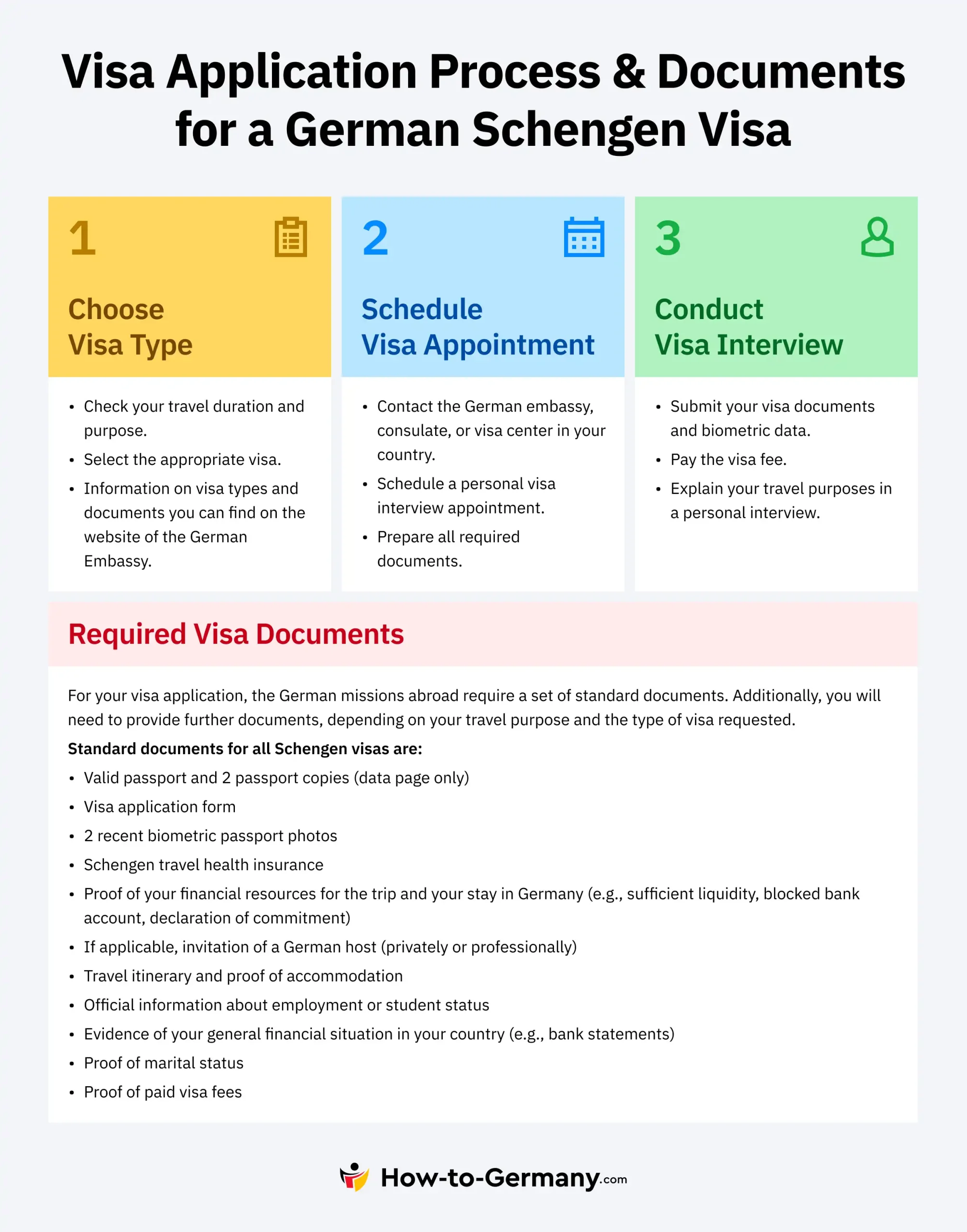
You submit your visa application at a German mission in your home country or in the country in which you have your permanent residence. Contact points for the application are:
- German Embassy
- German Consulate
- Visa application centre. These are external service providers commissioned by the German embassies to process visa applications.
The German missions’ websites will tell you where to apply, what requirements you must meet for the various visa categories, and what documents you need.
To apply for a German visa, you must schedule an in-person appointment, which you can usually make online.
The following agenda applies to the appointment at the embassy:
- Submission of visa documents and their examination by the embassy
- Payment of German visa fees
- Submission of biometric data (fingerprints). Fingerprints stored in the Visa Information System are reused for 59 months, just under five years; after that they are taken again.
- Visa interview with an embassy employee to clarify the reasons for the visa application and to answer any questions.
The time it takes to decide on a visa depends on the type of visa applied for. Short-term Schengen visas are usually issued by the embassies within 10-14 days, but processing a national visa can take up to 3 months or even longer.
In general, you should apply for your visa as early as possible. It can also take several weeks before your appointment at the embassy. The German embassies accept visa applications up to 6 months before the planned trip.
Options in case of visa denial
If your visa is denied, the embassy states the reasons in the refusal notice. Since July 1, 2025, there is no appeal at the embassy (remonstration) anymore. You can either submit a new application with better documents or file a lawsuit at the Berlin Administrative Court within the deadline stated in the notice, usually one month. The options are explained on the page about a German visa denial.
Visa requirements: Required documents for applications
Many visa documents are required for every visa application, whether a short-term Schengen visa or a German national visa. Other papers and certificates are only required for certain visa categories. For example, you do not generally have to provide proof of language skills for a short-term visa. Still, they are required to obtain a student visa or a visa for vocational training in Germany.
The following is an overview of relevant visa documents. German embassies are entitled to request further documents.
For your visa application, you submit the original documents and 2 copies.
The documents for a German visa are largely identical worldwide. Nevertheless, individual countries may have differences — this applies to official certificates, necessary notarizations, and translations. Country-specific requirements may also apply to financial statements or health insurance. For example, some blocked account providers are only accepted in certain countries. Therefore, you should only research visa requirements on the website of the German embassy responsible for your country. You may make mistakes if you use the websites of embassies in other countries.
Standard documents for a German visa
| Document | Requirement | Example / Details | Notes |
|---|---|---|---|
| Biometric Photos | 2 identical photos required. | Biometric passport photos meeting German standards. | Must follow official photo requirements. |
| Health Insurance | Valid Schengen travel insurance required. | Minimum coverage of €30,000. | Covers medical emergencies, repatriation, and death. |
| Passport | Must meet Schengen requirements. | Issued within last 10 years; valid at least 3 months beyond stay. | Must have at least 2 empty pages; longer validity may be required for national visas. |
| Passport Copies | Copies required. | Copies of passport data page. | Submitted with application documents. |
| Visa Application Form | Completed and signed. | Different forms for Schengen and national visas. | Must match visa type applied for. |
| Proof of Financial Resources | Must demonstrate sufficient funds. | Income, bank statements, blocked account, sponsor declaration, scholarship. | Documents must clearly prove financial stability for the stay. |
Health insurance for extended stays
If you apply for a national visa for extended stays in Germany, you will also need Schengen travel health insurance for the visa application. However, not all insurers offer these policies for longer periods, so you must switch to a German insurer before applying for a residence permit.
Germany visa health insurance requirements indicate the insurance must be valid until the expiry of the visa. Employees with regular annual gross earnings of up to €77,400 (€6,450 per month) are generally subject to compulsory statutory health insurance in 2026.
The same applies to apprentices who complete their vocational training in a company. Students and the self-employed have the choice between public and private health insurance. Some individuals — such as apprentices in a school-based training program, language students, and guest researchers without an employment contract — can only take out private insurance.
For them, an expat insurance policy that can be taken out for a maximum of five years and is also accepted for visa applications is an alternative to travel insurance.
Some plans are as follows:



Advertising notice: provider links in this overview are affiliate links — we receive a commission from the provider for sign-ups made through them.
Minimum amounts for short-term Schengen visas and extended stays
To grant a visa, German embassies require proof of minimum amounts. If you apply for a Schengen short-term visa at a German Embassy, you must prove that you have a minimum amount of €45–50 per day (2026, embassy-dependent). For a student visa, the blocked-account amount is €11,904 per year / €992 per month in 2026. Opportunity Card applicants must generally prove €13,092 per year / €1,091 per month. Financial requirements for other national visas vary according to the purpose of stay and individual circumstances. For stays of less than a year, the required amount must be proven for each month of stay. For a family reunification visa, the family member living in Germany must prove that the family can be supported without social benefits.
Blocked bank account as proof of financial means
Many visa applicants prefer to provide a blocked bank account as proof of financial means. You can open one of these at a bank in Germany or — much faster and less complicated — online with providers such as Expatrio, Studely, or Coracle, which German embassies accept. You deposit the required minimum amount into the account for one year or a pro-rata monthly amount for shorter stays and enclose the certificate with your visa application. Your provider pays a monthly installment into a German checking account for each month of your stay.
Documents you may also need (Depending on your visa type)
| Document / Information | Requirement | Example / Details | Notes |
|---|---|---|---|
| Accommodation Proof | Must be provided. | Hotel booking, rental contract, or invitation confirmation. | Required for entire stay (short-term visas); partial proof may be sufficient for national visas. |
| Employment / Education Status | If applicable. | Employer letter, student certificate, or enrollment proof. | Shows ties to home country. |
| Invitation Letter | If applicable. | Invitation from a private individual or public institution. | Must state relationship and be addressed to the German embassy; often required for business or event visas. |
| Marital Status Proof | Required. | Civil registry extract, marriage certificate, birth certificates, or death certificate of spouse. | Used to verify family status. |
| Professional & Educational Proof | For national visas if applicable. | Degrees, certificates, language proof. | Recognition of foreign qualifications may be required for work or job-seeker visas. |
| Travel Itinerary | Must be provided. | Flight reservations, travel dates, booking confirmations. | Return booking important for Schengen visas; flexible reservations recommended. |
| Visa Fee Payment | Proof required. | Receipt of visa fee payment. | Required for application processing. |
Additional proof of employment and education status
German embassies usually require additional documents regarding visa applicants’ employment or education status for both short-term Schengen visas and national visas.
Employees
- Employment contract
- Leave permission/no-objection letter from the employer
- Proof of salary for the last 6 months
- If applicable, the current tax assessment notice
Freelancers and self-employed individuals
- Copy of business license or official confirmation of self-employment status
- Business bank statements for the last 6 months
- Current tax assessment notice
Pupils, apprentices, students
- Official school or matriculation certificate
- No-objection letter from the educational institution
- Proof of paid tuition fees (if applicable)
Unemployed and retired visa applicants
- Unemployed spouses of employed German or EU citizens in Germany: Copy of the partner’s passport; Confirmation of employment of the partner (not older than 3 months, stating the professional position and the date of entry into the company), alternatively: Copy of the partner’s employment contract
- Retired people: pension statements from the last 6 months
Additional visa requirements for minors
Minors must fulfill a few additional requirements for a Schengen visa application:
- Birth certificate (original, if necessary, with a notarized translation)
- Signatures of both parents on the visa application form
- Certified copies of the passports or identity cards of both parents
- Minors traveling alone: Written consent of both parents on the visa application form and in a separate formal letter
- Minors traveling with only one parent: Written consent of the other parent
- If only one parent has custody: court order confirming sole custody
Legalization of visa documents
The following visa documents usually need to be legalized or apostilled:
- Birth certificates
- Marriage certificates/registered partnership certificates
- University diplomas
- Other documents issued by authorities in your home country
Notarization is not sufficient for official documents, as the content and authenticity of the document itself must be confirmed. Notarizations may additionally be required for translations.
You can find the required notarizations on the German Embassy website in your home country.
Legalization is a multi-step process in which the authenticity of documents is certified by a notary or public authority and the foreign ministry of the issuing country. The destination country’s embassy verifies these certifications and then carries out the final legalization. A much simpler and faster process is certification by an apostille. This is possible in countries that have joined the Hague Apostille Convention, which is carried out by duly authorized authorities. However, Germany does not recognize the apostilles of all countries.
Conclusion
Applying for a German visa requires thorough preparation and submitting all necessary documents. The process varies depending on the visa type, but all applicants must provide proof of financial means, health insurance, and a valid passport. Additional documents may be required based on the applicant’s employment status, educational background, and the purpose of their stay.
Incomplete or incorrect applications can lead to delays or rejections, making it crucial to check country-specific requirements on the website of the relevant German embassy. Applicants can submit a new application or file a lawsuit in case of a visa denial; the embassy appeal was abolished on July 1, 2025. Understanding and complying with the official requirements will significantly increase the chances of a successful visa application.
Frequently Asked Questions
German missions abroad accept visa documents in German and English. Documents in other languages must be translated and notarized. Many German embassies publish a list of approved translators on their websites.
When you submit your visa application, you usually pay the visa fees in cash in the respective local currency. In various countries, payments can also be made by credit or debit card (Visa or Mastercard only). To find out whether the German Embassy in your country accepts card payments, visit the embassy website.
With a no-objection letter, the employer or educational institution in your home country confirms that they know and agree to your absence and its duration. The letter must include details of the employment or training relationship (e.g., position in the company, duration of employment, field of study, academic year, date of enrollment, duration of training).
Some documents — such as a valid passport or proof of Schengen travel health insurance — are essential for a successful visa application. If they are missing, the application will be rejected. Other documents, such as formal invitations or no-objection letters from employers and educational institutions, may be waived after consultation with the embassy as long as your reason for travel and willingness to return can be proven beyond doubt. Suppose direct contact with the embassy is not possible. In that case, you should explain the reasons for the absence of a particular document in writing and, if necessary, enclose evidence as to why it cannot be obtained.
The willingness of visa applicants to return to their home country is an important criterion for granting German visas, especially for short-term Schengen visas, but also for national visas with no uncertain prospects of remaining in the country (e.g., visas for language courses or job seeker visas). The embassies check the economic and social roots in the home country based on proof of income and property, professional ties, and family situation (marriage, children, etc.).
No, the German embassies do not offer online applications. You must be at the embassy to submit your visa application and documents. However, the VIDEX portal (the foreign office’s international portal) allows you to prepare visa applications, including the preliminary review of uploaded documents. As a rule, you can schedule an appointment for the visa interview online via the embassy’s website. You can also find the visa application forms here.