
Training & Internship Visa for Germany
 Written by
Janine El-Saghir
Janine El Saghir is an editor at How-to-Germany.com, where she specializes in the practical aspects of daily life and integration for expatriates. With years of...
Written by
Janine El-Saghir
Janine El Saghir is an editor at How-to-Germany.com, where she specializes in the practical aspects of daily life and integration for expatriates. With years of...
 Reviewed by
Erkan Boga
Erkan Boga is the founder and CEO of qmedia GmbH, the publishing house behind How-to-Germany.com. He established the platform with the clear vision of creating...
Reviewed by
Erkan Boga
Erkan Boga is the founder and CEO of qmedia GmbH, the publishing house behind How-to-Germany.com. He established the platform with the clear vision of creating...
 Edited by
Sadie Voss
Content Lead & Editor
Sadie Voss is the Lead Editor for How-to-Germany.com. As an expat who carved her own way into Berlin from the United States, Sadie is deeply...
Edited by
Sadie Voss
Content Lead & Editor
Sadie Voss is the Lead Editor for How-to-Germany.com. As an expat who carved her own way into Berlin from the United States, Sadie is deeply...
- Third-country nationals who want to complete an internship or vocational training in Germany can apply for a training and internship visa.
- Under certain conditions, a visa can be issued to search for a training position in Germany.
- Further visa-granting requirements prove sufficient financial means and valid health insurance for the entire Schengen area.
- Training and internship visas are usually national visas that entitle the holder to a temporary residence permit for the duration of the training. Internship visas are also issued for the entire duration of the internship.
Visa requirements for internship in Germany
The first question you must answer for an internship or vocational training in Germany is whether you require a visa.
Germany and most other European Union countries, except Ireland and Cyprus, belong to the Schengen Area. Schengen countries without EU membership are Switzerland, Iceland, Norway, and Liechtenstein. If you are a citizen of one of these countries, you do not need a visa or a residence permit for Germany.
However, most third-country nationals are subject to German visa requirements for entry into Germany, as explained in the German visa guide.
Internship visa procurement varies by nationality
Citizens of some countries can enter Germany without a national visa and apply for a residence permit after arrival, but this rule is not the same for every visa-exempt nationality. Nationals of Australia, Canada, Israel, Japan, New Zealand, South Korea, the United Kingdom, and the United States can generally enter visa-free and apply for a residence permit in Germany, including for paid internships or vocational training.
A stricter rule applies to nationals of Andorra, Brazil, El Salvador, Honduras, Monaco, and San Marino. These nationals may also have post-entry application options, but not for every purpose. If the stay involves economic activity, such as a paid internship or dual vocational training, they should normally apply for the correct national visa before entering Germany. Otherwise, the immigration office may require them to leave Germany and apply from abroad.
[/info]
Whether they have a short-term or national visa, visa holders can travel throughout the entire Schengen area without further visa formalities. If you have a German national visa, your stay in another Schengen country may not exceed 90 days.
Internship visa
With a study-related internship in Germany, you will gain practical work experience and learn what it is like to work in Germany. If you are generally interested in living and working in Germany, you can establish contacts with potential employers during your internship.
Some requirements, such as proof of financial means to cover your living expenses and Schengen travel health insurance, apply to every visa application regardless of the reason for the planned stay. To obtain an internship visa for Germany, you must also meet the following requirements:
- Internship contract with a company or institution in Germany
- You are currently studying or graduated no more than 2 years ago.
- The internship must be related to your studies.
You can also apply for an internship visa if the internship is intended to prepare you for a course of study, vocational training, or employment in Germany. Alternatively, a German study visa can be applied for internships that prepare for a course of study.
A national visa usually also entitles the holder to secondary employment in Germany. However, this is not possible with an internship visa. A paid part-time job with an internship visa is not allowed.
Visa Validity
Internship visas are issued for a maximum of 6 months. An extension is possible in well-founded exceptional cases. These include:
- Compulsory internships
- Internships as part of other qualification programs.
- Unforeseen events such as long-term illness
Language skills
There are no legal language skill regulations for internship visas. The decisive factors are the language requirements of the internship company.
Many internship companies require German language skills at A2 or B1 level. In some cases, however, internships are also offered in English. To get an internship visa, it is typically sufficient to have confirmation from the company that you can complete the internship with little or no knowledge of German.
Exceptions apply to preparatory internships — German embassies typically require an official language certificate (at least A2 or B1, for a student applicant visa B2).
Vocational training visa
You can get a vocational training visa for Germany for a school-based or dual vocational training course:
- In a school-based program, the entire training occurs in a vocational school. This includes, for example, training in educational and social professions. Internships typically supplement it.
- A dual training program consists of a theoretical part, which you complete at a vocational school, and a practical part in the company. Most vocational training in Germany is organized on a dual basis.
Visa validity
For vocational training in Germany, you need a national visa (D visa) and must apply for a residence permit at the immigration office after entering the country. It is issued for the duration of the training. Vocational training in Germany takes between 2 and 3.5 years, depending on the occupation and training program.
With a vocational training visa and the corresponding residence permit, you can work up to 20 hours per week in a part-time job independent of your training.
Visa requirements
In addition to the general requirements for obtaining a visa (proof of financial means, health insurance), the following conditions apply to the granting of a vocational training visa:
- Full-time training in a state-recognized vocational training program
- Proof of a school-based or company-based (dual) training position, vocational training contract
- German language skills at B1 level (based on the Common European Framework of Reference for Languages).
To complete a dual vocational training program, you can also get a visa and a German residence permit for a preparatory language course. To achieve this, you can submit proof of booking a recognized language course with your visa application.
Visa to search for a training position
Normally, you can only get a vocational training visa if you provide a specific training place for the visa application. However, under certain conditions, German embassies issue visas to search for a training place in Germany. This option is for applicants who are under 35, have German language skills at B1 level, and hold either a school-leaving certificate that gives access to higher education or a qualification from a German school abroad. This visa is issued for a maximum of 9 months. In 2026, applicants must usually prove at least €1,091 per month, for example through a blocked account or declaration of commitment. During the search period, limited work of up to 20 hours per week and short trial work may be possible.
The Opportunity Card visa Germany may also be relevant for qualified applicants who want to come to Germany first and search for suitable employment or training-related opportunities, depending on their qualifications, language skills, and points eligibility.
Recruitment programs for trainees from abroad
The German government runs recruitment programs in various countries to attract applicants for vocational training in Germany – particularly in shortage occupations such as care, skilled trades, and IT. Recruitment focuses on countries with high youth unemployment and a pool of well-qualified applicants. In addition to arranging a training place, language training, and integration support are often offered.
Prospects after graduation
After completing your vocational training course in Germany, you have an excellent chance of being taken on directly in an employment relationship through a German work visa. Otherwise, you can get a residence permit for 18 months to seek employment without having to leave the country first, or later apply for a freelance German visa if you plan to work independently. Until you find a job matching your qualifications, you can work full-time without restriction to earn a living.
Proof of financing and health insurance
You will need proof of financial means and health insurance to apply for a visa.
Proof of financial means
To obtain a visa, you must prove that you can cover your living costs as an intern or trainee. Germany does not use one single amount for every internship or training visa. The required amount depends on the exact visa category:
- Study-related internships: usually follow the student blocked-account amount of €992 per month, or €11,904 per year, in 2026.
- School-based vocational training: at least €959 per month, or €11,508 per year, in 2026.
- Dual / in-company vocational training: livelihood is generally considered secure if the training salary is at least €1,048 gross or €822 net per month in 2026. If the salary is lower, you must prove the difference.
- Search for a vocational training place: at least €1,091 per month in 2026.
There are various options for proving financial means:
- Income in Germany by training or internship allowance, which must be stated in your contract.
- Income in your home country or a declaration by another person, not a resident of Germany, such as your parents, to cover your costs. In both cases, you must provide suitable evidence of your circumstances (payslips, bank statements, or other proof of ownership).
- Declaration of commitment from a German sponsor to cover all costs related to your stay in Germany (living expenses, accommodation, health insurance). Private individuals, companies, and other institutions with permanent residences or company headquarters in Germany can issue it.
- Blocked bank account with the required minimum amount per month of stay or, for vocational training, for the required visa period or first year.
Your income in Germany
You can partially earn your income through an internship or vocational training in Germany.
- For internships, it depends on your employer, as there are both paid and unpaid internships. Submit your internship contract for the visa application, including a salary statement if applicable. If you receive an internship salary, you only have to prove financial means that are not covered by this allowance. Some internships must be paid at the statutory minimum wage, especially voluntary internships lasting longer than 3 months. Compulsory internships, short internships of up to 3 months, and certain orientation internships can be exempt from minimum-wage rules.
Unpaid internships are permissible in Germany in the following cases: compulsory internships required for graduation, short internships of up to 3 months, and orientation internships before studies. However, voluntary internships lasting longer than 3 months usually trigger German minimum-wage rules. In such cases, the internship contract should clearly state whether the internship is compulsory, voluntary, paid, or exempt.
- School-based vocational training is not remunerated. You, therefore, need proof of financial means of at least €11,508 for the first year in 2026.
- You will always receive a salary if you complete a dual vocational training program in Germany. Your earnings depend on your occupation and employer. It also increases with each year of training. For dual vocational training contracts beginning in 2026, the statutory minimum apprentice remuneration in the first year is €724 per month gross. For visa purposes, your livelihood is generally considered secure if your training salary is at least €1,048 gross or €822 net per month. If your training salary is lower, you must prove the difference, for example through a blocked account or declaration of commitment.
Health insurance
You require Schengen travel health insurance covering at least €30,000 for the visa application.
If you come to Germany as an intern, the insurance must be valid for your entire stay.
For a vocational training visa, it must cover the period until the start of your training contract. From then on, you will need German health insurance.
If you are doing a dual vocational training program in Germany, you must take out statutory health insurance, as your earned income will be below the compulsory insurance threshold. By contrast, if you are doing school-based vocational training, you can choose between public and private health insurance, as you do not receive an income from this form of training.
Approval by the Federal Employment Agency
The Federal Employment Agency must approve third-country nationals’ internships and vocational training courses. There are exceptions for compulsory internships and internships within the framework of EU programs.
The German Embassy and the relevant German authorities typically provide this approval:
- The Embassy forwards your visa application to the relevant immigration office in Germany.
- The authority requests the approval of the Federal Employment Agency.
- The agency sends the document directly to the immigration office, which forwards it to the German Embassy in your home country.
Alternatively, employers can apply for the approval of the Federal Employment Agency in advance. In this case, you will receive the document from your training company and enclose it with your visa documents.
For company-based vocational training, employers may be able to use the accelerated skilled worker procedure under § 81a AufenthG. This is an employer-led process handled through the immigration authority in Germany. It can shorten parts of the visa process, especially when recognition, Federal Employment Agency approval, and embassy appointment timing are involved. The employer needs authorization from the applicant and pays the official procedure fee. The accelerated procedure can speed up processing, but it does not guarantee that the visa will be granted.
Visa Application process
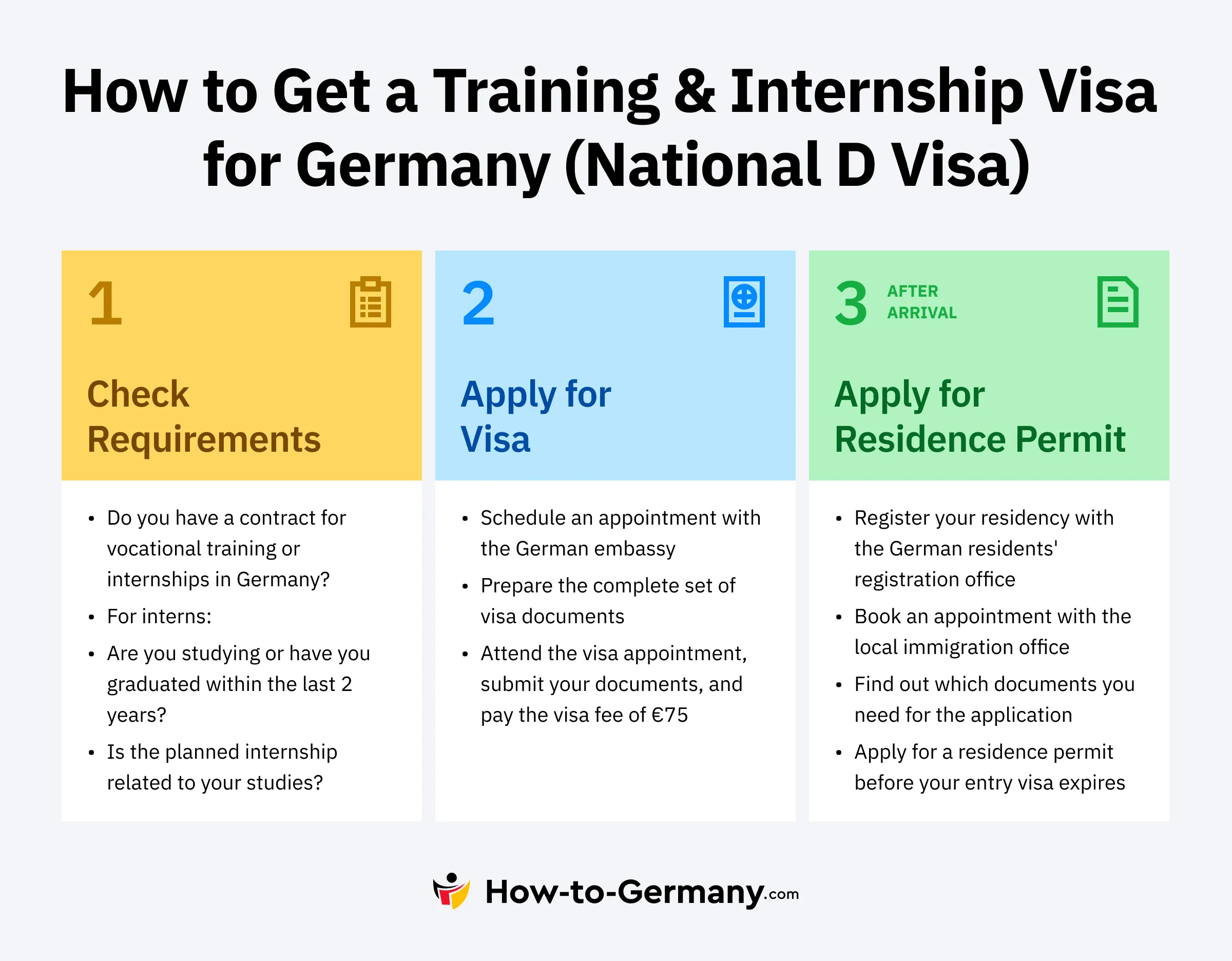
You submit your visa application personally to the German Embassy, a designated visa center, or a German consulate in your home country. You can usually schedule an appointment for your visa interview online.
Application process
The application process for the visa involves the following steps:
- Scheduling the appointment
- Compiling the visa documents
- At the visa appointment: handing over the visa documents, providing fingerprints, personal interview about your reasons for an internship or vocational training in Germany
Required documents
The following documents are required for an internship or vocational training visa (each in original and with 2 photocopies):
| Document | Requirement | Applies To | Example / Details | Notes |
|---|---|---|---|---|
| Biometric Photos | 2 recent photos. | All applicants | German biometric photo standard. | Incorrect format may cause delays. |
| Enrollment / Employer Confirmation | If applicable. | Interns | Letter from university or employer in home country. | Not required for all applicants. |
| Federal Employment Agency Approval | If required. | Some applicants | Approval from German Federal Employment Agency. | Depends on internship/training type. |
| German Language Proof | Language skills certificate. | Vocational training applicants | Recognized German language certificate. | Level depends on program. |
| Health Insurance | Valid coverage. | All applicants | Schengen travel health insurance. | Required for visa approval. |
| Internship / Training Contract | Official agreement required. | All applicants | Internship agreement or vocational training contract. | Must include duration and conditions. |
| Marital Status Proof | If applicable. | Applicants with family status | Marriage certificate, children’s birth certificates. | Only if relevant. |
| Passport | Valid passport with copies. | All applicants | Passport meeting German requirements + data page copies. | Must be valid for the entire stay. |
| Previous Passports | If available. | All applicants | Old passports with visas or stamps. | Supports travel history. |
| Proof of Accommodation | Address in Germany. | All applicants | Hotel booking, rental contract, or invitation letter. | Temporary accommodation is acceptable. |
| Proof of Financial Means | Sufficient funds. | All applicants | Blocked account, sponsor letter, training salary, or bank statements. | Amount depends on visa category: internship, school-based training, dual training, or training-search visa. |
| Proof of Qualifications | Educational documents. | All applicants | School certificates, degrees, additional qualifications. | May require translation. |
| Travel Plan | Planned itinerary. | All applicants | Flight reservations, train tickets. | Do not book final tickets before approval. |
| Visa Application Form | Completed and signed. | All applicants | National visa (D visa) form. | Download from embassy website. |
| Visa Fee Payment | Proof of payment. | All applicants | Receipt of visa fee. | Usually paid during appointment. |
Processing time & visa application fee
The processing time for an internship visa is between 6 and 12 weeks, but the visa process can sometimes take up to 4 months. You should expect a processing time of 8 to 16 weeks for a vocational training visa.
You can typically get a short-term Schengen visa within 14 days.
The visa application fee for a German national visa is €75. If you only want to complete a short internship in Germany, you will pay a fee of €90 for a Schengen short-term visa.
Conclusion
Germany offers excellent opportunities for international applicants seeking professional experience through internships or vocational training. Whether planning a short internship, applying for a training place, or using a search pathway before securing a contract, the right visa depends on the exact purpose of stay, salary level, nationality, and financial proof. Applicants should be especially careful with 2026 funding thresholds, because study-related internships, school-based training, dual training, and training-search visas do not all use the same monthly amount.
Upon completing vocational training, long-term career prospects in Germany are promising, with opportunities to transition into full-time employment. Even if employment isn’t directly offered, it can be possible to apply for a Opportunity Card visa Germany. Depending on the skill and job quality, an EU Blue Card Germany visa may also be issued.
Ultimately, Germany’s Training & Internship Visa is an excellent option for those who want to gain professional experience in a well-structured and internationally recognized environment. By planning and meeting all visa requirements, applicants can set a strong foundation for future careers in Germany.
Frequently Asked Questions
You register with your German residential address at the registration office and schedule an appointment with the immigration office of your place of residence. You will need your passport, your visa, and your training certificate. The immigration office will provide you with information about any further required documents. The issuance of a residence permit costs about €100.
Important: You must apply for it before your visa expires.
It is not possible to convert the visa. You have to leave Germany and apply for a visa to seek employment in Germany in your home country. If you meet the requirements, you can stay in Germany for up to 18 months to find a suitable job.
If you drop out of your training or your training company terminates your contract, you risk losing your residence permit. If you are not responsible for losing the training place yourself – for example, in the case of a termination due to staff reduction – you can receive a residence permit for 6 months to look for a new training place.
You can change your training place with the prior consent of the immigration office. You should apply for this as soon as you have received the acceptance or a contract for the new training place. It only makes sense to terminate the previous training after a positive decision by the immigration office not to jeopardize your residence permit.