
Visa Application Process for Germany
 Written by
Janine El-Saghir
Janine El Saghir is an editor at How-to-Germany.com, where she specializes in the practical aspects of daily life and integration for expatriates. With years of...
Written by
Janine El-Saghir
Janine El Saghir is an editor at How-to-Germany.com, where she specializes in the practical aspects of daily life and integration for expatriates. With years of...
 Reviewed by
Erkan Boga
Erkan Boga is the founder and CEO of qmedia GmbH, the publishing house behind How-to-Germany.com. He established the platform with the clear vision of creating...
Reviewed by
Erkan Boga
Erkan Boga is the founder and CEO of qmedia GmbH, the publishing house behind How-to-Germany.com. He established the platform with the clear vision of creating...
 Edited by
Sadie Voss
Content Lead & Editor
Sadie Voss is the Lead Editor for How-to-Germany.com. As an expat who carved her own way into Berlin from the United States, Sadie is deeply...
Edited by
Sadie Voss
Content Lead & Editor
Sadie Voss is the Lead Editor for How-to-Germany.com. As an expat who carved her own way into Berlin from the United States, Sadie is deeply...
- You submit your application for a Schengen visa at your country’s German embassy, consulate, or authorized visa center.
- Some national visa applications can now be started online through Germany’s Consular Services Portal, depending on your country and visa type.
- Different requirements apply depending on the visa type. Schengen Type C visas and National Type D visas have different forms, financial rules, insurance requirements, and processing times.
- Blocked accounts are mainly relevant for long-term National Type D visas, not ordinary short-stay Schengen visas.
- The Entry/Exit System (EES) now records many non-EU short-stay border crossings digitally, replacing manual passport stamps at Schengen external borders.
- Detailed country-specific information can be found on the official website of the German mission responsible for your place of residence.
Visa obligations and visa types determine the application process
The Schengen Agreement has created the world’s largest area without internal border controls. The Schengen countries include all EU member states except Ireland and Cyprus, as well as Switzerland, Norway, Iceland, and Liechtenstein. EU nationals and citizens of the four other Schengen countries enjoy freedom of movement throughout the Schengen area and do not have to complete ordinary visa formalities.
Visa obligations depend on nationality and purpose
Whether third-country nationals require a visa to enter the Schengen area depends on nationality, travel purpose, and duration of stay. Before applying, check the country-specific rules in the German visa requirements guide and on the website of the German mission responsible for your residence country.
Citizens of many countries can travel visa-free to Germany and other Schengen countries for short stays of up to 90 days within any 180-day period. This applies, for example, to citizens of the United States, Canada, Australia, the United Kingdom, Japan, South Korea, and several other countries.
Some visa-free nationals can also enter Germany without a visa for a planned stay of more than 90 days and apply for a residence permit after arrival. This is not the general rule for all third-country nationals. Most non-EU citizens who plan to work, study, train, freelance, reunite with family, or stay long-term need a National Type D visa before entering Germany.
Third-country nationals traveling for short-term business purposes should check whether they need a German business visa.
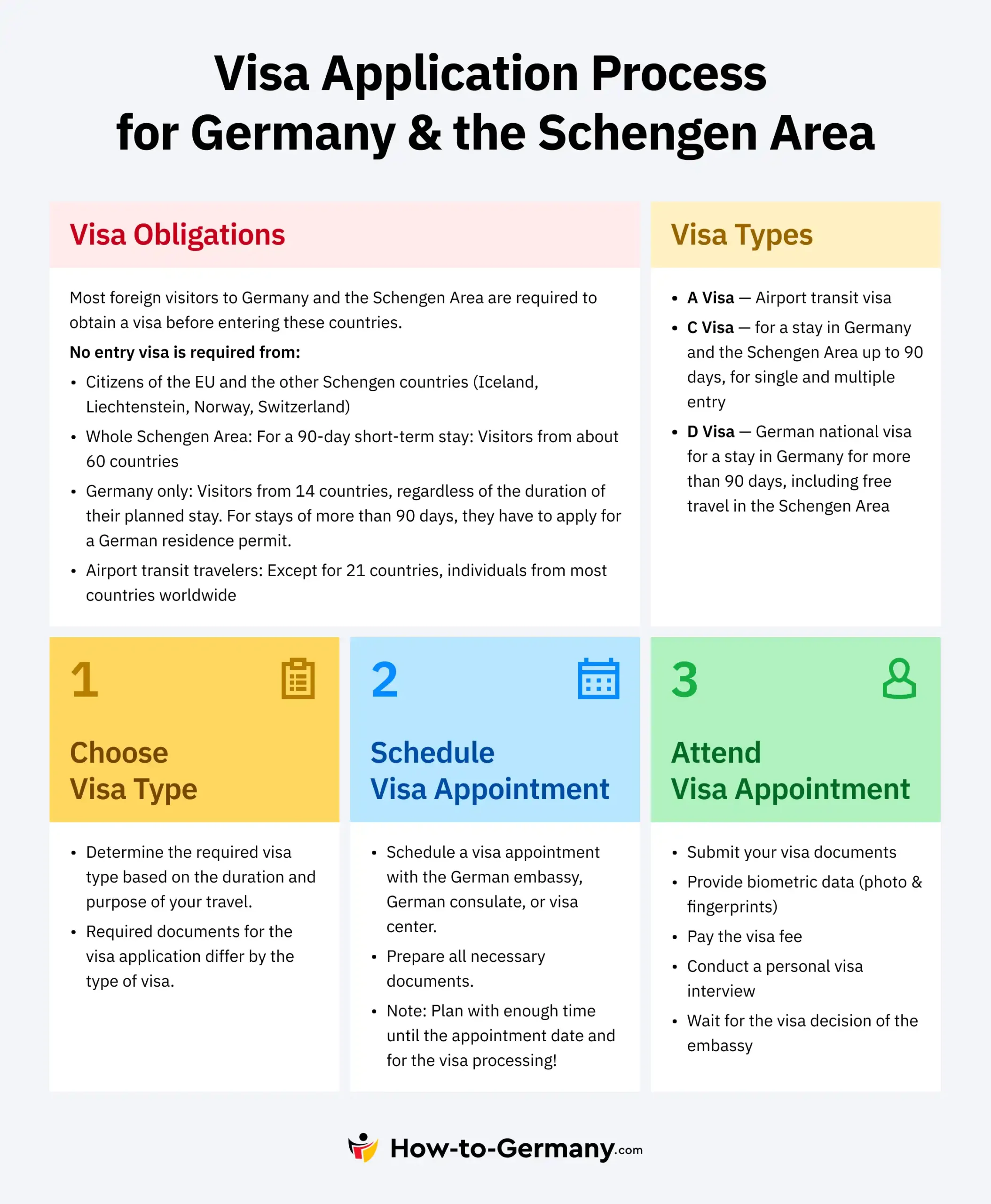
You apply for a Schengen visa at the embassy or consulate of the country where you will spend the most time during your trip. If your main destination is Germany, you must apply through the German mission or visa center responsible for your place of residence.
Visa types for Germany are based on stay length and purpose
The type of visa you need depends on the duration and purpose of your intended stay:
- A visa: An airport transit visa for a stopover in the international transit area of a German airport. It is only valid for airport transit and normally for a maximum of 12 hours. Since Germany lifted the airport transit visa requirement for Indian nationals on June 3, 2026, this requirement now applies to citizens of 20 countries, not 21. The processing time is usually up to 5 days.
- C visa: A Schengen short-stay visa for entry and stay in Germany and other Schengen countries for a maximum of 90 days within any 180-day period. It is used for tourism, visits, short business trips, trade fairs, or other short stays. The processing time is typically up to 14 days, but appointments and peak periods can make the total timeline longer.
- D visa: A German long-stay visa, also called a National visa, for stays longer than 90 days. This category includes German work visas, job seeker visas, freelance visas, student visas, family reunion visas, the EU Blue Card, and the Opportunity Card. Many D visas are issued for 90 days, but they can also be issued for 3, 6, or 12 months depending on the purpose of stay and the mission’s practice. After arrival, most applicants apply for a German residence permit at the local immigration office.
The issuance of Schengen visas in categories A and C is uniformly regulated in the Schengen area. National Type D visas are governed by German residence law and depend strongly on the purpose of stay.
Recent visa and border updates affect 2026 applications
Germany and the Schengen area have introduced several changes that matter for applicants and travellers:
- Airport transit visa update: Indian nationals no longer need a German airport transit visa from June 3, 2026, reducing the transit-visa country list to 20 countries.
- Consular Services Portal: Germany has expanded digital national visa application options through the Consular Services Portal. Availability depends on the visa type and country.
- Entry/Exit System: The EES digitally records many non-EU short-stay entries and exits at Schengen external borders. It replaces passport stamps and can affect how overstays are detected.
- Opportunity Card: The Opportunity Card gives eligible skilled workers a way to enter Germany to look for work if they meet the points, qualification, and financial requirements.
- VIDEX forms: Some applicants still complete visa forms through the official VIDEX system, especially for Schengen visas or where a mission requires it.
German visa applications follow embassy and visa-center procedures
You submit your application for a German visa to the German embassy or consulate in your country of residence. If it is not your home country, you will usually need a valid residence permit for that country.
In some countries, German missions abroad cooperate with external visa centers for their consular services. These service providers accept visa applications, collect biometric data, check documents, and arrange appointments for the applicant’s visa interview.
The required documents include an application form. Depending on the visa type and country, you may complete the form through the embassy website, VIDEX, or the Consular Services Portal.
If you are applying for a Schengen visa or a national visa for Germany for the first time, your fingerprints may also be taken as part of the application process. If you apply for a German visa again, biometric data may be reused for a limited period depending on the visa category and applicable rules.
Applying for a visa to Germany usually requires a personal visa appointment at the embassy, consulate, or visa center, even if parts of the application can be prepared online.
Required documents for a Schengen Type C visa
Schengen visa documents are for short stays of up to 90 days within any 180-day period. They are not the same as National Type D visa documents. A blocked account is usually not a standard requirement for an ordinary short-stay Schengen visa.
| Document | Requirement | Example / Details | Notes |
|---|---|---|---|
| Application Form | Completed and signed. | Schengen visa application form, often completed through VIDEX or the mission’s system. | For minors, both parents or legal guardians usually sign. |
| Biometric Photos | Recent photos required. | Biometric passport photos. | Must meet official German photo standards. |
| Civil Status Documents | If applicable. | Marriage certificate, children’s birth certificates, or family documents. | Used to prove family ties or sponsorship context. |
| Cover Letter | Often required or strongly recommended. | Explanation of travel purpose, route, and plans. | Should match bookings, invitation letters, and financial proof. |
| Employment / Study Proof | If applicable. | Employment letter, university confirmation, leave letter, or proof of self-employment. | Supports your intent to return after the trip. |
| Flight Reservations | Travel proof required. | Outbound and return flight bookings. | Only required for short-term Schengen travel. |
| Health Insurance | Valid Schengen travel insurance required. | Travel health insurance with at least €30,000 coverage. | Must cover the full Schengen area and the full travel period. |
| Passport | Valid passport required. | Original passport plus copies. | Usually remains with the embassy or visa center during processing. |
| Proof of Accommodation | Accommodation proof required. | Hotel booking, invitation, rental confirmation, or host letter. | Must cover the planned stay. |
| Proof of Financial Means | Proof of sufficient funds for the short stay. | Bank statements, payslips, sponsor declaration, invitation, or proof of paid travel package. | This is not the same as a blocked account for long-term stays. |
| Statement of Accuracy | Signed declaration required. | Confirmation that all information is correct. | Usually part of the application package. |
| Visa Fee Payment | Proof of payment required. | Receipt of visa fee. | Mandatory for application processing unless exempt. |
Required documents for a National Type D visa
National Type D visa documents depend heavily on the purpose of stay. A student, worker, freelancer, Opportunity Card applicant, spouse, and researcher will not have the same checklist.
| Document | Requirement | Example / Details | Notes |
|---|---|---|---|
| Application Form | Completed and signed. | National visa application form or digital application through the Consular Services Portal. | Use the official route required by the German mission in your country. |
| Biometric Photos | Recent photos required. | Biometric passport photos. | Must meet official German standards. |
| Health Insurance | Proof of adequate health insurance required. | Travel insurance for entry plus German statutory or private health insurance for residence. | Requirements differ for students, workers, freelancers, and family members. |
| Passport | Valid passport required. | Original passport plus copies. | Must usually be valid beyond the intended entry date. |
| Proof of Financial Means | Required for most long-term visas. | Blocked account, employment contract, scholarship, declaration of commitment, or other accepted proof. | For many 2026 long-stay applications, the general blocked-account benchmark is €11,904 per year, or €992 per month. Some visa types can require a higher amount. |
| Proof of Purpose | Required for the selected visa category. | Work contract, university admission, training contract, family documents, business plan, or Opportunity Card proof. | This is the core document that determines your visa category. |
| Proof of Qualifications | Required for many study, work, and skilled-worker visas. | Degree certificate, vocational qualification, recognition notice, CV, language certificate, or Anabin proof. | Documents may need legalization, apostille, or certified translation. |
| Visa Fee Payment | Proof of payment required. | National visa fee receipt. | Fee exemptions can apply in some family or EU-related cases. |
A blocked account is mainly relevant for National Type D visas, such as student, language course, job search, Opportunity Card, or other long-term stay routes. It should not be presented as a normal Schengen short-stay visa requirement. Always check the exact monthly amount required for your visa type and application year.
Visa type finder for Germany
Use this quick self-check to narrow down the right application route before gathering documents.
Which German visa route should I check first?
Rule of thumb: If your stay is longer than 90 days, do not use a Schengen checklist. Start with the National Type D visa category that matches your main purpose.
Visa applications follow three main steps
The application for a German visa is usually made in the following steps. The exact route depends on your country, visa type, and whether the German mission uses a visa center, VIDEX, or the Consular Services Portal.
1. Choose the correct visa type and prepare the application
Before booking or attending an appointment, identify whether you need an Airport Transit visa, Schengen Type C visa, or National Type D visa. Then check the responsible German mission’s website for the exact checklist.
For Schengen visas, you may need to complete the form through VIDEX. For some National visas, you may be able to start the process through the Consular Services Portal.
If you provide incomplete documents or submit them in the wrong order, your visa application may not be accepted, and you may need to schedule a new appointment.
2. Schedule an appointment
You typically make the appointment for submission of documents and your visa interview online on the website of the German embassy, consulate, or visa center. Plan with sufficient lead time. Appointment waiting times can be much longer than the formal processing time, especially for student, work, family reunion, and peak travel seasons.
You will usually receive a written appointment confirmation. Bring this confirmation to the visa center or mission if required.
3. Attend the visa appointment
The day of your visa appointment has come. The appointment should be kept exactly. If you are late, you may not be allowed to submit your application. You will usually complete the following process:
- Submission and review of visa documents
- Payment of the visa fee, unless already paid online or exempt
- Entering or verifying the information from your application form in the embassy or visa center system
- Checking and signing printed application data, if required
- Recording biometric data, such as fingerprints and sometimes a photo
- Visa interview with an embassy employee, if required
EES changes Schengen border checks
The Entry/Exit System (EES) now affects many non-EU travellers entering and leaving the Schengen area for short stays. Instead of relying on passport stamps, the system digitally records entry and exit dates, border crossing points, and biometric data.
This matters because the EES makes it easier for border authorities to calculate the 90/180-day rule and detect overstays. It can also make first-time border crossing slower because fingerprints and a facial image may be recorded.
The EES does not replace a visa. If you need a Schengen visa, you still need to apply before travel. If you are visa-free, EES still records your short-stay entries and exits.
Conclusion
The visa application for Germany and other Schengen countries follows a structured procedure, but the correct route depends on the visa type. Airport transit visas, Schengen Type C visas, and National Type D visas have different requirements, processing times, forms, insurance rules, and financial proof.
For short stays, focus on Schengen rules, travel insurance, itinerary proof, accommodation, and evidence that you will leave the Schengen area on time. For long-term stays, focus on the National Type D visa category, purpose-specific documents, health insurance, financial proof, and residence permit planning after arrival.
The most important step is choosing the correct visa type before preparing documents. For up-to-date and country-specific information, always consult the official German mission responsible for your place of residence and use official tools such as VIDEX or the Consular Services Portal where required.
Frequently Asked Questions
For a Schengen visa in categories A and C, the adult visa fee is €90. For children between the ages of 6 and 12, a reduced fee of €45 applies. Various other groups of people are also eligible for discounts or fee exemptions. A national visa for Germany costs €75 for adults and €37.50 for minors.
For a Schengen visa of category C, you require travel health insurance with coverage of at least €30,000. It must cover the entire duration of your stay and be taken out with a German or European insurance company. In addition to acute medical treatment, medically necessary return transport to your home country and repatriation in the event of death must also be insured.
Such travel insurance is also sufficient for applying for a national visa as long as it fully covers the period until you receive a German residence permit. You will need regular German health insurance for the rest of your stay.
The requirements for airport transit visas (A visas) are partially less stringent regarding the documents required. In particular, you do not need proof of financial resources or Schengen health insurance. Furthermore, the processing time of 5 days is significantly shorter than for other visa categories.
In this case, you will receive a rejection letter from the embassy by email explaining the reasons for the decision. You can appeal against this decision or take legal action against it.