
Family Reunion Visa for Germany
 Written by
Janine El-Saghir
Janine El Saghir is an editor at How-to-Germany.com, where she specializes in the practical aspects of daily life and integration for expatriates. With years of...
Written by
Janine El-Saghir
Janine El Saghir is an editor at How-to-Germany.com, where she specializes in the practical aspects of daily life and integration for expatriates. With years of...
 Reviewed by
Erkan Boga
Erkan Boga is the founder and CEO of qmedia GmbH, the publishing house behind How-to-Germany.com. He established the platform with the clear vision of creating...
Reviewed by
Erkan Boga
Erkan Boga is the founder and CEO of qmedia GmbH, the publishing house behind How-to-Germany.com. He established the platform with the clear vision of creating...
 Edited by
Sadie Voss
Content Lead & Editor
Sadie Voss is the Lead Editor for How-to-Germany.com. As an expat who carved her own way into Berlin from the United States, Sadie is deeply...
Edited by
Sadie Voss
Content Lead & Editor
Sadie Voss is the Lead Editor for How-to-Germany.com. As an expat who carved her own way into Berlin from the United States, Sadie is deeply...
- The family reunion visa allows third-country nationals to bring close family members to Germany.
- Spouses, registered partners, and their children are the primary beneficiaries of family reunification and are usually entitled to a family reunion visa if the requirements are met.
- A family reunion visa is a German national visa that entitles the holder to a residence permit.
- The requirements for granting a visa may include that the relative already living in Germany can secure the livelihood of the new family members, can provide sufficient living space, and that visa applicants have basic German language skills.
- Important exemptions apply to family members of German citizens, EU/EEA citizens exercising free movement, recognized refugees, EU Blue Card holders, and many skilled workers.
- Since 1 March 2024, some skilled workers can also bring their parents and, if their spouse lives permanently in Germany, their parents-in-law. This rule under § 36(3) AufenthG is currently scheduled to expire on 31 December 2028.
Qualifying for the family reunification visa
The German constitution protects marriage and family, and close relatives of persons living in Germany have a right to join them under certain conditions. This applies to the relatives of German citizens, citizens of the European Union, and third-country nationals with a German residence permit.
Visa obligations
Family members who are citizens of an EU country or another Schengen state (Iceland, Norway, Liechtenstein, Switzerland) do not require a visa or residence permit to join their families in Germany, as they enjoy complete freedom of movement within the Schengen area.
Citizens of 14 countries, including Great Britain, Israel, Canada, and the USA, can enter Germany and may eventually need an ETIAS travel authorization for short stays, subject to the 90/180 day rule calculator Germany. This also applies if they come to Germany to join their family. However, they must apply for a residence permit at the immigration office in their place of residence. Typically, it is granted without complications.
Citizens of all other countries require a family reunion visa to join their families in Germany. A family reunion visa is a German national visa that entitles the holder to a residence permit.
Short-term Schengen visas do not entitle to family reunification
According to the German visa guide and the Germany Schengen visa requirements, German C-visas are either short-term for stays of up to 90 days or national visas (D visas). Permanent entry to Germany for family reunification from countries requiring a visa is generally only possible with a national visa.
Visa eligibility
The right to join relatives in Germany primarily applies to spouses, registered partners, minor children, and parents of minor children.
Other family members can only receive this visa under hardship provisions, unless a special rule applies.
Since 1 March 2024, skilled workers whose qualifying residence permit was first issued on or after that date may also be able to bring their parents to Germany under § 36(3) AufenthG. If the skilled worker’s spouse lives permanently in Germany, this can also apply to the spouse’s parents. This is separate from the traditional hardship route for other family members. The current rule is temporary and is scheduled to expire on 31 December 2028, unless it is extended.
Parent and parent-in-law reunification sounds simple on paper, but it can be difficult in practice. Elderly non-EU parents usually need comprehensive health insurance that is accepted for residence purposes in Germany. Public family co-insurance usually does not apply to parents, and private health insurance can be expensive or difficult to obtain depending on age, health history, and coverage level. Before relying on the parent reunification route, check whether secure livelihood can realistically cover rent, living costs, and full health insurance.
Requirements for a family reunion visa
A family reunion visa is subject to certain requirements referring to the status of the reference partner in Germany.
Family reunification with third-country nationals
Third-country nationals who wish to bring their family to Germany must have a secure residence status. This can be a residence permit (including a temporary one), a settlement permit, an EU long-term residence permit, or an EU Blue Card.
They must usually fully support all family members from their resources and have sufficient living space. However, important exemptions apply for skilled workers, including EU Blue Card holders. For core family reunification with qualified skilled workers, such as spouses and minor children joining holders of residence titles under §§ 18a, 18b, or 18g AufenthG, the sufficient living space requirement can be waived under the skilled worker facilitation rules.
Spouses and registered partners entering the country must usually prove that they have a basic knowledge of German at the A1 level to be granted a visa.
No language certificate is required in the following cases:
- Subsequent immigration to join a qualified skilled worker with a valid residence title in Germany, including many permits under the skilled worker rules
- Subsequent immigration to join holders of an EU Blue Card, researchers, highly qualified workers, and many self-employed people
- Immigrants with high integration abilities (e.g., university degree)
- In certain hardship cases, if language acquisition is unreasonable due to external circumstances or not possible due to illness or disability
Children aged 16 and 17 can face stricter requirements under § 32 AufenthG. If they are not relocating together with both parents, or with the sole parent who has custody, they may need to prove C1-level German or show strong positive integration prospects. Exemptions can apply when the sponsoring parent holds certain residence titles, such as an EU Blue Card, a qualified skilled worker permit, or recognized refugee status.
- Joining a German spouse: A1 German is usually required, unless an exemption applies.
- Joining an EU/EEA or Swiss citizen exercising free movement in Germany: A1 German is not required under EU free movement rules.
- Joining an EU Blue Card holder: A1 German is not required.
- Joining a qualified skilled worker: A1 German is generally not required for the spouse before entry.
- Joining a recognized refugee: A1 German is not required for privileged family reunification.
- Hardship, illness, disability, or impossible language access: An exemption may apply, but evidence is usually needed.
Family reunification with Germans and EU citizens
If you join a German national, your reference partner does not usually need to prove a sufficient income. Spouses joining German citizens must usually demonstrate basic German language skills, unless an exemption applies.
For family reunification with citizens of an EU member state, the EEA, or Switzerland who are exercising their right to free movement in Germany, the joining spouse is not required to prove A1 German language skills. These cases follow EU free movement rules rather than the standard German spousal reunification language requirement.
Joining a recognized refugee
Refugees recognized under the Geneva Convention do not have to prove sufficient income, and family members do not need language certificates to obtain a visa if the application falls under privileged family reunification.
Family reunification for beneficiaries of subsidiary protection under § 36a AufenthG has been suspended for 2 years. The suspension took effect on 24 July 2025 and applies up to and including 23 July 2027. During this period, family reunion visas under § 36a AufenthG are generally not being granted for this group. Only exceptionally rare humanitarian hardship cases under § 22 or § 23 AufenthG may still be considered.
Secured livelihood is calculated dynamically
German authorities do not use one flat national income number for every family reunion case. Instead, the required net income is usually calculated from the household’s actual needs.
The basic formula is:
2026 Bürgergeld / Grundsicherung standard needs + warm rent + health insurance + additional household needs = required secured livelihood
For 2026, the standard needs include:
- €563 for a single adult
- €506 per adult partner in a couple
- €357 for children aged 0 to 5
- €390 for children aged 6 to 13
- €471 for children aged 14 to 17
This means a married couple’s basic standard need is €1,012 per month before rent, heating, health insurance, and other required costs are added. From 1 July 2026, the Bürgergeld system is being reworked into the new Grundsicherung, but these standard needs remain the practical reference point for this type of livelihood calculation.
For example, a sponsor bringing a spouse to Germany should not rely on an old flat figure such as “€1,480 net.” The actual requirement depends on the couple’s warm rent, health insurance situation, and whether children or other dependents are part of the household.
A simple example for a spouse joining a sponsor in Germany could look like this:
- Adult partner 1: €506 standard need
- Adult partner 2: €506 standard need
- Warm rent: €950
- Health insurance or additional required costs: depends on the household
In this example, the household would already need at least €1,962 net per month before adding any extra health insurance costs, maintenance obligations, debt payments, or other required expenses. The exact number is always case-specific.
Sufficient living space depends on age and residence title
The common living-space guideline is not simply 12 square meters for every person. In many cases, the guideline is:
- 12 square meters for each family member aged 6 or older
- 10 square meters for each child under 6
- Infants under 2 are generally not counted in many authority calculations
Some shortfalls may be accepted depending on the federal state and the individual case. For core family reunification, qualified skilled workers under rules such as §§ 18a, 18b, and 18g AufenthG may be exempt from proving sufficient living space for spouses and minor children under § 29(5) AufenthG. This facilitation is currently scheduled to expire on 31 December 2028, unless extended.
Independent right of residence
If you come to Germany with a family reunion visa, your residence permit initially depends on your partner. You have unrestricted access to the German labor market and all available education options during this time.
Spouses and registered partners are entitled to an independent right of residence after 3 years. In the event of separation before the end of this period, an independent residence permit is possible in cases of hardship (e.g., domestic violence) or if custody of a joint child is granted.
They can obtain a permanent settlement permit after 5 years. It can be granted after 3 years if the reference partner already has a settlement or EU long-term residence permit. The basic requirement for obtaining a settlement permit is that you can support yourself from your resources.
Children aged 18 generally receive an independent residence permit. After 5 years, minors can also get a settlement permit.
If the reference partner receives German citizenship, spouses, registered partners, and children can apply for naturalization under certain conditions instead of obtaining a settlement permit.
Visa application process and required documents
You apply for a family reunion visa at the German embassy in your home country. In some countries, the German missions also work with external visa application centers to accept visa applications — check the embassy’s website to see if this applies to your country.
For skilled workers, the beschleunigtes Fachkräfteverfahren can speed up parts of the visa process. The employer usually starts it with the competent foreigners authority in Germany. If the skilled worker’s spouse and children apply at the same time, family reunification can often be coordinated with the worker’s own visa procedure. This does not guarantee visa approval, but it can reduce delays in suitable cases.
Visa application process
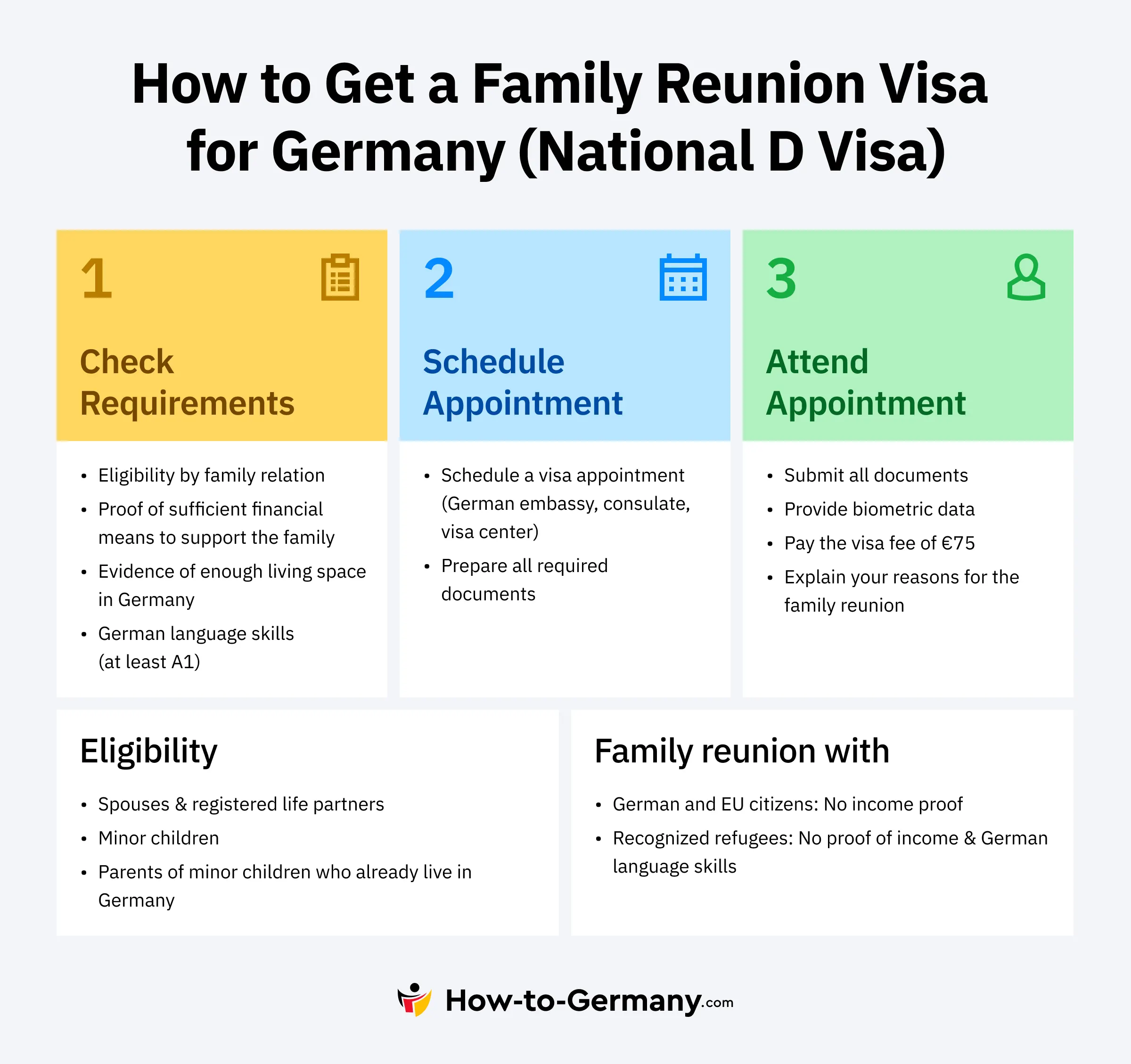
The visa application process involves the following steps and follows the general Germany visa application process requirements:
- Schedule an appointment in person at the German embassy (usually possible online).
- Gather the visa documents.
- At the appointment at the embassy, pay the visa fee if no exemption applies, submit the necessary documents and biometric data (fingerprints), and conduct a visa interview about your background.
In some countries, German embassy appointments for family reunion visas can be difficult to get and waiting times may stretch for several months. Start checking the responsible embassy’s appointment system early, prepare legalized and translated documents before the appointment, and follow the embassy’s country-specific checklist exactly. If the sponsor in Germany is entering as a skilled worker, ask whether the fast-track procedure for skilled workers can include the family members at the same time.
Family Reunion of Spouses
A family reunion visa for spouses (or fiancées in the case of applications for a visa to marry) will only be issued if the German authorities do not doubt that the couple plans to live together in Germany. You may be invited by the German embassy for an additional interview, in which a questionnaire will be used to discuss your relationship with your partner. Your partner, already living in Germany, will undergo a similar interview at the immigration office in their residence.
Required Documents
You submit the original documents for your visa application to the German embassy and two photocopies. If the papers are not written in English or German, you will need a translation by a sworn translator, who the embassy approves.
| Document | Requirement | Applies To | Example / Details | Notes |
|---|---|---|---|---|
| Application Form | Completed and signed. | All applicants | National visa (D visa) application form. | Usually completed online before the appointment. |
| Biometric Photos | 2 recent photos. | All applicants | Photos meeting German biometric standards. | Incorrect format may lead to rejection. |
| Custody Documents | Proof of parental rights. | Children cases | Sole custody certificate, court order, or notarized consent from the non-moving parent. | If parents share custody, a legalized and translated declaration of consent is usually required instead of proof of sole custody. |
| German Language Certificate | A1 level, if required. | Spouses in non-exempt cases | Goethe, telc, or equivalent certificate. | Exemptions apply for EU free movement cases, Blue Card holders, skilled workers, refugees, and other listed cases. |
| Health Insurance | Valid coverage. | All applicants | Travel insurance for initial entry period in line with Germany visa insurance requirements. | Switch to German insurance after arrival. Parents and parents-in-law may need comprehensive private coverage. |
| Invitation Letter | From family member in Germany. | All applicants | Written confirmation of intention to live together. | May be requested by the embassy. |
| Passport | Valid and not older than 10 years. | All applicants | Valid for at least 12 months beyond application date. | Must include copies of data pages. |
| Proof of Income | Sufficient livelihood, if required. | Usually third-country sponsors | Salary slips or employment contract. | Not usually required for German/EU citizens or privileged refugee cases. |
| Proof of Living Space | Adequate housing, if required. | Usually third-country sponsors | Rental contract showing apartment size. | Requirement may be waived for qualified skilled workers, including Blue Card holders, in core family cases. |
| Proof of Relationship | Official certificate. | Spouses & children | Marriage or birth certificate (translated & legalized). | Certification requirements vary by country. |
| Sponsor ID & Residence Proof | Valid ID and permit. | All applicants | Passport or ID card & residence permit copy. | Depends on sponsor’s status in Germany. |
Before you get the visa documents, you should contact the German embassy in your home country to ask about the required documents for a family reunion visa and any necessary notarizations. The requirements may vary depending on the country and individual circumstances. Most embassies provide checklists and lists of the translators they accept. You can also find information on the embassy’s website.
For a German family reunification visa, you will typically need the following documents:
- Application form for a German national visa
- Valid passport (not older than 10 years and valid for at least another 12 months)
- Copies of the data pages of your passport
- 2 biometric passport photos (according to the requirements for visa photos)
- Travel health insurance for Germany and the Schengen area
- Invitation letter from a family member living in Germany
- Proof of financial means: As a rule, this is financial proof from the family member already living in Germany. If you have sufficient means to support yourself in Germany, you should enclose the relevant documents with your visa application.
- Proof of sufficient living space for the relative already living in Germany, if required
- If applicable: Proof of German language skills — at least at A1 level
- Subsequent immigration to German or EU citizens: copies of their ID card or passport
- Subsequent immigration to third-country nationals: copies of their passport and residence permit
Spouses/registered partners
- Marriage certificate or partnership registration translated into German, with notarizations from the authorities of the issuing country and the German Embassy
Children
- Birth certificate
- If only one parent is relocating with the child: proof of sole custody, a court order, or a notarized declaration of consent from the non-moving parent, depending on the custody situation
Parents and parents-in-law of skilled workers
- Proof of family relationship
- Proof that the sponsor’s qualifying skilled worker residence permit was first issued on or after 1 March 2024
- For parents-in-law: proof that the spouse lives permanently in Germany
- Proof of secure livelihood, including realistic health insurance coverage for the parent or parent-in-law
Other family members
- Proof of family relationship (possibly with certified documents)
- Hardship case justification, unless a special legal route applies
Travel health insurance is sufficient for many visa applications. However, when you apply for your residence permit, you will need permanent German health insurance with a public or private company. Under certain conditions, you can be co-insured by your partner’s public health insurance. Parents and parents-in-law should check this especially carefully, because they are usually not eligible for free family co-insurance through an adult child.
Processing time and visa fee
The processing time for a German national visa and, consequently, for a family reunion visa varies depending on the country and personal circumstances of the visa applicant, between a few weeks and several months. On average, it takes 3 months to issue a visa, but in countries with appointment bottlenecks the total timeline can be much longer.
The standard fee for issuing a visa for family reunification is €75 for adults and €37.50 for minors.
Under § 52 AufenthV, certain family members are exempt from national visa fees. This includes spouses, registered partners, and minor unmarried children of German citizens, as well as parents of minor German children. Family members of EU/EEA citizens exercising free movement may also be exempt from visa fees under EU free movement rules. Always check the fee rule on the responsible German mission’s checklist before paying.
Conclusion
The German Family Reunion Visa provides a structured legal pathway for third-country nationals to reunite with their close family members in Germany. While spouses, registered partners, and minor children typically have the right to join their relatives, the process is subject to strict requirements. These can include proof of secure residence status, sufficient financial means, adequate living space, and, in some cases, basic German language skills.
Special provisions apply to family members of German citizens, EU/EEA nationals, qualified skilled workers, EU Blue Card holders, and recognized refugees, simplifying their reunification process. Since the 2024 Skilled Immigration Act reforms, some skilled workers can also bring parents and parents-in-law under § 36(3) AufenthG, but this route is currently limited until 31 December 2028. However, the visa application can be complex and time-consuming, often requiring several months for approval. Understanding the eligibility criteria, fee exemptions, custody documents, health insurance requirements, and correct embassy checklist is crucial for a successful application, especially if you later plan to transition to options such as a German freelance visa, German Opportunity Card, or the German job seeker visa.
Frequently Asked Questions
No. Spouses of EU/EEA or Swiss citizens who are exercising their right to free movement in Germany do not need to prove A1 German language skills for family reunification. These cases follow EU free movement rules, not the standard German spousal reunification language requirement.
There is no single flat-rate net income number. German authorities usually calculate secured livelihood dynamically using the household’s 2026 Bürgergeld standard needs, warm rent, health insurance, and other required costs. In 2026, the basic standard need is €563 for a single adult and €506 per adult partner, so a couple starts at €1,012 before rent, heating, health insurance, and other costs are added.
Yes, in some cases. Since 1 March 2024, skilled workers whose qualifying residence permit was first issued on or after that date may be able to bring their parents to Germany. If the skilled worker’s spouse lives permanently in Germany, the rule may also apply to the spouse’s parents. This is separate from the older hardship-only route for other family members.