
Language Course Visa for Germany
 Reviewed by
Erkan Boga
Erkan Boga is the founder and CEO of qmedia GmbH, the publishing house behind How-to-Germany.com. He established the platform with the clear vision of creating...
Reviewed by
Erkan Boga
Erkan Boga is the founder and CEO of qmedia GmbH, the publishing house behind How-to-Germany.com. He established the platform with the clear vision of creating...
 Edited by
Sadie Voss
Content Lead & Editor
Sadie Voss is the Lead Editor for How-to-Germany.com. As an expat who carved her own way into Berlin from the United States, Sadie is deeply...
Edited by
Sadie Voss
Content Lead & Editor
Sadie Voss is the Lead Editor for How-to-Germany.com. As an expat who carved her own way into Berlin from the United States, Sadie is deeply...
- If you will take an intensive German language course in Germany lasting more than 90 days, you usually need a German national visa or residence permit for language acquisition.
- A short-term Schengen C visa may be enough only for language courses lasting up to 90 days, but the 90/180-day Schengen rule still applies.
- A standalone language course residence permit is usually issued under § 16f AufenthG and can be granted for up to 12 months.
- A language course that directly prepares you for university study is usually treated differently and may fall under the study-preparatory route under § 16b AufenthG.
- To be granted a visa, you must attend an intensive German language course with daily lessons and usually at least 18 hours of classes per week. Weekend or evening-only courses are normally not enough.
- In 2025/2026, study-preparatory language courses generally use the student blocked account amount of €992 per month, or €11,904 per year.
- Standalone language course visas under § 16f usually require a higher amount: €1,091 per month, or €13,092 per year.
- Language-course residence permits can allow employment of up to 20 hours per week. Self-employment is not permitted.
Who requires a German language course visa?
A German language course visa is required by international participants in an intensive German language course who are subject to visa requirements or need a residence permit in Germany under the Germany Schengen visa requirements. In addition, there are different visa and residence permit routes depending on the duration and purpose of the language stay in Germany. The course you book must meet specific requirements.
Who requires a visa?
Whether you are required to apply for a language course visa and a residence permit depends on which country you come from:
- Countries without visa and residence permit requirements: Citizens of all EU member states, Iceland, Norway, Liechtenstein, and Switzerland do not need a visa or a residence permit to stay in Germany. Like all other residents, they must register with the relevant residents’ registration office if they move to Germany.
- Countries without an entry visa requirement: Citizens of countries such as the USA, United Kingdom, Australia, Canada, Israel, Japan, South Korea, and New Zealand can usually enter Germany without a visa for up to 90 days. For a longer stay, they must apply for the correct residence permit at the local immigration office within this period.
- All other countries: Citizens of all other countries generally require an entry visa before coming to Germany. If you stay in Germany for more than 90 days, you will also need the appropriate residence permit.
German language course visa: C-visa or D-visa?
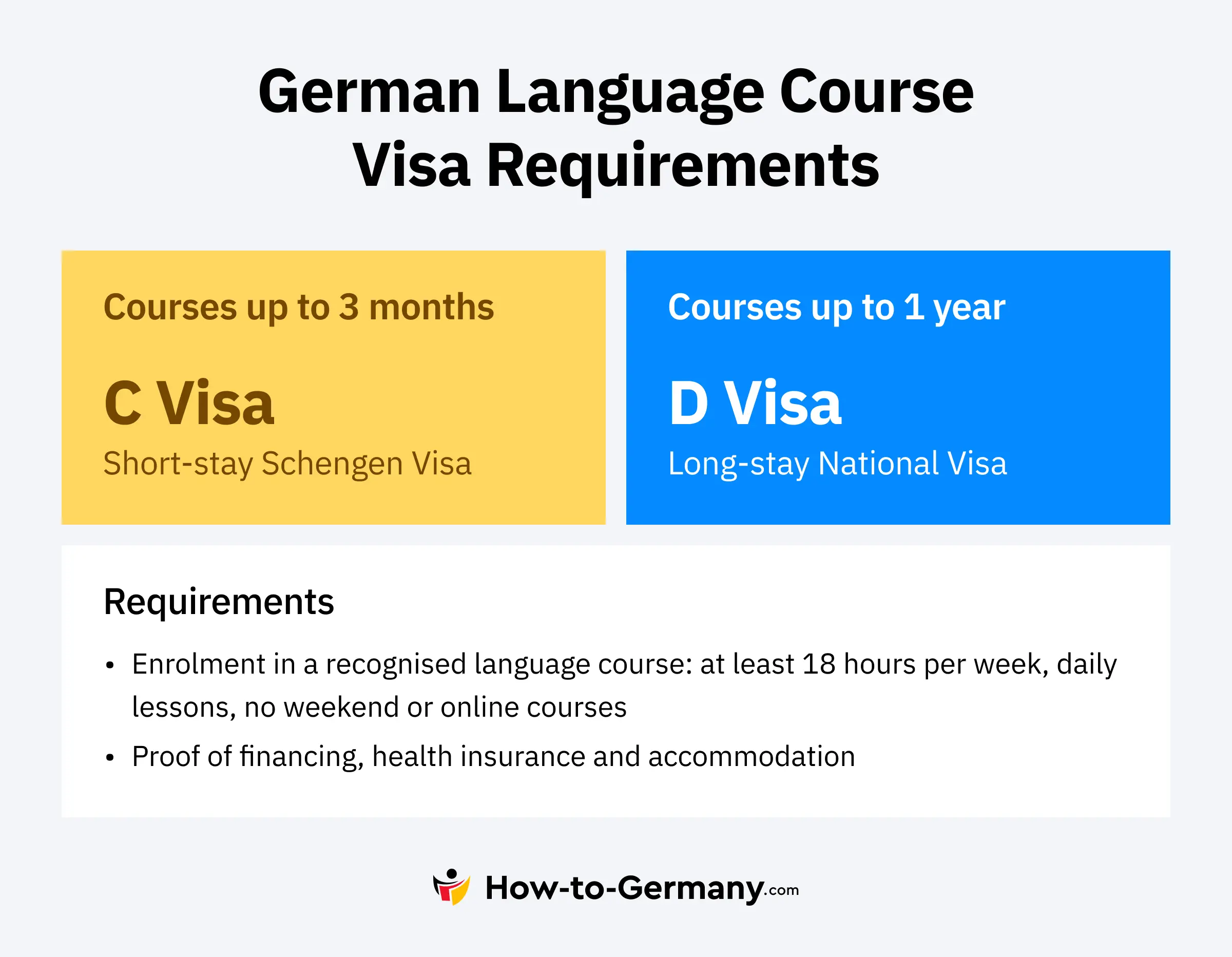
A C-visa for Germany is issued for a stay of up to 90 days. It is suitable for tourist trips and visiting family and friends, but also for intensive German language courses that do not exceed the validity of this visa. The German Embassy will ask you about the purpose of your visit, even with a short-term visa, because different documents are required for a language course in Germany than for a tourist stay. With a C-visa, you do not need a residence permit to stay in Germany. Remember, short-stay visas are subject to the strict Schengen limit. Use our 90/180 day German rule calculator to check your allowed days before applying.
A D-visa or German national visa is one of the German long stay type visas and entitles you to a longer-term stay in Germany. It is issued for various reasons, such as a German study visa, student applicant visa, German work visa, or a visa for vocational training. If your language course in Germany lasts longer than 90 days, you will need this visa. You will need a residence permit for your language study trip to Germany if your stay continues beyond the national visa period.
You can only apply for a language course visa for Germany if you attend an intensive language course with daily lessons and usually at least 18 hours of classes weekly. You will not be able to get a visa for courses that do not meet this requirement.
A standalone German language course residence permit under § 16f is usually issued for up to 12 months. It is not a permanent immigration route by itself, so your next step must be planned early if you want to stay in Germany after the course.
Language course visas differ by purpose
The most important 2026 update is that not every German language course visa is treated the same. A language course that prepares you for university study is different from an independent language course taken only to learn German.
| Route | Legal basis | Typical blocked account amount | Best for |
|---|---|---|---|
| Independent language course | § 16f AufenthG | €1,091/month, or €13,092/year | People coming to Germany mainly to learn German, without a direct university admission or study-preparation route. |
| Study-preparatory language course | Usually § 16b AufenthG | €992/month, or €11,904/year | Applicants whose language course is part of preparation for university study in Germany. |
A language course that prepares you for university study may fall under the study-preparatory rules of § 16b. A standalone language course taken only for language acquisition is usually handled under § 16f and often requires higher financial proof.
Language course students can work up to 20 hours per week
International language course participants in Germany can be entitled to take on employment for a maximum of 20 hours per week. Self-employment is not permitted.
This right is normally written directly into the residence permit or visa conditions. It is therefore outdated to say that language students always need to apply for a separate work permit after arrival. However, you should still check the exact wording printed on your visa or residence permit before starting work, because the document itself controls what you are allowed to do.
Current rules allow up to 20 hours of employment per week for language-course residence permits, but self-employment is not allowed. Before starting a job, check the wording on your residence permit or ask the immigration office if anything is unclear.
Changing from a language course visa is now more flexible
Older guidance often stated that a German language course visa could never be converted into another residence title and that the holder always had to leave Germany first. This is too absolute under the current immigration framework.
A standalone language course visa is still issued for a specific purpose: attending the language course. It is not the same as a student visa, vocational training visa, job seeker visa, or work visa. However, a change of purpose inside Germany may be possible if you meet the requirements for another residence title, such as:
- Skilled employment under the relevant skilled worker rules, if you meet the qualification, job offer, salary, and recognition requirements
- Study or study preparation under § 16b AufenthG
- Vocational training under § 16a AufenthG
This is not automatic. The immigration office must check whether you meet the requirements for the new residence purpose. If you want to study, train, or work in Germany after the language course, start the process early and get advice before your current permit expires.
You should not rely on the language course visa as a general bridge to any future stay. A change of purpose may be possible, but only if you meet the legal requirements for the new visa or residence permit.
Language schools issue attendance proof, not automatic official certificates
Completing an intensive German language course in Germany does not automatically give you an official standardized German certificate such as TestDaF, telc, DSH, or Goethe-Zertifikat. Most language schools issue a Teilnahmebescheinigung, meaning an attendance certificate or course participation confirmation. This document can show the course level, attendance period, and weekly hours, but it is not the same as a recognized external language exam.
If you need an official certificate for university admission, a job application, professional recognition, or a future visa route, you usually need to register for a separate standardized examination. This exam is normally booked separately, paid separately, and taken at an authorized exam center.
| Certificate or proof | Who issues it | What it proves | Important note |
|---|---|---|---|
| DSH | German university or Studienkolleg exam body | German language ability for university admission | Usually linked to university admission procedures, not issued automatically by private language schools. |
| Goethe-Zertifikat | Goethe-Institut or authorized exam partner | Standardized German level from A1 to C2 | Must be registered and paid for as a separate exam. |
| Teilnahmebescheinigung | Your language school | Course participation, attendance, course dates, and level | Useful for visa or residence documentation, but usually not enough as an official standardized exam certificate. |
| telc | Authorized telc exam center | Standardized German language level, depending on exam type | Must be booked separately unless your school is also an exam center and includes it clearly in the offer. |
| TestDaF | Licensed TestDaF test center | Academic German ability for university study | Recognized by German universities and taken separately from normal course attendance. |
The German Language Diploma, Level II, known as DSD II, is generally connected to the German school system abroad and PASCH-style school contexts. It should not be presented as a certificate that adult students automatically receive after taking a private language course in Germany.
Language course visa timeline from school choice to arrival
A language course visa works best when you plan the administrative steps in the right order. The biggest practical mistake is paying for a course, flight, or accommodation before checking embassy appointment availability and blocked account timing.
| Stage | What to do | Practical warning |
|---|---|---|
| 1. Choose the visa route | Decide whether your course is standalone language learning under § 16f or study preparation under § 16b. | The route affects financial proof, future residence options, and how the embassy reads your motivation letter. |
| 2. Choose the language school | Book an intensive course with daily lessons and usually at least 18 hours per week. | Weekend, evening, casual, or low-hour courses are usually not enough for a language course visa. |
| 3. Check embassy appointment availability | Look at the German embassy or consulate booking system before paying major non-refundable costs. | Appointment backlogs can delay the whole plan by weeks or months. |
| 4. Prepare financial proof | Open a blocked account or prepare sponsorship, declaration of commitment, scholarship, or parental funding proof. | Use €992/month for many study-preparatory cases and €1,091/month for many standalone language-course cases. |
| 5. Prepare the visa application | Collect passport, photos, course registration, motivation letter, health insurance, accommodation proof, and financial proof. | Incomplete applications can be refused or delayed. |
| 6. Attend the embassy appointment | Submit documents and answer questions about why you want to learn German in Germany. | Your motivation letter and future plan should match the visa route. |
| 7. Enter Germany | Travel after visa approval and keep copies of your documents with you. | You may need the same documents again for the residence permit. |
| 8. Register your address | Complete Anmeldung after moving into your German accommodation. | Without address registration, many banking, insurance, and residence permit steps become harder. |
| 9. Activate blocked account payouts | Open or connect a German current account so monthly blocked account payouts can begin. | Do this early so you can access your monthly living funds. |
| 10. Apply for the residence permit | Book or attend the Ausländerbehörde appointment before your entry visa expires. | Local immigration offices often have long waiting times, so start immediately after arrival. |
Do not assume everything becomes easier after arrival. Anmeldung appointments, bank account setup, blocked account activation, and Ausländerbehörde appointments can all take time. Keep digital and printed copies of every visa document and start residence permit steps as soon as possible.
Health insurance and proof of financial support
Important requirements for granting a German language course visa are health insurance for your stay under German visa insurance requirements and proof of financial support.
4 options for proof of financial support
As proof of financial support, you can choose between the following options:
- Blocked account with the deposit required by the German authorities
- German declaration of commitment by a sponsor living in Germany to cover the costs, which they confirm in writing to the responsible German immigration authority
- Proof of a scholarship for language acquisition that covers your living expenses in Germany
- Written declaration by your parents that they will finance your stay in Germany, including their bank statements and salary statements from the last 6 months
How a blocked bank account works
You can open a blocked bank account at various German banks or a specialized online provider. Suppose you must apply for a German language course visa in your home country. In that case, we recommend online providers such as Coracle, Fintiba, Studely, or Expatrio, which the German authorities recognize. The advantage of these providers is that you can open an account online and receive a confirmation within a few days.
The required deposit depends on the legal route. For 2025/2026, the standard student amount is generally €992 per month, or €11,904 per year. For an independent language course under § 16f, German missions often require the higher amount of €1,091 per month, or €13,092 per year.
| Language course situation | Typical amount | Why it matters |
|---|---|---|
| Independent language course under § 16f | €1,091/month, or €13,092/year | Standalone language courses usually require the BAföG-based amount plus 10%. |
| Study-preparatory language course under § 16b | €992/month, or €11,904/year | This is the standard student blocked account amount for study-related routes. |
You should confirm the exact blocked account amount with the German embassy, consulate, or immigration office before paying the deposit. The amount can depend on whether your course is treated as study preparation under § 16b or as an independent language course under § 16f.
Language visa application — interview and documents
To apply for your visa, you need to book an appointment with the German Embassy in your home country via the Embassy’s website. In a visa interview with an Embassy official, you explain your reasons for wanting to take a language course in Germany and answer a few questions. All visa documents must be ready for this appointment — incomplete applications can be refused or delayed.
Appointment waiting times can be very long at many German embassies and consulates. Start checking appointment availability before you pay for a course or accommodation. If appointments are released in batches, monitor the booking page regularly and prepare your documents before a slot opens.
Required documents for a language course visa
The following documents are usually required for the visa application:
| Document | Requirement | Applies To | Example / Details | Notes |
|---|---|---|---|---|
| Application Forms | 2 completed and signed forms. | All applicants | National visa application forms for a D visa. | Usually submitted as originals. |
| Biometric Photos | 2 recent photos. | All applicants | Photos meeting German biometric standards. | No copies required unless the embassy asks for them. |
| Course Registration | Confirmed enrollment. | All applicants | Official confirmation from the language school. | The course usually must be intensive, daily, and at least 18 hours/week. |
| Employer Leave Letter | If applicable. | Employed applicants | Official letter confirming leave of absence. | Must be signed and stamped. |
| Health Insurance | Valid for the intended stay. | All applicants | Insurance accepted for the visa and later residence permit stage. | Short-stay travel insurance may not be enough for long-term residence. |
| Letter of Motivation | Written explanation. | All applicants | Reasons for attending the language course. | Should explain why Germany, why this course, and what you plan to do afterward. |
| Passport | Valid passport with copies. | All applicants | Issued within the last 10 years and valid beyond the planned stay. | Include copies of data pages, usually 2 copies. |
| Previous Schengen Visas | If available. | All applicants | Copies of past visas. | Supports travel history. |
| Proof of Accommodation | Address for the intended stay. | All applicants | Rental contract, hotel booking, student housing confirmation, or host invitation. | Must cover the required period or be plausible for the application. |
| Proof of Financial Means | Sufficient funds. | All applicants | Blocked account, sponsor letter, declaration of commitment, scholarship, or equivalent. | Usually €992/month for study-preparatory cases or €1,091/month for standalone language courses. |
| Visa Fee Payment | €75 fee. | All applicants | Receipt of visa fee payment. | Usually paid at the appointment. |
Requirements may vary slightly depending on the German embassy or consulate.
Printable checklist for your embassy appointment
Use this checklist before your embassy interview. Print it or copy it into a document so you can mark each item before the appointment.
| Checklist item | Ready? | Notes |
|---|---|---|
| Application forms | ☐ | Completed, signed, and printed if required. |
| Biometric photos | ☐ | Recent photos meeting German biometric standards. |
| Blocked account or financial proof | ☐ | Use the correct amount for § 16b or § 16f. |
| Course registration | ☐ | Shows intensive course, dates, level, and weekly hours. |
| Health insurance | ☐ | Valid for Germany and suitable for the visa/residence stage. |
| Motivation letter | ☐ | Explains why Germany, why this course, and your plan afterward. |
| Passport and copies | ☐ | Check validity, data pages, and embassy copy requirements. |
| Proof of accommodation | ☐ | Rental, host letter, hotel booking, or student housing proof. |
| Proof of previous German learning | ☐ | Certificates, course confirmations, or placement test results if available. |
| Visa fee | ☐ | Check payment method accepted by the embassy. |
A convincing motivation letter reduces avoidable risk
The motivation letter is not just a formality. It helps the embassy understand whether your purpose of stay is plausible and whether the language course fits your personal, academic, or professional plans.
A strong motivation letter should explain:
- Course logic: Why this specific language school, level, course length, and city make sense.
- Financial realism: How you will fund the course, rent, health insurance, and daily costs.
- Future plan: Whether you plan to return home, prepare for study, apply for training, or later meet another residence route.
- Personal link: Why learning German matters for your career, studies, family situation, or long-term plan.
- Proof of seriousness: Any previous German learning, certificates, course attempts, or professional need for German.
Do not write only “I want to learn German because Germany is a nice country.” Explain why the course is necessary, why the timing makes sense, and what your realistic next step is after the course.
Documents for the application for a residence permit
If you apply for a residence permit at the immigration office of your place of residence, the following documents are usually required:
- Certificate of registration and participation in a language course, training agreement, or course contract issued by the language school
- One current biometric passport photo
- Passport with a valid visa or proof of lawful entry and stay
- Proof of accommodation in the form of a certificate of registration, rental contract, or landlord confirmation where required
- Proof of financing and health insurance
- Signed application for a residence permit
The issuance of a residence permit costs about €100. Further fees may be due for an extension or replacement document.
Local immigration offices can also have long waiting times. Apply for your residence permit as early as possible after arrival, especially if your entry visa is valid for only 90 days.
Ausländerbehörde delays can affect your stay after arrival
Even if your visa is approved, the local residence permit stage can be stressful. Many Ausländerbehörden have limited appointments, slow email response times, and long processing delays. This matters especially if your entry visa is valid for only 90 days and you need a residence permit for the rest of the course.
To reduce problems after arrival:
- Book early: Check the local immigration office appointment system as soon as you know your German address.
- Keep proof: Save screenshots or confirmations showing that you tried to book an appointment before your visa expired.
- Prepare copies: Keep digital and printed copies of your visa, passport, course registration, insurance, blocked account, and Anmeldung.
- Watch expiry dates: Do not assume that a booked appointment automatically solves everything unless the immigration office confirms your lawful stay.
- Use official contact forms: Some cities require online upload or contact forms instead of email.
If you cannot get an Ausländerbehörde appointment before your visa expires, keep written proof that you tried to apply in time. This can matter if you need to show that you contacted the authority before your current permission ended.
Visa rejection options changed in 2025
If your German visa application is rejected, read the refusal letter carefully. It should explain the reason for the rejection, such as insufficient financial proof, unclear purpose of stay, weak motivation, missing documents, or doubts about your intention to leave if required.
Since July 1, 2025, Germany has abolished the remonstration procedure for visa rejections worldwide. This means applicants can no longer rely on the old informal embassy appeal route. Instead, the practical options are usually:
- File a legal action with the competent administrative court, usually the Administrative Court in Berlin, if appropriate.
- File a new application with stronger documents and a clearer explanation, if the problem can be fixed.
- Seek legal advice if the rejection appears legally wrong or strategically serious.
The old informal remonstration process is no longer available for German visa refusals. If your visa is rejected, you usually need to decide between a better new application, legal advice, or formal court action.
Conclusion
Obtaining a German language course visa offers an excellent opportunity for individuals aiming to immerse themselves in the language and culture of Germany through an intensive language course. However, the rules in 2026 are more specific than many older guides suggest.
The most important distinction is whether your course is a standalone language course under § 16f or a study-preparatory language course under § 16b. This affects your financial proof, your long-term strategy, and your next visa options. The outdated figure of €11,208 should no longer be used. In 2025/2026, plan with €11,904 per year for study-preparatory cases and €13,092 per year for many standalone language-course cases.
It is also important to understand what your language school can and cannot certify. A school can usually issue a Teilnahmebescheinigung confirming course participation, but official certificates such as TestDaF, telc, DSH, or Goethe-Zertifikat require separate standardized exams. DSD II should not be listed as an adult private language-school certificate.
It is also no longer accurate to say that a language course visa can never lead to another residence title inside Germany. A change of purpose may be possible if you meet the requirements for study, vocational training, or skilled work, but it is not automatic and should be planned early.
The safest approach is to choose the right visa route before applying, book your embassy appointment early, prepare a convincing motivation letter, keep your financial proof current, and contact the local immigration office soon after arrival if you need a residence permit. Proper planning and adherence to current regulations will make your language learning stay in Germany much smoother.
Frequently Asked Questions
The local German embassies determine the processing time for the visa application. This can take between 6 and 16 weeks. On average, applicants have to wait around 3 months for their visa. So, you should apply for your visa for a language course in Germany as early as possible.
After completing an intensive German language course in Germany, the language school usually issues a Teilnahmebescheinigung, or attendance confirmation. This confirms your course participation, course dates, level, and weekly hours, but it is not the same as an official standardized German language certificate.
If you need an officially recognized certificate, such as TestDaF, telc, DSH, or Goethe-Zertifikat, you usually need to register for a separate exam, pay the exam fee, and take the test at an authorized examination center. Some language schools are also certified test centers, but the exam is still a separate standardized assessment and is not automatically issued after course completion.
The DSD II should not be listed as a certificate issued by private language schools in Germany. It is part of the German school system abroad and is generally used in secondary-school contexts, not adult private language courses in Germany.
In this case, you may only have to deposit the amount the provider pays you monthly into the blocked account for each month of your stay. However, before you transfer any money into the account, you should find out from the German Embassy in your home country how much you need to deposit.