
German Medical Treatment Visa
 Written by
Janine El-Saghir
Janine El Saghir is an editor at How-to-Germany.com, where she specializes in the practical aspects of daily life and integration for expatriates. With years of...
Written by
Janine El-Saghir
Janine El Saghir is an editor at How-to-Germany.com, where she specializes in the practical aspects of daily life and integration for expatriates. With years of...
 Reviewed by
Erkan Boga
Erkan Boga is the founder and CEO of qmedia GmbH, the publishing house behind How-to-Germany.com. He established the platform with the clear vision of creating...
Reviewed by
Erkan Boga
Erkan Boga is the founder and CEO of qmedia GmbH, the publishing house behind How-to-Germany.com. He established the platform with the clear vision of creating...
 Edited by
Sadie Voss
Content Lead & Editor
Sadie Voss is the Lead Editor for How-to-Germany.com. As an expat who carved her own way into Berlin from the United States, Sadie is deeply...
Edited by
Sadie Voss
Content Lead & Editor
Sadie Voss is the Lead Editor for How-to-Germany.com. As an expat who carved her own way into Berlin from the United States, Sadie is deeply...
- Most non-EU foreigners need a visa to enter Germany for medical treatment. They require a German medical visa, which is also valid for short travel in other Schengen countries within the applicable limits.
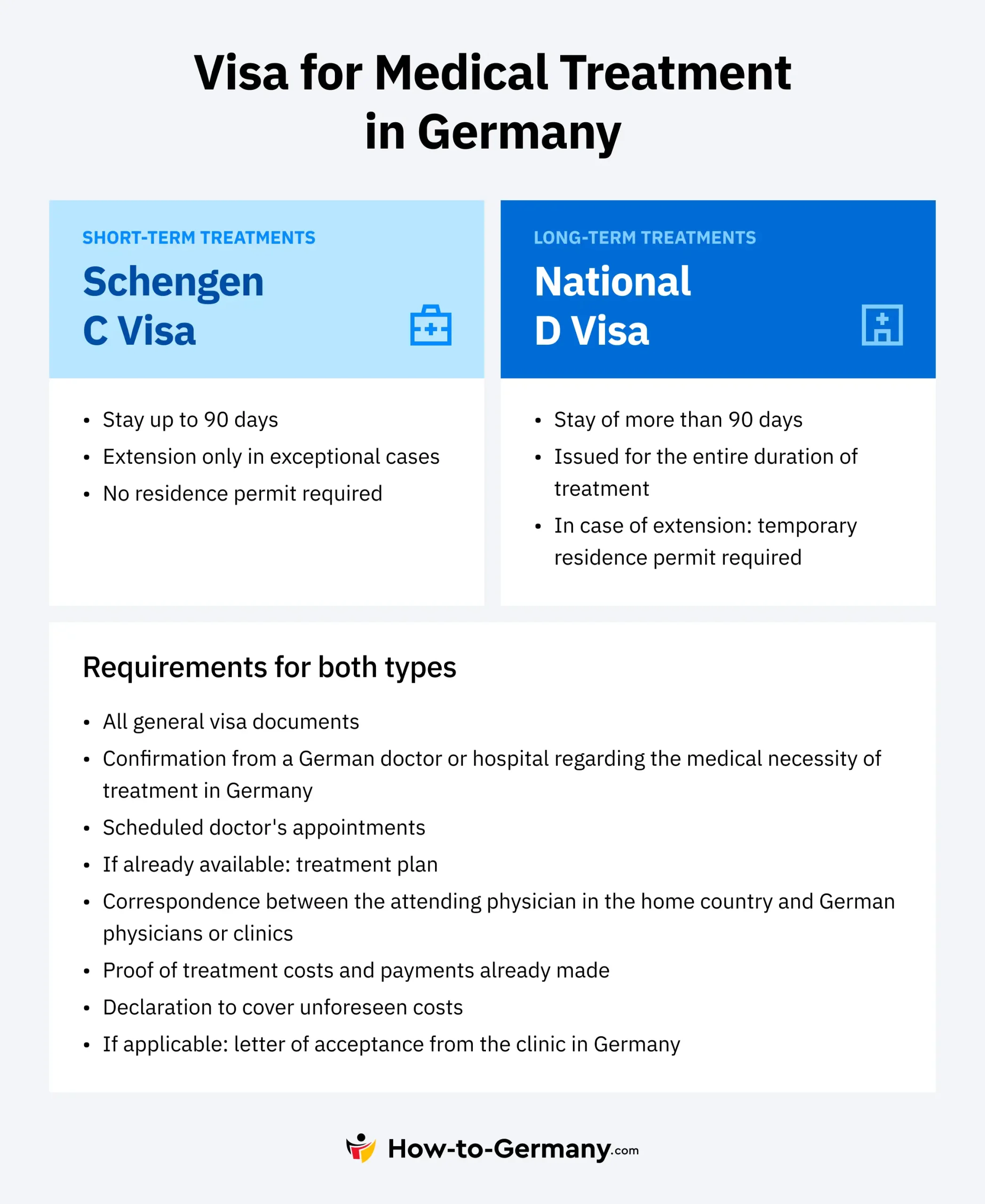
- Germany offers 2 types of medical visas, providing flexibility to suit different needs. The Schengen visa type C is for short-term stays of up to 90 days, while a German national visa type D is required for longer stays.
- Under certain conditions, C visas for medical treatment in Germany can be extended.
- The requirements for granting a German medical visa include a medical certificate, a confirmation from the treating physicians or clinics, proof of financing of the treatment and the entire stay, and Schengen travel health insurance.
- Under certain circumstances, it is also possible to issue a visa for medical treatment to accompanying individuals.
Medical treatment visa: Germany & Schengen area
Most foreign visitors who come to Germany for medical treatment require a visa for this purpose and, for stays of more than 90 days, also a German residence permit. Germany treats an estimated around 250,000 international and EU/Schengen patients in its hospitals each year. This figure includes EU and Swiss citizens as well as visa-exempt and visa-required third-country nationals, so it should not be interpreted as the number of medical visas issued by German missions abroad. Remember, short-stay visas are subject to the strict Schengen limit. Use our 90/180 day rule calculator to check your allowed days before applying.
Visa requirements in Germany
The Schengen Agreement also regulates German Schengen visa requirements. On this basis, the world’s largest visa-free travel area was created. Border controls in the entire Schengen area normally only occur at external borders, although temporary internal checks may be introduced. German visas are valid for the country that issued them and may also permit travel throughout the Schengen area within the conditions and permitted duration of the visa.
The following groups of people do not require a visa for Germany and the Schengen area:
- Citizens of the EU, Schengen states, and third-country nationals who hold a residence permit for one of these countries
- Citizens of about 60 countries who, under visa liberalization agreements, can enter the Schengen area and stay there for a maximum of 90 days without a visa
The Schengen states include all members of the European Union except Ireland and Cyprus, as well as the non-EU countries Norway, Iceland, Switzerland, and Liechtenstein. Bulgaria and Romania participate fully in the Schengen Area: air and sea border controls were lifted on March 31, 2024, followed by internal land-border controls on January 1, 2025.
German medical treatment visa – also for outpatient treatment and prevention
A Schengen medical visa for Germany can be issued for inpatient hospital stays, outpatient medical consultations, and preventive measures. The decisive factor for approving such a visa is that the treatment in Germany is medically necessary, and the medical facility in Germany must confirm this.
An application for a German medical visa is possible in the following cases:
- Inpatient treatment: hospital stays, operations, rehabilitation measures
- Outpatient consultations: specialist consultations, specialized diagnostics, second opinions, specific medical treatment that does not require hospitalization
- Preventive measures: medically recommended checkups, special medical checkups, and preventive cures provided a doctor has confirmed their medical necessity.
The German embassies do not issue medical visas for wellness cures or stays for general recreation, even if the stay is booked at a specialized facility. For these purposes, you need a Schengen visa for a tourist stay.
German medical treatment visa — in 2 variants
The type of visa you require for medical treatment in Germany depends on the expected duration of treatment. In general, 2 types of visa can be relevant:
Schengen visa type C
C visas are visitor visas for short-term stays. Our German short stay visa guide indicates that this visa type allows you to stay in Germany and the other Schengen countries for a maximum of 90 days within 180 days.
Suppose you can foresee before applying for the visa that your medical consultations or hospital treatment will not take up more time. In that case, you should apply for a C visa for medical treatment in Germany.
With this visa, you can travel within the entire Schengen area during the permitted stay. However, if you are planning medical treatment in several Schengen states, you should check with the embassies of these countries in advance whether additional authorization is required.
Schengen visa type C cannot normally be extended. However, an extension may be possible in exceptional cases, including when serious medical reasons prevent departure before the permitted stay expires. The responsible immigration authority decides whether the existing visa can be extended or whether another residence status is required. A short-stay C visa is not automatically converted into a national visa.
German national visa type D
You will need a German national medical visa type D for treatment that is expected to last longer than 90 days. It is issued under German national law rather than the Schengen Visa Code. After entering Germany, you must generally apply for a temporary residence permit, which the German immigration authorities issue. It expires when your treatment in Germany is completed.
A German national visa type D generally also permits short stays in other Schengen countries for up to 90 days within any 180-day period, but it does not create a right to receive long-term medical treatment, work, study, or reside in another Schengen state.
Visitors from 14 countries, including the USA, Great Britain, Canada, Australia, New Zealand, and Israel, can also enter Germany without a visa for extended stays. However, for stays of more than 90 days, they also require a German residence permit.
Application Process for a German medical treatment visa
You apply for a German medical treatment visa at the German embassy or consulate in your country of residence. German embassies cooperate with external visa centers in some countries to receive and examine visa applications. Information can be found on the website of the responsible German embassy.
A German medical visa can also be issued for family members or other accompanying individuals. The prerequisite for this is a medical certificate from Germany stating that the person concerned must be accompanied for medical or care reasons, for example, in the case of minors, older people, or seriously ill patients. In addition, the family or supervisory relationship must be proven by suitable documents. Like all other visa applicants, accompanying people must also have proof of financing for their stay in Germany and travel health insurance for Germany and the Schengen area. If there is no explicit medical or supervisory need for the accompaniment, accompanying people can alternatively apply for a Schengen tourist visa (C visa).
You will need a personal appointment for the visa application, which you can usually schedule online on the embassy’s website. At this appointment, you will submit your visa documents and complete a visa interview in which you explain your reasons for applying for the visa.
Documents for a German medical visa
The following documents are generally required for a German medical visa application; however, the embassies are entitled to request further documents. You must submit the required documents in the original and with 2 photocopies.
| Document | Requirement | Example / Details | Notes |
|---|---|---|---|
| Accommodation Proof | Confirmed stay for entire duration. | Hospital confirmation, hotel booking, invitation, or rental contract. | Must cover full stay. |
| Application Form | Printed & signed form. | Schengen or national visa application form, depending on the intended stay. | Submit with copies. |
| Biometric Photos | Recent biometric photos. | Must meet photo visa German requirements. | For the visa application abroad, follow the responsible mission’s photo instructions. For later residence-permit applications or extensions in Germany, physical paper photos are generally no longer accepted from May 1, 2025; the photo must be captured at an official terminal or transmitted digitally by a certified provider. |
| Financial Proof | Proof of funds & coverage of treatment. | Bank statements, salary, pension, or sponsor declaration. | Must cover stay & medical costs. |
| Flight Reservation | Travel itinerary required. | Outbound & return booking. | Avoid non-refundable tickets. |
| Leave Letter | If applicable. | Employer or educational institution approval. | For employees, pupils, students. |
| Marital Status Proof | If applicable. | Marriage certificate, children’s birth certificates. | Required in certain cases. |
| Medical Necessity Proof | Confirmation of treatment need. | Medical certificate or hospital documentation. | Core requirement. |
| Minor Consent Documents | If applicant is under 18. | Birth certificate & parental consent declaration. | Required for minors. |
| Passport | Valid passport. | Issued within 10 years, valid 3+ months after stay, 2 blank pages. | Required for visa sticker. |
| Travel Health Insurance | Minimum €30,000 coverage. | Valid across the Schengen area and compliant with visa insurance German requirements. | Mandatory. |
| Visa Fee Payment | Proof of payment. | Receipt. | Mandatory. |
Documents and agreements for medical treatment
To obtain a German medical visa, it is crucial that you can prove beyond doubt that you require medical treatment in Germany. The following documents are relevant for this:
- A medical certificate from a German doctor or clinic stating that the treatment is medically necessary and can be carried out in Germany.
- Appointments with this doctor or hospital, if possible, already including a treatment plan
- Correspondence between the treating physician in the home country and the admitting physician in Germany
- Proof of advance payments and other financial agreements with the German physician or hospital
- Declaration of commitment by the visa applicant to also cover unforeseen treatment costs
- If applicable, proof of accommodation at the treating clinic
Processing times for medical visa and visa fees
You can apply for a German medical visa 6 months before your planned entry to Germany.
The processing time for a C visa is typically 14 days, but you should plan with a time buffer to cover any delays.
However, it can take several months before a national visa is issued since the issuance of national visas may also be coordinated with the immigration office in Germany.
The visa fees for a C visa are €90 for adults and minors aged 12 and over. A reduced fee of €45 applies to children from the age of 6 and below the age of 12, while children under 6 receive the visa free of charge.
A national visa costs €75 for adults and €37.50 for minors.
Conclusion
Obtaining a German medical treatment visa requires thorough preparation and adherence to specific application requirements. While the process may seem complex, the possibility of receiving high-quality medical care in Germany makes it worthwhile. Applicants must provide all necessary documents, including proof of medical necessity and financial coverage.
Understanding the distinction between a short-term Schengen C visa and a German national visa type D for longer treatments is crucial. A C visa is governed by the Schengen rules and limited to 90 days within a 180-day period, while a German national visa type D is issued under German law for longer stays and may require a residence permit after entry.
Applicants who later extend their stay or apply for a residence permit in Germany should also account for the digital biometric-photo requirements introduced on May 1, 2025. Foreign patients can confidently access Germany’s healthcare system by carefully following the process and checking the current instructions of the responsible German mission and immigration authority.
Frequently Asked Questions
Great Britain is not a member of the Schengen area or the EU; however, British citizens can enter other Schengen countries visa-free. If your medical treatment in Germany will not take longer than 3 months, you do not need a visa or a German residence permit. If the treatment takes longer, you will need to apply for a temporary residence permit at the German immigration office.
In principle, yes. The medical necessity of the treatment is not the only criterion for granting a visa, nor is it the main one. The German embassy will also thoroughly check applications for a medical treatment visa. In addition to secured financing of the medical treatment and the stay in Germany, an essential criterion for the decision is, for example, a verifiable willingness for the applicant to return. Financial aspects also play a central role here.
If your German medical treatment visa application has been rejected, the German Embassy or Consulate will let you know the reasons in writing. You can appeal the negative visa decision within 4 weeks if you can provide additional evidence that refutes the reasons for the rejection. Alternatively, you can request a court decision on your visa application – this option is available immediately after receiving the rejection letter or after an unsuccessful appeal. The embassy will also inform you of these legal steps in its rejection letter.