
German Visa Passport Requirements
 Written by
Janine El-Saghir
Janine El Saghir is an editor at How-to-Germany.com, where she specializes in the practical aspects of daily life and integration for expatriates. With years of...
Written by
Janine El-Saghir
Janine El Saghir is an editor at How-to-Germany.com, where she specializes in the practical aspects of daily life and integration for expatriates. With years of...
 Reviewed by
Erkan Boga
Erkan Boga is the founder and CEO of qmedia GmbH, the publishing house behind How-to-Germany.com. He established the platform with the clear vision of creating...
Reviewed by
Erkan Boga
Erkan Boga is the founder and CEO of qmedia GmbH, the publishing house behind How-to-Germany.com. He established the platform with the clear vision of creating...
 Edited by
Sadie Voss
Content Lead & Editor
Sadie Voss is the Lead Editor for How-to-Germany.com. As an expat who carved her own way into Berlin from the United States, Sadie is deeply...
Edited by
Sadie Voss
Content Lead & Editor
Sadie Voss is the Lead Editor for How-to-Germany.com. As an expat who carved her own way into Berlin from the United States, Sadie is deeply...
- Third-country nationals must have a valid passport to enter Germany and the Schengen area. Citizens of EU and Schengen countries can generally enter Germany with a national ID card or equivalent identity document.
- A valid passport is a basic requirement for obtaining a visa for Germany and the Schengen area. It’s the first and most important document you require for your travel plans.
- Foreign passports must meet strict criteria for visas to be issued. Your visa application will be automatically rejected if your passport does not meet these requirements.
Passport and visa requirements for entry to Germany
Based on the Schengen Agreement, 29 European countries have joined to form the Schengen Area, as identified by information on the Schengen Area explained. Within this area is freedom of movement, from which third-country nationals also benefit — border controls are usually only carried out at the external borders and when entering a Schengen country for the first time. Nevertheless, travelers in the Schengen area must carry valid proof of identity regardless of their citizenship.
Schengen countries are almost all EU member states (except for Ireland and Cyprus) and the four non-EU countries: Iceland, Norway, Liechtenstein, and Switzerland.
To enter Germany, travelers from third countries generally require a passport and, in most cases, a visa.
Passport obligation
By the Schengen Agreement and EU freedom of movement rules, individuals with German citizenship and citizens of EU and Schengen countries are exempt from the passport requirement for Germany. Their national ID card or equivalent document is generally sufficient proof of identity, including for citizens of EU countries that are not part of the Schengen area, such as Ireland and Cyprus. This exemption is also rooted in Germany’s constitutional Basic Law, which guarantees the right of German citizens to enter and leave the country freely.
Citizens of all other countries must have a valid passport to enter Germany and the Schengen area. This also applies to third-country nationals with a valid residence permit for Germany or another Schengen country.
German children living abroad can enter Germany as German citizens, but they still need a valid travel document. Germany abolished the simplified Kinderreisepass on January 1, 2024. Children now generally need a standard biometric German passport, known as a Reisepass, for international travel.
Refugees without passports and stateless people can receive a travel document from the state where they have a residence permit based on the Geneva Refugee Convention or the 1954 Convention Relating to the Status of Stateless Persons. Germany and all other Schengen countries automatically recognize refugee or stateless person passports issued by a Schengen country. For documents from third countries, German embassies decide individually whether to accept these papers for issuing Schengen visas.
Visa requirement
Individuals with German passports and citizens of the EU and Schengen countries do not require visas to enter Germany.
Citizens of 62 countries can enter Germany or another Schengen country without a visa for stays of up to 90 days.
According to German Schengen visa requirements, other travelers require a visa to enter Germany and the Schengen area. The issuance of Schengen visas (C visas) for stays of up to 90 days is regulated uniformly throughout the Schengen area. In addition, there are national visas (D visas) for longer stays — for example, for work, study, or family reunification. The German Foreign Office defines the criteria for granting these visas in consultation with other national authorities.
The Schengen Entry/Exit System started on October 12, 2025 and became fully operational on April 10, 2026. For non-EU passport holders, short-stay border checks now use digital entry and exit records with biometric data, such as fingerprints and facial images, instead of routine manual passport stamping.
ETIAS is expected to become relevant for visa-free short stays once it launches, but the exact start date should be checked before travel. It will not replace a Schengen visa or a national visa, but visa-exempt travelers may need to complete ETIAS travel authorization before short visits to Germany.
You apply for a visa for Germany at a German mission abroad (embassy or consulate) in your country of residence. Since the June 2024 fee increase, a short-stay Schengen visa (Type C) generally costs €90 for adults and €45 for children aged 6 to 12. A German national visa (Type D) generally costs €75.
Federal Foreign Office passport information: auswaertiges-amt.de
EU Entry/Exit System: travel-europe.europa.eu/ees
EU ETIAS information: travel-europe.europa.eu/etias
Passport requirements for Germany
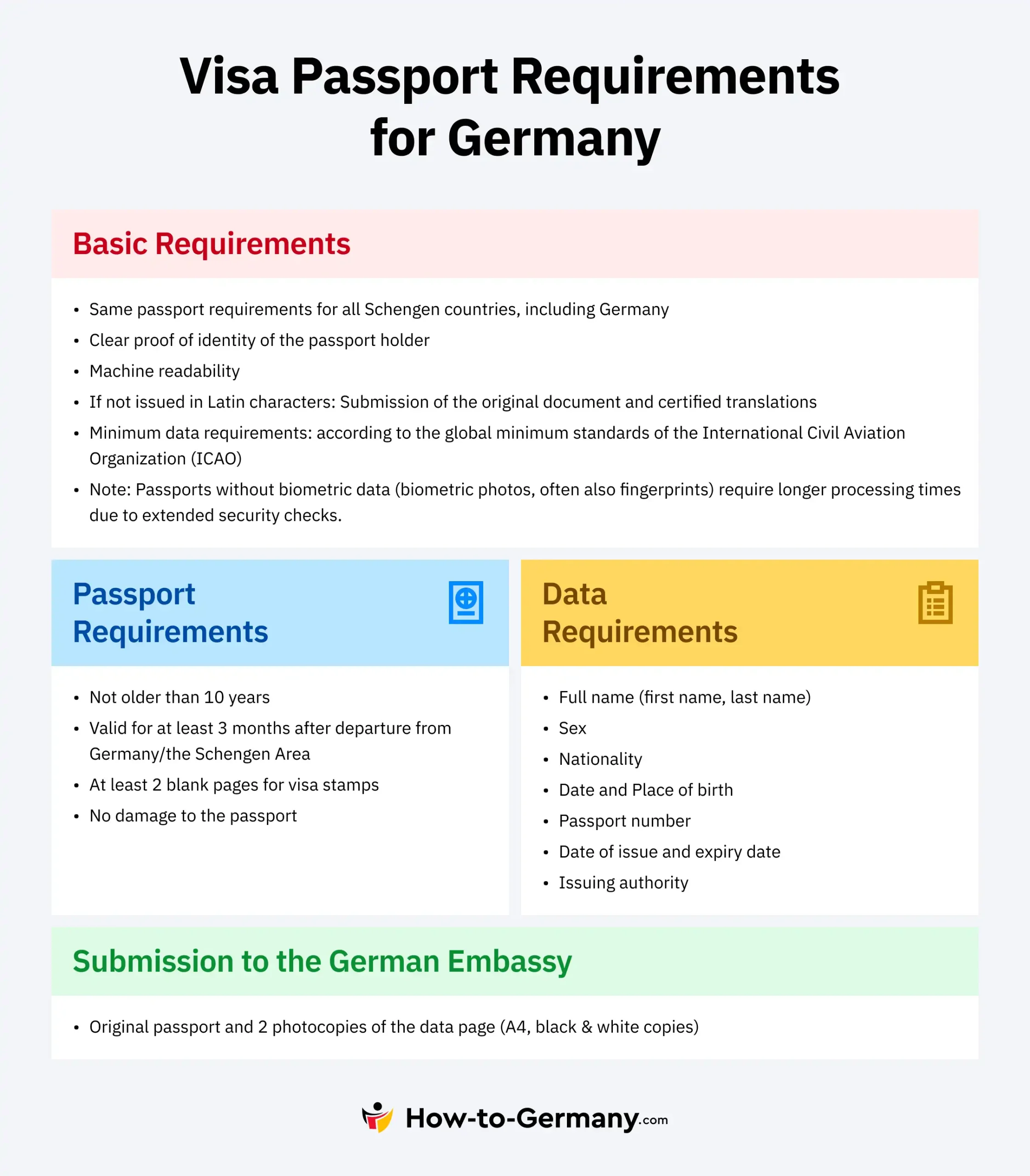
The Schengen Agreement defines the basic requirements for foreign passports to issue a Schengen visa. These requirements are identical in all 29 Schengen countries and apply also to national visas.
For a Schengen visa or a German national visa, passports must meet the following requirements:
Clear proof of identity
The submitted passport must clearly show the traveler’s identity. If a passport was not issued in Latin characters, translated and certified copies must be submitted to the German embassy along with the original document for the visa application.
Passports with illegible data are not eligible for a visa — in such a case, the visa application will be rejected directly by the German Embassy after the document check.
Recorded data
The data recorded in passports is not identical worldwide. It depends on national law. However, global minimum standards defined by the International Civil Aviation Organization (ICAO) apply to ensure a uniform machine-readable structure. The embassies of Schengen countries do not accept passports that do not meet these standards.
A passport accepted for a Schengen visa must contain the following data:
| Field | Requirement | Example / Details | Notes |
|---|---|---|---|
| Date of Birth | Must be clearly stated. | Day, month, and year of birth. | Must match application documents. |
| Full Name | Complete legal name required. | First name and last name. | Must match all submitted documents. |
| Issuing Authority | Authority must be indicated. | Government office or agency issuing the passport. | Usually printed on the passport data page. |
| Nationality | Must be specified. | Country of citizenship. | Should match visa application details. |
| Passport Number | Unique identifier required. | Alphanumeric passport number. | Used for tracking and verification. |
| Passport Validity Dates | Issue and expiry dates required. | Date of issue and expiration date. | Passport must be valid for visa eligibility. |
| Place of Birth | Must be stated. | City and country of birth. | Sometimes listed alongside date of birth. |
| Sex | Must be indicated. | Male, female, or other designation. | As shown in passport. |
Passports with biometric data (chips with digital photos, often also fingerprints) have become a worldwide norm. They are highly secure against forgery and make it easier to identify individuals unambiguously. However, a few countries still issue non-biometric passports to their citizens. Visa applicants with such a passport must expect longer processing times for their visa application due to an extended security check.
Validity
To receive a visa for Germany or another Schengen country, the passport presented must be valid for 3 months after departure from the Schengen area.
The Schengen state embassies do not accept extended passports. In this case, you must apply for a new passport in your country to obtain a German visa.
Please check your passport in time to ensure it meets these and all other passport requirements. If you need a new travel document, in addition to the processing time for your German visa, also allow for the time needed for passport application.
Passport age — no more than 10 years old
Some countries issue passports with a validity of more than 10 years. For a Schengen visa, the passport must have been issued within the previous 10 years on the date of entry into Germany or the Schengen area. A passport can pass the 10-year mark during your stay, provided it was issued within the previous 10 years when you entered and still remains valid for at least 3 months after your planned departure from the Schengen area.
At least 2 blank pages
There must be at least 2 blank pages left in your passport for affixing the visa. Some German embassies require that these pages be consecutive. If you require any clarification, please contact the German embassy before applying for a visa.
Some countries insert additional pages into their passports once the original pages are full. Such passports are generally not accepted for a Schengen visa.
No damage to the passport
To apply for a Schengen visa, your passport must not be damaged. The embassies reject torn, burnt, or damaged passports. This also applies if only individual pages of the passport are damaged.
Visa applications can be delayed or rejected if the passport is damaged, too old on the date of entry, missing blank pages, extended instead of newly issued, or not accepted by the responsible German mission. UK passport holders after Brexit should check both the 10-year issue-date rule and the 3-month validity-after-departure rule carefully.
Submitting your passport for the visa application
To apply for a Schengen visa, you must submit your original passport, 2 photocopies of the data page, and biometric photos that meet German visa photo requirement criteria. These can be black and white or color copies in A4 format.
You should also include any previous passport that is no longer valid or that no longer contains blank pages with your visa application, provided it contains previous visa stickers, stamps, or residence permits for other countries. The embassy can use these to track your visa history and verify the information you provided on the visa application form. For short stays, newer travel history is increasingly verified through the Schengen Entry/Exit System rather than only through manual passport stamps.
Since April 10, 2026, the Schengen Entry/Exit System has been fully operational. For short stays, biometric registration has replaced routine manual passport stamping, so future travel history is increasingly checked through digital entry and exit records rather than only old passport stamps.
If you have more than one older passport, tie them together with a rubber band or hand them in a plastic bag. German embassies do not accept stapled documents — this rule also applies to older passports.
Conclusion
A valid passport is the foundation for obtaining a German Schengen visa. Like all Schengen countries, Germany follows strict passport requirements to ensure security and compliance with international standards. Travelers from third countries must ensure their passport meets specific criteria, including validity, issue date, ideally biometric compatibility, and sufficient blank pages. Failure to meet these standards will result in an automatic visa rejection.
Refugees and stateless people can sometimes travel with special documents issued by Schengen countries, while non-biometric passport holders may face extended processing times. Since 2026, short-stay travel history is also increasingly checked through the Entry/Exit System, which records entries and exits digitally for non-EU travelers. The visa application process may also require additional supporting documents if individuals must meet German declaration of commitment requirements, and passport return options vary depending on the German embassy responsible.
To avoid delays or rejection, applicants should carefully review their passport details and consult the relevant German mission abroad.
Frequently Asked Questions
No, information about your marital status is not required to receive a Schengen visa. Some countries include this information in their passports and data on religion or ethnicity. However, this information is irrelevant to a visa application for Germany or another Schengen country.
Your marital status information and (if available) your marriage and children’s birth certificates should be attached to your visa application as separate documents.
Always required documents (each in the original and with 2 copies) for a Schengen visa are:
- Valid passport
- 2 biometric passport photos
- Information about your reasons for traveling to Germany and a Declaration of Accuracy of Information
- Proof of health insurance recognized by Germany and the Schengen countries for the entire duration of the trip
- Proof of sufficient financial funds (for example, through salary statements, bank statements, a declaration of commitment, or a blocked bank account for longer stays)
- Proof of accommodation
- For short-term stays of up to 90 days: Confirmed flight reservations (outward and return journey)
- If applicable: Proof of employment, leave letters from employer or educational institution, marriage certificate, birth certificates of children
- Proof of payment of visa fee
Additional documents are required for a German national visa. The website of the relevant German Embassy provides information about these.
Your passport will be returned to you after the application process is complete. You will be notified that you can pick up your passport at the embassy. Passports can be sent by post or courier service in many countries. Additional fees apply for these options. If this option is available to you, and you wish to take advantage of it, please indicate this at your visa appointment and pay the fee.
If your child has German citizenship and a German passport, they can travel to Germany without any requirements. However, different legal regulations may apply to dual citizenship holders in your country of residence. If your child only has citizenship in a third country, the passport and visa requirements for these travelers apply.