
How we earn our money
We finance our services on how-to-germany.com through affiliate programs.
When a user orders a financial product through our site and their application is approved, we may receive a commission from some providers. It’s important to note that this does not in any way influence our independent ratings and recommendations.
All the products we present on how-to-germany.com are selected for their quality, range of services, and excellent value for money.
What the Lufthansa card offers residents of Germany
 Written by
Janine El-Saghir
Janine El Saghir is an editor at How-to-Germany.com, where she specializes in the practical aspects of daily life and integration for expatriates. With years of...
Written by
Janine El-Saghir
Janine El Saghir is an editor at How-to-Germany.com, where she specializes in the practical aspects of daily life and integration for expatriates. With years of...
 Reviewed by
Erkan Boga
Erkan Boga is the founder and CEO of qmedia GmbH, the publishing house behind How-to-Germany.com. He established the platform with the clear vision of creating...
Reviewed by
Erkan Boga
Erkan Boga is the founder and CEO of qmedia GmbH, the publishing house behind How-to-Germany.com. He established the platform with the clear vision of creating...
 Edited by
Sadie Voss
Content Lead & Editor
Sadie Voss is the Lead Editor for How-to-Germany.com. As an expat who carved her own way into Berlin from the United States, Sadie is deeply...
Edited by
Sadie Voss
Content Lead & Editor
Sadie Voss is the Lead Editor for How-to-Germany.com. As an expat who carved her own way into Berlin from the United States, Sadie is deeply...
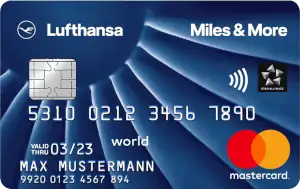
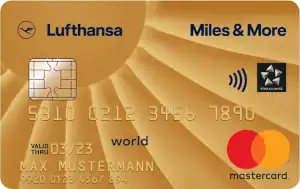
Advertising notice: provider links in this overview are affiliate links — we receive a commission from the provider for sign-ups made through them.
- Card options: Miles & More Blue Credit Card and Miles & More Gold Credit Card, both Mastercard products.
- Issuer: Deutsche Bank AG, Taunusanlage 12, Frankfurt am Main. Miles & More GmbH runs the loyalty programme; the bank runs the card.
- Monthly pricing: the cards are priced per month – €5.50 for Blue and €11.50 for Gold, which is €66 and €138 per year.
- Earning: one award mile for every €2 you spend, on either card, credited to your Miles & More account.
- Mileage validity: both cards suspend the standard 36-month expiry – your miles stay valid for as long as the card contract runs.
- Insurance: the Gold card includes trip cancellation and curtailment, a rental car excess policy and unlimited emergency medical cover abroad. The Blue card has no insurance package.
- Foreign currency: 1.95% outside the euro, 0% within it, on both cards.
- Before you apply: membership of the Miles & More programme is a precondition, and the revolving-credit versions are open only to applicants who are not self-employed or freelance.
- Best suited to: residents of Germany who fly Lufthansa Group airlines, and anyone saving miles slowly towards a large reward.
If you live in Germany and fly home once or twice a year, a Lufthansa Miles & More credit card is one of the few loyalty products worth a serious look: the programme covers Lufthansa, Austrian, SWISS, Brussels Airlines, Eurowings and around 40 partner airlines, and the two cards issued by Deutsche Bank do something the programme itself does not – they stop your miles from expiring. This review looks at both cards from the perspective of someone who moved to Germany: what you need in order to apply, what the Gold card’s insurance actually covers when you travel to your country of origin, and how the cards compare with the Eurowings cards from easybank (as of 16 September 2026).
The programme and the bank behind the cards
Two organisations are involved, and separating them explains most of the fine print. Miles & More GmbH operates the loyalty programme: the account your miles sit in, the redemption rules and the status tiers. Deutsche Bank AG issues the credit cards, holds the card contract and is also the policyholder for the insurance package attached to the Gold card. That is why the price list is a Deutsche Bank document while the mileage rules come from Miles & More.
One consequence matters before you apply: membership of the Miles & More programme is a precondition for the card. Membership is free and can be arranged independently, and the card carries both a card number and a Miles & More service card number on the back, so it doubles as your loyalty card.
A second consequence matters if you work for yourself. The terms state that cards with a revolving repayment option may only be applied for by private individuals who are not self-employed or working freelance – and that this also covers the Miles & More cards intended for personal use. Freelancers and business owners are directed to the Business versions, open to self-employed people, freelancers and companies with a framework agreement.
Blue and Gold: what each price buys
Both cards earn at the same rate and both protect your miles from expiring. The difference is an insurance package and a set of partner benefits.
| Feature | Blue Credit Card | Gold Credit Card |
|---|---|---|
| Price per year | €66 (€5.50 per month) | €138 (€11.50 per month) |
| Partner card per year | €52.80 | €94.80 |
| Earning rate | 1 mile per €2 spent | 1 mile per €2 spent |
| Mileage expiry | suspended while the card runs | suspended while the card runs |
| Trip cancellation and curtailment | not included | up to €5,000 per trip, excess 10%, minimum €100 |
| Emergency medical cover abroad, including repatriation | not included | no upper limit, up to 90 days per trip |
| Rental car excess cover | not included | up to €75,000, excess €200, maximum 30 rental days |
| Cash abroad | 2%, minimum €5 | first two withdrawals outside Germany each calendar year without the transaction fee |
| Converting miles into status points | not available | once per calendar year, up to 25,000 miles |
| Partner benefits | – | Marriott Bonvoy Silver Elite status, Wolt+ without the monthly base fee, Avis discount, Flexiroam data allowances |
| Sources: Deutsche Bank price and services list for the Lufthansa Miles & More Credit Card (July 2026), the insurance confirmation issued by AWP P&C S.A. for Deutsche Bank AG, the Miles & More card benefits pages (retrieved 16 September 2026) and our own product database. Additional cards on the same account cost the full card price; partner cards are cheaper. Neither card includes airport lounge access – that comes with Lufthansa frequent flyer status, not with the card. | ||
The Blue card is therefore a mileage account with a payment function attached. The Gold card is the same thing plus a travel insurance package, and the €72 a year that separates them is close to what a standalone annual trip cancellation policy costs in Germany.
Applying as a resident of Germany
The application runs online in three steps: you complete the form, identify yourself electronically and – for the versions with a revolving repayment option – sign with a digital signature. Once your details have been checked, a virtual card appears in your card banking area and the physical card follows by post within a few days.
Two points are worth preparing for if you have recently moved to Germany. The first is your Miles & More membership: sort it out before you start the application, because the programme number belongs in the form. The second is the credit check. Deutsche Bank issues these cards with a credit line, and in Germany that means a Schufa enquiry and a check of your income – the same hurdle every applicant faces, but one that is harder to clear with a short German credit history. Our guide on how to apply for a credit card in Germany as an expat explains what the banks look at, and the overview of credit cards without a Schufa check covers what to do if the answer is no.
The Gold insurance package – and what “abroad” means for you
The insurance is underwritten by AWP P&C S.A., the German branch of the Allianz Partners group, with Deutsche Bank AG as policyholder. It has five elements: trip cancellation and curtailment, a rental car excess policy, travel health cover including repatriation, telemedicine and 24-hour travel assistance. Two rules decide whether you can rely on them.
When a card payment is required
Trip cancellation, curtailment and the rental car policy only apply if the trip – or the car hire – was paid for in full with the card. If you book the components of a trip separately and can only pay some of them by card, because a booking office does not accept card payments, cover applies to the components you did pay for. Where full payment before departure is not possible, as with a hotel or a rental car, lodging the card together with a written confirmation from the booking office counts as activating the cover and serves as proof in the event of a claim. Travel health cover, repatriation, telemedicine and travel assistance apply regardless of who paid.
What counts as “abroad”
This is the clause that matters most if you moved to Germany from somewhere else, because travel health cover and the telemedicine service apply only abroad. The conditions define abroad as a country in which you have no permanent residence, and add that a country also counts as abroad if you have not spent longer than three months per year there over the past three years. Your permanent residence is defined as the place where your centre of life is located.
For most people who live and work in Germany, that puts a trip to their country of origin squarely within the definition: you no longer have a permanent residence there, and you visit for a few weeks at a time. Two exclusions deserve a note. The conditions do not treat relocations or commuting to and from work as a trip at all, so the move itself is not an insured journey. And the trip has to meet one of three criteria – a destination at least 50 kilometres from your home, abroad, or including at least one overnight stay.
Who else is covered
On a personal card, cover extends to your spouse or partner registered at the same main address, dependent children up to their 25th birthday, and up to four further travelling companions. On a Business card, cover extends to employees of your company, with a maximum of five people including you. Cover under the travel health policy runs for up to 90 days per trip; if a trip runs longer, the first 90 days are covered. Cancellation and curtailment cover has no time limit, the rental car policy is capped at 30 rental days.
If you hold more than one credit card with travel insurance, you can only claim from one of them for any single event – the Deutsche Bank conditions state explicitly that benefits from different credit cards never add together. The same applies to the easybank cards, where the insurer settles the claim at the highest single sum. And where another policy covers the same loss, each insurer pays only its proportional share. Before paying for a second card mainly for its insurance, check what you already have.
Earning, keeping and spending miles
You earn one award mile for every €2 you spend, whether or not the merchant is a programme partner. Card fees, cash withdrawals and anything classified as one, interest, payments into and out of the card account and bank transfers do not earn miles; refunds are offset against future credits.
The feature that distinguishes these two cards from every other way of collecting Miles & More miles is the expiry rule. Under the programme’s own terms, award miles expire after 36 months. Holders of a Blue or Gold Credit Card issued by Deutsche Bank are exempt from the day the card is issued, regardless of how much they spend. If you cancel the card, the standard expiry applies again, with a grace period of at least three months after the end of the quarter in which the cancellation took effect. For anyone saving slowly towards a long-haul reward flight, that exemption is the main reason to hold the Blue card at all.
Miles can go towards award flights, vouchers and hotel bookings, or be used with MilesPay wherever you pay with the card. They can also settle the monthly card price itself, from 1,350 miles upwards – Miles & More publishes the conversion for each card, and 5.50 euros equals 1,650 miles. Gold cardholders have one further option: once per calendar year, up to 25,000 award miles earned on card spending can be converted into points and qualifying points, in packages from 5,000 miles for 20 points up to 25,000 for 100. That is the only bridge between card spending and Lufthansa frequent flyer status – and status, not the card, opens the lounge door.
Foreign currency, cash and interest
Outside the eurozone the card charges 1.95% of the transaction amount; within the eurozone it charges 0%. For payments in another EEA currency the bank applies the most recent European Central Bank reference rate, outside the EEA the rate used by Mastercard. Cash withdrawals cost 2% of the amount, minimum €5, and outside the EU and EEA or in a foreign currency the foreign transaction fee is charged on top – so cash in a non-euro country costs close to 4 per cent in total, plus whatever the ATM operator adds. Gold cardholders get the first two withdrawals outside Germany each calendar year without the transaction fee; the foreign transaction fee still applies.
If you do not settle the monthly statement in full, interest applies. The price list gives a borrowing rate of 10.05% per year for the flexible repayment option, with an interest-free payment period of 30 days. That rate is low by German credit card standards, but it is still far more than any mileage credit is worth – our guide to German credit card fees puts the numbers in context.
Miles & More or Eurowings: which card fits
The Eurowings Classic and Premium cards from easybank, the German branch of BAWAG that traded as Barclays until the rebrand, collect miles into the same Miles & More account at the same rate. They are the natural alternative, and on two counts they are the better one.
| Card | Price per year | Non-euro transactions | Mileage expiry | Insurance |
|---|---|---|---|---|
| Miles & More Blue | €66 | 1.95% | suspended | none |
| Miles & More Gold | €138 | 1.95% | suspended | full package |
| Eurowings Classic | €29 from year two | 1.99% | 36 months | cancellation and curtailment only |
| Eurowings Premium | €99 from year two | 0% | 36 months | cancellation, medical, rental car |
| Sources: Deutsche Bank price and services list (July 2026), easybank price lists valid from 23 April 2026, both insurance policy documents and our own product database, retrieved 16 September 2026. The easybank cards cost €14.50 and €49.50 respectively in the first year for new customers. Only the two Miles & More cards appear in the comparison at the top of this page; the Eurowings cards have their own review. | ||||
The first count is foreign currency. The Eurowings Premium card charges nothing on transactions in any currency, which for anyone who sends money home, books flights in dollars or spends several weeks a year outside the eurozone is worth more than the mileage credit on the same spending. The second is cash: both easybank cards let you withdraw abroad without a fee from the bank, from €50 upwards, although withdrawals inside Germany cost 4 per cent with a minimum of €5.95.
Where the Deutsche Bank cards win is the expiry rule and the depth of the Gold insurance package. The easybank policies cover trips of up to 42 consecutive days and require that the trip begins and ends in your home country – a condition worth reading twice if you tend to book a flight that starts somewhere other than Germany. The Miles & More policy has no such requirement for cancellation cover and allows 90 days of medical cover per trip.
Which card suits which resident
| Your situation | Best fit | Check first |
|---|---|---|
| You fly home once or twice a year and save slowly | Miles & More Blue | the expiry exemption ends when the card does – plan the redemption before cancelling |
| You travel several times a year and have no travel insurance | Miles & More Gold | pay the trip in full with the card, or the cancellation cover does not apply |
| You rent cars abroad | Miles & More Gold or Eurowings Premium | pay the hire in full with the card; the excess is €200 and €230 respectively |
| Much of your spending is in a non-euro currency | Eurowings Premium | the foreign transaction fee outweighs the mileage credit on the same spending |
| You are self-employed or freelance | the Business version of Blue or Gold | insurance cover applies to business trips only, with a maximum of five travellers |
| You have lived in Germany for less than a year | start with a card that has no credit line | a credit line means a Schufa enquiry – see the guides linked above |
| Current terms for both Miles & More cards are in the comparison at the top of this page. For a broader view, see our best travel credit cards in Germany and the full credit card comparison tool. | ||
Frequently asked questions
Can I get a Miles & More credit card as a foreigner living in Germany?
Nationality is not the deciding factor – residence and creditworthiness are. Deutsche Bank issues these cards with a credit line, which means a German address, an identity check and a Schufa enquiry. A short German credit history is the usual obstacle for people who have recently arrived. You also need to be a member of the Miles & More programme, which is free and can be arranged in advance.
Do my miles expire if I leave Germany?
The expiry exemption is tied to the card contract, not to your address. While the Blue or Gold card issued by Deutsche Bank is active, your miles stay valid. If you cancel the card, the standard 36-month expiry applies again, with a grace period of at least three months after the end of the quarter in which the cancellation took effect. Plan your redemption before you close the account.
Does the Gold card’s health cover apply when I visit my country of origin?
In most cases yes. The conditions define abroad as a country in which you have no permanent residence, and add that a country also counts as abroad if you have not stayed there longer than three months per year over the past three years. If your centre of life is in Germany and you visit for a few weeks, the trip qualifies. Cover runs for up to 90 days per trip and does not depend on who paid for the journey.
Do the cards include airport lounge access?
No. Lounge access and extra baggage allowance are privileges of Lufthansa frequent flyer status, not features of the card. What the Gold card offers instead is a way to reach that status: once per calendar year you can convert up to 25,000 award miles earned on card spending into up to 100 points and 100 qualifying points.
Can freelancers and self-employed people apply?
Not for the personal cards with a revolving repayment option: Miles & More states that these may only be applied for by private individuals who are not self-employed or freelance, and that this also applies to the cards intended for personal use. The Business versions are open to self-employed people, freelancers and companies with a framework agreement, cost the same per month and carry the same insurance package, limited to business trips.
Which is cheaper overall, Miles & More or Eurowings?
It depends on where you spend. On euro transactions the Eurowings Classic is the cheapest of the four at €29 a year from the second year, and the Eurowings Premium removes the foreign transaction fee entirely. The Miles & More cards cost more but suspend the 36-month mileage expiry and, in the Gold version, carry the broader insurance package. Read our Eurowings credit card review alongside this page before deciding.