
German Schengen Visa Denial & Appeals
 Written by
Janine El-Saghir
Janine El Saghir is an editor at How-to-Germany.com, where she specializes in the practical aspects of daily life and integration for expatriates. With years of...
Written by
Janine El-Saghir
Janine El Saghir is an editor at How-to-Germany.com, where she specializes in the practical aspects of daily life and integration for expatriates. With years of...
 Reviewed by
Erkan Boga
Erkan Boga is the founder and CEO of qmedia GmbH, the publishing house behind How-to-Germany.com. He established the platform with the clear vision of creating...
Reviewed by
Erkan Boga
Erkan Boga is the founder and CEO of qmedia GmbH, the publishing house behind How-to-Germany.com. He established the platform with the clear vision of creating...
 Edited by
Sadie Voss
Content Lead & Editor
Sadie Voss is the Lead Editor for How-to-Germany.com. As an expat who carved her own way into Berlin from the United States, Sadie is deeply...
Edited by
Sadie Voss
Content Lead & Editor
Sadie Voss is the Lead Editor for How-to-Germany.com. As an expat who carved her own way into Berlin from the United States, Sadie is deeply...
- Most travelers from third countries need a Schengen visa to visit Germany, which allows short stays of up to 90 days within the Schengen Area.
- German visa requirements differ depending on the purpose of travel and the visa type, especially between short-stay C visas and long-stay national D visas.
- A visa may be refused if documents are missing, the purpose of travel is unclear, financial means are insufficient, there are security concerns, or the embassy doubts the applicant’s willingness to leave the Schengen Area.
- If a German visa is rejected, the realistic options are now usually submitting a stronger new application or filing a lawsuit with the Administrative Court in Berlin.
- A new visa application is often more practical if the refusal was caused by missing documents, weak evidence, or unclear travel plans.
- A lawsuit can be appropriate if the refusal appears legally wrong, but it must usually be filed within one month of receiving the rejection notice.
Visa obligation and visa rejection
Travelers from most third countries require a Schengen visa to enter Germany, which entitles them to travel freely in all 29 Schengen countries. Understanding the Schengen German visa requirements is crucial for a successful application.
When issuing a visa, a distinction is made between C visas for short stay visa types Germany of up to 90 days and national D visas for a longer stay, such as studying, working, seeking employment, or family reunification. Travelers require specific proof and documents for each type of visa.
Germany has signed the Schengen agreement, like most other EU countries except Ireland and Cyprus. Together with the non-EU countries Iceland, Norway, Switzerland, and Liechtenstein, they form the Schengen area. There are usually no internal border controls between the Schengen countries. To enter the Schengen area, travelers from most third countries need a Schengen visa issued according to uniform criteria. The embassy of the country through which you enter the Schengen area or where you are expected to spend most of your time is usually responsible for issuing the visa.
However, travelers from third countries who require a visa have no automatic right to be issued a Schengen visa. German visa refusals are not rare. In 2025, German missions processed 1,979,931 visa applications overall and refused 257,941, which is an overall refusal rate of about 13.03%. In 2024, the overall refusal rate was about 13.23%. For Schengen visas specifically, Germany’s 2022 refusal rate was higher, at about 16.06%.
If your application is refused, you will receive a rejection letter from the responsible German mission stating the reasons for the refusal.
Since July 1, 2025, applicants can no longer use the voluntary embassy-level remonstration procedure. Instead, the realistic next steps are usually to submit a new application or file a lawsuit with the Administrative Court in Berlin. The central Federal Foreign Office notice on the abolition of remonstration confirms that this embassy-level review procedure has ended worldwide.
Reasons for a German Visa Rejection
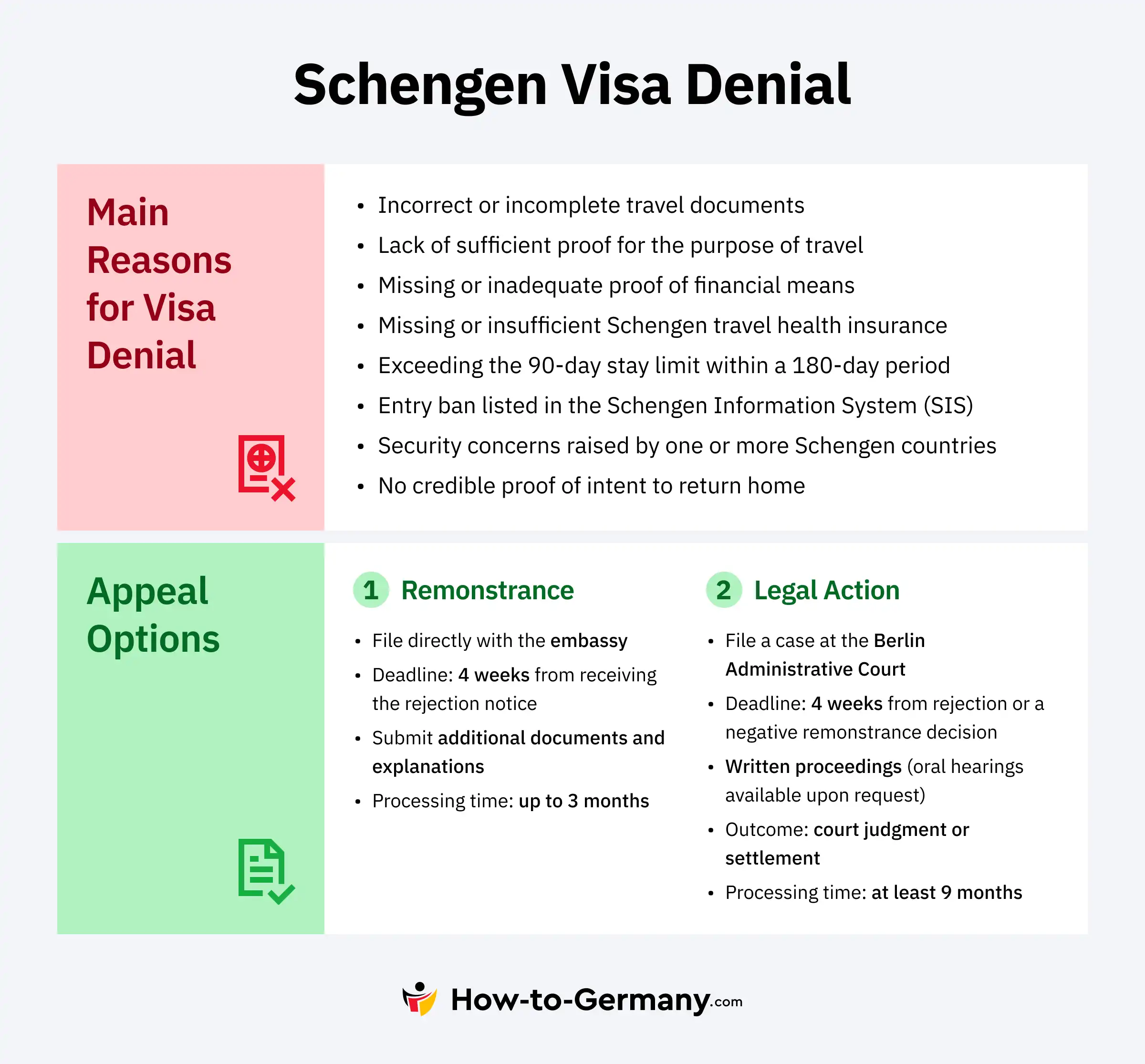
The reasons for a visa rejection can vary greatly. A visa rejection due to missing documents or procedural errors may be easier to fix with a new application. It is more serious if the embassy rejects a German visa because of security concerns, doubts about the purpose of stay, doubts about the willingness to return, or non-fulfilled admission criteria.
The main reasons for a visa rejection are as follows:
Forged, falsified, or non-accepted travel documents
A valid passport is required for a visa to be issued.
The visa application will be rejected if the embassy concludes that a passport is forged or falsified.
Passport photos submitted with the visa application must meet the biometric requirements of the German authorities. These Germany visa photo requirements typically include specific dimensions for the photo, a neutral facial expression, and a plain background.
There may also be problems with issuing visas in a few countries whose passports do not meet the Schengen countries’ technical standards for biometrics and machine readability. Some countries’ passports may not be recognized in the Schengen area or by individual Schengen countries.
Forgery of other documents also leads to visa rejection.
Missing documents
To receive a visa for Germany, you must provide all necessary documents. If documents are missing, your visa may be rejected. You must also submit the correct visa application form and, where required, pass a visa interview at the German mission or visa application center.
Difficulties in obtaining a visa typically arise in the following situations, for example:
Insufficient evidence of the purpose of travel
Applicants must provide appropriate documentation to support their travel reasons when applying for a German visa. For a student visa, this might include a letter of admission from a German university. A work visa might require a job offer from a German employer and proof of professional qualifications. German embassies require specific documents for different visa types and travel reasons.
For example, international students can apply for a student applicant visa or a regular German student visa. However, a student visa will only be granted if the student is officially admitted to a German university. Proof of contact with universities for orientation or admission to a study preparation program can be relevant for a student applicant route.
Reasons for refusal due to insufficient evidence of the purpose of the trip include, for example:
| Reason | Issue | Example / Details | Notes |
|---|---|---|---|
| Canceled Bookings | Submitted travel documents are no longer valid. | Flight or hotel reservations have been canceled. | Embassies may verify bookings. |
| Inconsistent Travel Dates | Mismatch in documentation. | Leave letter dates differ from planned travel dates. | Must align across all documents. |
| Insufficient Family Proof | Family ties not credible. | Missing or unclear proof when visiting relatives. | Applies to family visit visas. |
| Missing Employment / Study Proof | No strong evidence of ties to the home country. | No proof of job, enrollment, business activity, or other return ties. | Can weaken return intention. |
| Missing Qualifications / Language Proof | Requirements not met. | No degree certificates, recognition documents, or language proof. | Common for students, job-seekers, skilled workers, and family reunification visas. |
| No Leave Letter | Employer or institution did not confirm leave. | Missing official leave approval. | Required for many employees and students. |
| Previous Visa Misuse | Prior visa not used as intended. | German visa used mainly for another country. | Raises credibility concerns. |
| Unclear Purpose of Stay | Purpose not sufficiently documented. | Submitted documents do not clearly explain reason for travel. | One of the most common refusal reasons. |
Missing or insufficient proof of financial means
To be issued a Schengen visa, applicants must prove that they can independently finance their living expenses during the entire stay in Germany and the Schengen area. There are various options for doing so, for example:
- Proof of own financial means through salary statements or bank statements
- A written declaration from family members, for example parents, that they will cover the costs of the stay, including proof of available financial resources
- A German Declaration of Commitment from a sponsor residing in Germany. Sponsors can be family members, friends, companies, or public institutions. The declaration must be submitted to the relevant immigration office, which will review it.
- International students can open a German blocked account with a deposit of at least €11,904 for a full year. €992 can be paid out to a German current account per month. A pro rata deposit is possible for shorter study visits.
The visa application will be rejected if none of these proofs are provided or the German mission does not accept the documents submitted.
No proof of health insurance
A health insurance policy with coverage of at least €30,000 is required for a German visa. It must be valid for the entire duration of the planned trip, and, in addition to outpatient and inpatient emergency treatment, it must also ensure medically necessary return transport to the home country and repatriation in the event of death. The insurer must be based in Germany or another European country.
International students can usually also obtain a German visa with travel health insurance that meets the requirements of the German authorities. However, providers often only offer travel insurance for a limited period of time. An alternative can be expat insurance, which is offered by insurers such as Feather or Getsafe for a stay of up to 5 years. Students studying full-time at a German university need regular German health insurance at the latest after entering Germany.
C-Visa: Non-compliance with the permissible length of stay
A C visa entitles you to stay in the Schengen Area for a maximum of 90 days within a 180-day period. If your travel plan violates this rule, or if you recently used too many Schengen days, the visa may be refused.
Security concerns
Germany or another Schengen country may have security concerns about a visa applicant’s entry. These may include assumed threats to internal security, public order, international relations, or public health.
A German visa is usually impossible if a visa applicant has been reported to the Schengen Information System, known as SIS. Those affected can apply to the Federal Criminal Police Office in Wiesbaden for self-disclosure and, if necessary, to the office that initiated the entry to request deletion or a time limit.
Lack of willingness to return
One of the most common reasons for refusing visitor visas for the Schengen area is the assumption that the applicant is unwilling to return to their home country.
Visa applicants must convince the embassy that they are economically and socially rooted in their country. Evidence of this includes, for example:
- A verifiable and adequate occupation
- Care of relatives
- Family ties, such as spouse, children, or parents
- Property, real estate, or other assets
The economic circumstances play a central role in assessing the willingness to return. If the embassy has doubts, the visa may not be granted.
What to do after a German visa rejection
If your German visa application is rejected, you have two realistic options: file a lawsuit with the Administrative Court in Berlin or submit a new visa application with improved documents.
Since July 1, 2025, the remonstration procedure, meaning the voluntary appeal at the German embassy, has been abolished worldwide. Applicants can no longer request a review of their visa rejection through the embassy. The Federal Foreign Office announcement explains that the voluntary remonstration procedure was discontinued worldwide.
In many cases, submitting a new visa application is the faster and more practical option — especially if the rejection was due to missing documents, insufficient evidence, unclear travel plans, or fixable contradictions.
After July 1, 2025, German missions do not process remonstrations. If you wait for an embassy appeal that no longer exists, you may lose the one-month deadline for a court action.
Submitting a new visa application
If your visa was rejected due to incomplete or unclear documentation, reapplying is often the most effective solution.
Before submitting a new application, you should:
- Carefully review the reasons for the visa rejection
- Provide all missing or corrected documents
- Strengthen proof of your travel purpose and financial means
- Submit additional evidence demonstrating your willingness to return to your home country
- Remove contradictions between your travel dates, hotel bookings, flight reservations, bank statements, and leave approval
A new application can usually be processed faster than legal action and offers a higher chance of success if the issues are clearly resolved.
Filing a lawsuit with the Administrative Court in Berlin
Alternatively, you can challenge the visa rejection by filing a lawsuit with the Administrative Court in Berlin. Visa lawsuits are usually handled by the Administrative Court in Berlin.
This option may be appropriate if:
- You believe the decision was legally incorrect
- You have already submitted all required documents
- The rejection is based on disputed facts or legal interpretation
- The refusal affects a high-stakes situation such as study, work, family reunification, or long-term residence plans
Legal proceedings must typically be initiated within one month of receiving the rejection notice. Read the legal-remedy instructions in the refusal letter carefully, because they state the competent court and deadline.
A visa lawsuit is more formal than a new application. The application to the court must be written in German. The Administrative Court does not explain the reasons for the embassy’s rejection and does not provide legal advice. A lawyer is not always legally required, but legal help can be useful if the case involves complex facts, disputed documents, family reunification, skilled work, or a previous overstay. The court’s legal application office information can help applicants understand procedural support, but it is not a substitute for legal advice.
Court fees apply. As a rough orientation, applicants often need to budget several hundred euros for court fees. For a standard visa lawsuit with a default value in dispute of €5,000, the 3.0 court fee after the June 1, 2025 update is generally €511.50, plus lawyer fees if an attorney is used. The exact amount can vary depending on the case and court assessment. The duration depends on the individual case and court workload. Many visa lawsuits take many months, and some can take 12 to 15 months or longer.
How to read a German visa refusal letter
A visa refusal letter usually lists the reasons for refusal, often through checked boxes or numbered reasons. Do not treat the form as a generic rejection. The specific boxes and any added notes determine what you should fix next.
| Refusal letter part | What it usually means | What to do next |
|---|---|---|
| Doubts about return intention | The embassy is not convinced that you will leave the Schengen Area on time. | Add stronger evidence of employment, study, family ties, property, business activity, or other return obligations. |
| Financial means not proven | Your bank statements, sponsor proof, or declaration of commitment were missing or not credible. | Submit clearer financial documents, consistent bank history, accepted sponsorship proof, or a proper declaration of commitment. |
| Missing or invalid documents | The application was incomplete or contained documents the embassy could not accept. | Use the embassy checklist and submit a corrected new application. |
| Purpose of stay unclear | The documents do not clearly support the claimed purpose of travel. | Add a clearer invitation, itinerary, admission letter, work contract, event proof, or other purpose-specific evidence. |
| Security or SIS issue | There may be an alert, public-order concern, or identity issue. | Consider legal advice before reapplying, because this can be harder to fix with documents alone. |
The Auslandsportal can reduce document mistakes
Germany launched the Consular Services Portal, also known as the Auslandsportal, worldwide for national visa procedures on January 1, 2025. The system allows applicants to submit many national visa applications online and upload required documents digitally.
The portal does not remove the need for careful preparation. You may still need an in-person appointment to show original documents, give biometric data, and pay the fee. However, the online process can help reduce common errors because documents can be uploaded and reviewed earlier in the process.
For national visa applications, check whether your visa type and responsible German mission support online submission through the Consular Services Portal. This can help avoid avoidable refusals caused by incomplete paperwork.
Conclusion
Obtaining a German visa requires careful preparation and complete documentation. While a rejection can be frustrating, it is often possible to resolve the issue.
Applicants now need to decide between reapplying with improved documents and filing a lawsuit with the Administrative Court in Berlin. In most cases, reapplying is faster and more practical if the rejection was caused by missing or weak documents. Court action is more appropriate where the decision appears legally wrong, the case is high-stakes, or the refusal cannot realistically be fixed by simply submitting better paperwork.
The safest next step is to read the refusal letter carefully, identify the exact reasons for rejection, check the one-month court deadline, and decide quickly whether a stronger new application or legal action is the better route.
Frequently Asked Questions
No. The remonstration procedure was abolished worldwide on July 1, 2025. German embassies and consulates no longer accept, process, or reply to remonstrations against visa refusals. Do not wait for a remonstration response, because you may miss the strict deadline for filing a lawsuit.
Your main options are to submit a stronger new visa application or file a lawsuit with the Administrative Court in Berlin. A new application is often better if the refusal was caused by missing documents, weak financial proof, unclear travel purpose, or fixable contradictions. A lawsuit may be appropriate if the decision appears legally wrong or the refusal affects a serious long-term plan.
You usually have one month from receiving the rejection notice. Always read the legal-remedy instructions in the refusal letter, because they state the deadline and competent court. If you miss the deadline, you may lose the chance to challenge that decision in court.
The lawsuit must be filed in German, and the court does not give legal advice. You should include the refusal letter, your application documents, supporting evidence, and the reasons why you believe the rejection was unlawful. Court fees apply, and lawyer fees apply if you hire an attorney. The process can take many months and sometimes longer than one year.
A refusal letter usually lists the reasons for rejection, often through checked boxes or numbered reasons. Common reasons include unclear purpose of travel, insufficient financial proof, doubts about return intention, missing documents, invalid insurance, or security concerns. The exact reasons determine whether reapplying or filing a lawsuit makes more sense.