
How we earn our money
We finance our services on how-to-germany.com through affiliate programs.
When a user orders a financial product through our site and their application is approved, we may receive a commission from some providers. It’s important to note that this does not in any way influence our independent ratings and recommendations.
All the products we present on how-to-germany.com are selected for their quality, range of services, and excellent value for money.
Electricity in Germany: Cost Comparison 2026
- Liberalized Market & The Default Trap: Germany has a competitive energy market where you can choose your own supplier. If you don’t sign a contract, you fall into the Grundversorgung (basic supply)—the most expensive default tariff provided by the local utility. Use our energy calculator to determine if you’re being overcharged.
- Price Structure: Your bill is split into a fixed monthly Grundpreis (base fee) and a usage-based Arbeitspreis (unit rate). Due to recent federal grid fee subsidies, average rates are currently stabilized between 31–33 cents/kWh.
- The Payment Cycle: You pay a fixed monthly installment called an Abschlag. Once a year, you receive your Jahresabrechnung (annual statement), which compares your payments to actual usage, resulting in either a refund or a Nachzahlung (extra payment).
Best Electricity Plans for Expats
Understanding the German Electricity Market
The average electricity price for German households is approximately 32.5 to 34 cents per kWh. A typical single-person household consumes about 1,500 kWh annually, resulting in a monthly cost of roughly €50 to €60 (including the base price). Prices vary based on your region, provider, and whether you use electricity for water heating.
Those who don’t switch to private plans have to pay a flat fee, which expats often aren’t aware of. Electricity bills for expats in Germany don’t have to be expensive: With new federal subsidies on grid fees and the rise of dynamic tariffs, companies offer stable plans for electricity rates – if you know where to find them.
Average German Electricity Expense by Family
| Household Size | Avg. Annual Consumption | Est. Monthly Cost | Recommendation |
|---|---|---|---|
| 1 Person | 1,500 kWh | €52 | Ideal for “Single-Tariff” plans. |
| 2 People | 2,500 kWh | €80 | Compare “Eco-power” (Ökostrom) plans. |
| 3 People | 3,500 kWh | €110 | Potential for savings via switching. |
| 4+ People | 4,500+ kWh | €140+ | High potential for savings via switching. |
The German electricity market is characterized by high transparency but complex pricing structures. Unlike many countries where a flat rate might apply, German utility bills are divided into fixed and variable costs. Understanding these components is essential for using an electricity calculator effectively.
The basic supply (Grundversorgung) applies when you move into a new home, and you are automatically enrolled with the local provider. This is usually the most expensive tariff. Switching to a private provider can save up to €300 per year. Look for contracts with a Preisgarantie to protect against market fluctuations for 12 or 24 months.
Example Calculation of a Fair German Electricity Price
| Step / Description | Calculation |
|---|---|
| 1. Convert Power to Kilowatts (kW) | 500W / 1,000 = 0.5 kW |
| 2. Calculate Daily Energy Consumption (kWh) | 0.5 kW × 6 hours/day = 3 kWh |
| 3. Calculate Weekly Energy Consumption (kWh) | 3 kWh/day × 5 days/week = 15 kWh |
| 4. Calculate Weekly Electricity Cost | 15 kWh × €0.29/kWh = €4.35 |
| Final Monthly Cost | €4.35 x 4 = €17.40 |
Key Electricity Terms
- Arbeitspreis (Unit Price): The cost per kilowatt-hour (kWh) consumed. This is the primary lever for reducing your bill through energy-saving habits.
- Grundpreis (Base Price): A fixed monthly fee independent of consumption. It covers grid maintenance and billing administration.
- Abschlagszahlung (Installment): Monthly payments based on estimated annual usage. A final settlement (Abrechnung) occurs once a year.
Components of the Electricity Price
The price paid by consumers is composed of several regulated and market-driven factors. According to recent data from the Federal Network Agency (Bundesnetzagentur), the breakdown is as follows:
Electricity Bill Page 1: The Summary
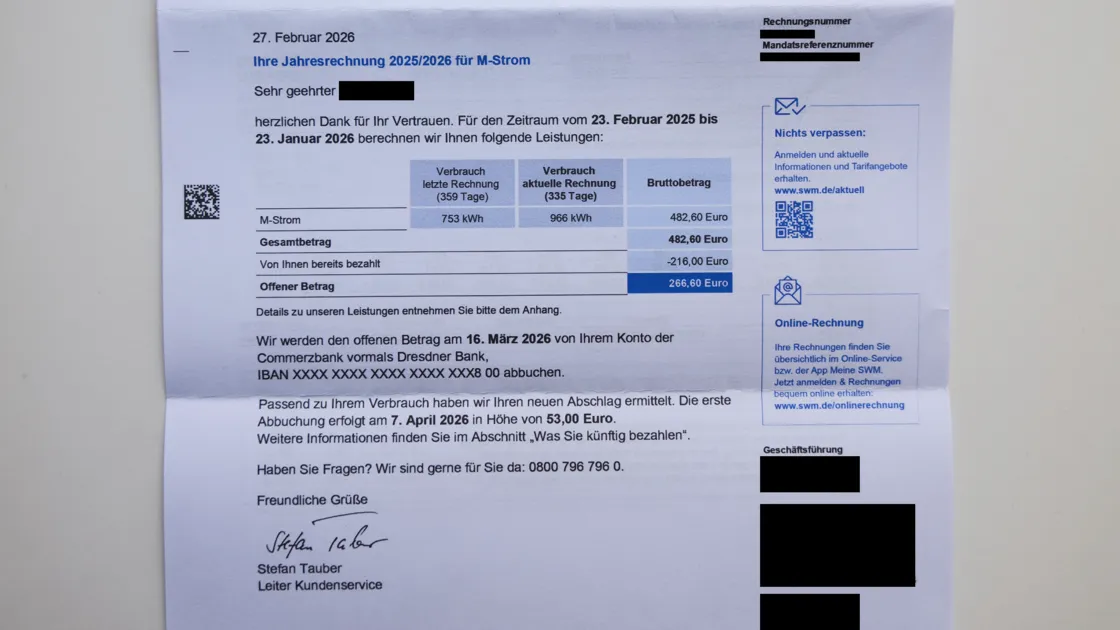
The front page is your annual summary. It shows whether you have a credit (Guthaben) or if you owe an additional payment (Nachzahlung). Good to watch for:A large Nachzahlung and a big jump in your new monthly payment (Abschlag) are the first signs your current plan is too expensive for your actual energy usage.
Electricity Bill Page 2: Price Breakdown
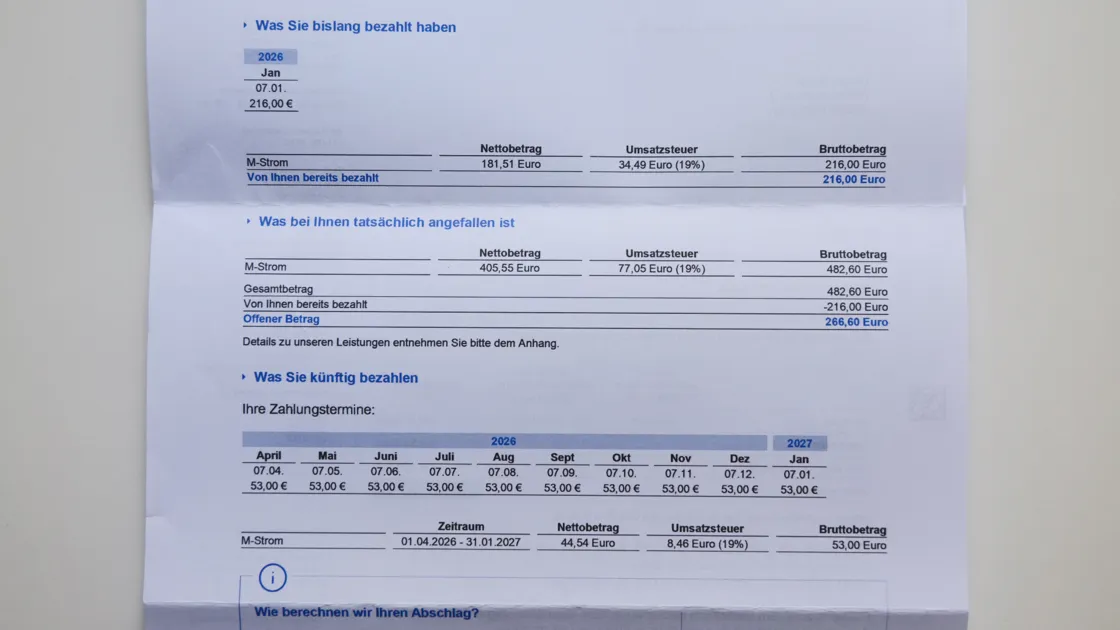
This page details your total electricity cost for the year before deducting the monthly payments you’ve already made. It separates the cost of the electricity itself from the fees for using the grid (Netznutzung).
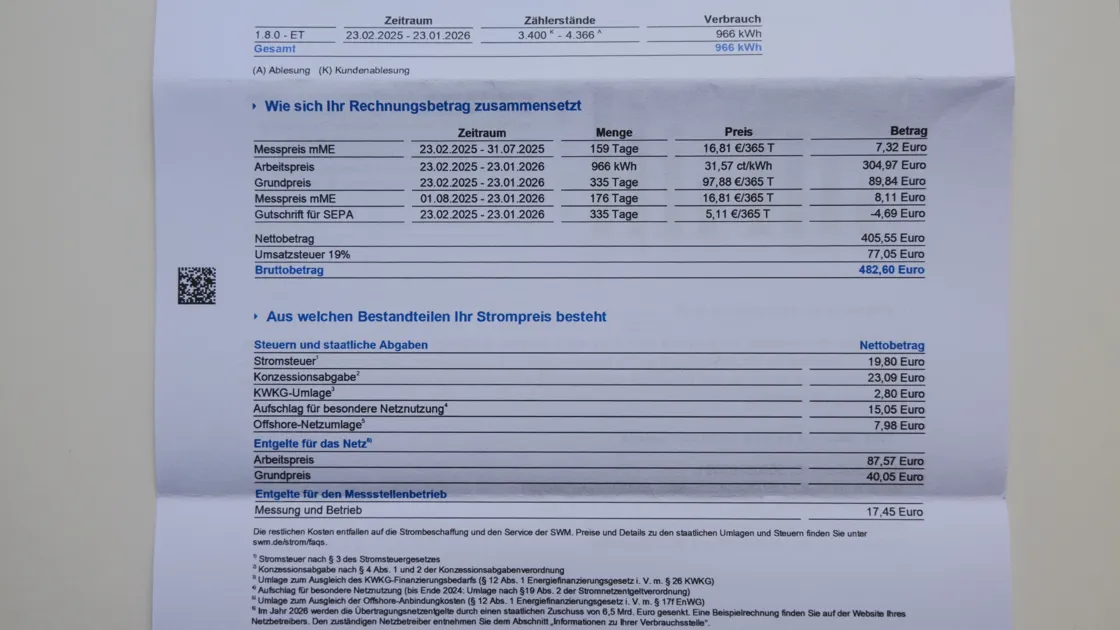
Some price distributions vary, but in general, the bill is comprised of:
- Procurement and Sales (~40%): The cost for providers to buy energy on the European Energy Exchange (EEX) and their profit margin.
- Network Charges (Netznutzungsentgelte) (~27%): Fees for the transport of electricity. These are higher in rural areas due to lower population density.
- Taxes and Levies (~33%): Includes the 19% VAT (Umsatzsteuer), Electricity Tax (Stromsteuer), and various surcharges like the Offshore Liability Levy.
Energy Calculator: Determine Overpriced Electricity
To get an accurate estimate of your future bills or to check if a provider’s offer is competitive, you will need:
- Your Annual Consumption: Found on your last Stromabrechnung (annual bill).
- The Power Rating (Watts): For individual appliances, check the label on the back or bottom of the device.
- Calculate Daily Consumption: Energy calculator tools like the one in the image below determine if you’re being charged too much for your electricity bill.
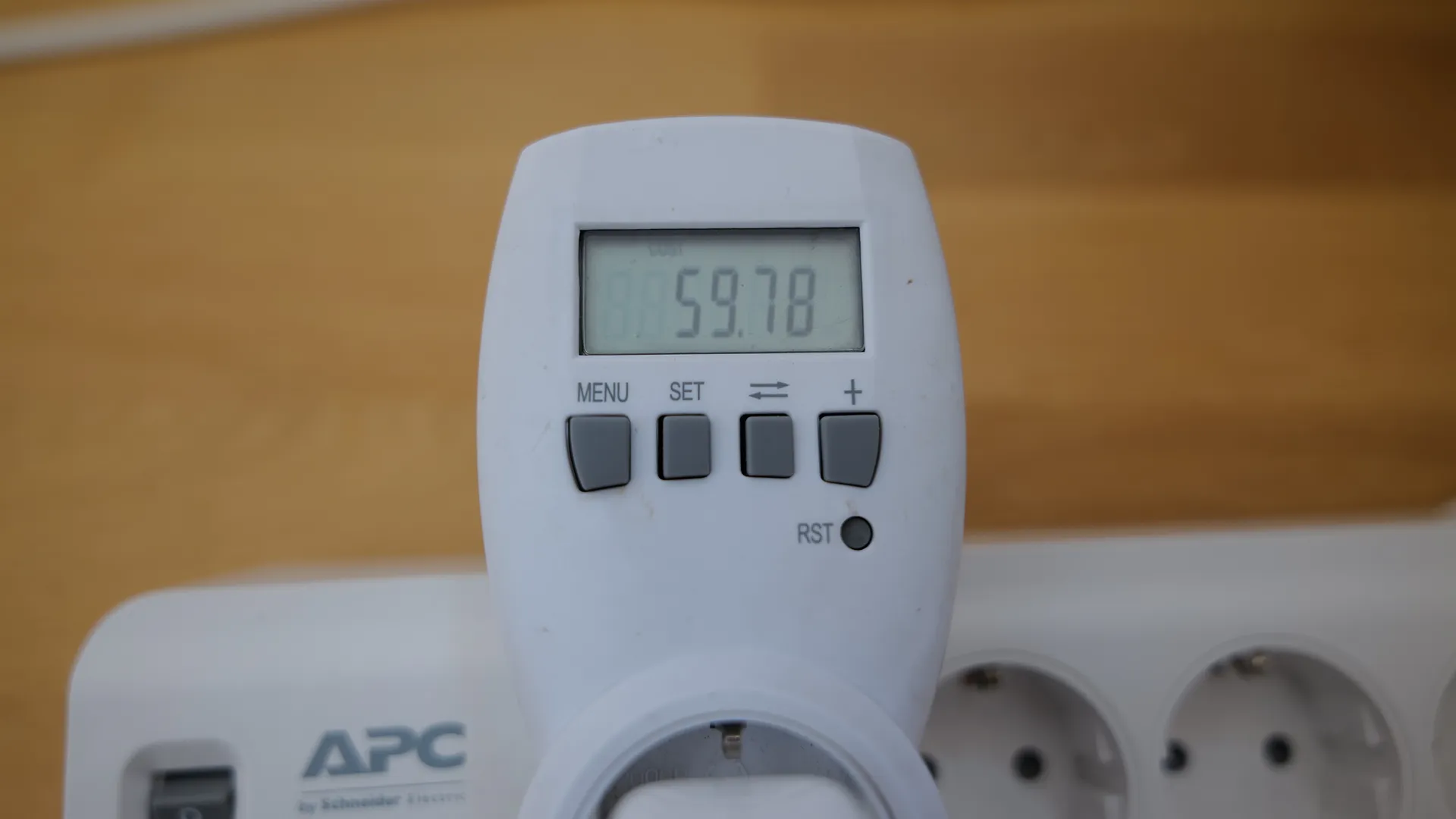
Important: This calculator helps you pinpoint exactly how much a single appliance costs you per year based on its power usage and your personal electricity rate. To see if your base rate is too high, compare the annual cost using your current price per kWh against the cost you would get using the German national average of ~33 cents.
Conclusion
Navigating the German electricity market is a matter of proactive management rather than passive acceptance. While prices have stabilized around 33 cents per kWh, the most crucial takeaway is that significant savings are readily available to those who take action.
The default “basic supply” (Grundversorgung) tariff, where many residents and nearly all newcomers start, is consistently the most expensive option. The single most effective strategy for reducing your electricity bill is to compare offers and switch to a competitive private provider. This simple step can save a typical household between €200 and €400 annually.
By understanding the key components of your bill—the Arbeitspreis and Grundpreis—and securing a contract with a price guarantee (Preisgarantie), you can create predictable and manageable energy costs. Ultimately, the power to lower your electricity expenses in Germany lies firmly in your hands.
Frequently Asked Questions
As of early 2026, the average electricity price for household customers has stabilized at approximately 32.5 to 34.5 cents per kWh. This is a decrease from the peaks of 2023, largely due to reduced grid fees and federal subsidies. However, prices vary significantly by region and provider, so it is always best to check your specific tariff.
For a single-person household with an average annual consumption of 1,500 kWh, you can expect a monthly bill of roughly €45 to €55. This includes both the consumption price per kWh and the fixed monthly base price (Grundpreis).
Your electricity bill consists of two parts: the Arbeitspreis (the price you pay for each kWh consumed) and the Grundpreis (a fixed monthly base fee). The base fee covers the costs of the meter, billing, and grid access. Even if you use zero electricity, you will still be charged the Grundpreis.
For most private consumers on standard contracts, the answer is no. Night-time tariffs (Nachttarife) were common for older storage heaters, but they are becoming rare. However, if you have a Smart Meter, you can now switch to Dynamic Tariffs. These allow you to pay lower rates during off-peak hours (like midday when solar production is high or late at night).
You can usually find the wattage (W) on a silver sticker or plate located on the back or bottom of the device. Common examples include:
Kettle: 2,000–2,400W
Gaming PC: 200–600W
LED TV: 50–150W
Laptop: 30–60W
To the relief of many consumers, the Gas Storage Levy was abolished on January 1, 2026. This has helped lower the overall cost per kWh for natural gas, though CO2 pricing continues to influence the final total.
In Germany, energy companies use an Abschlag system. They estimate your annual consumption and divide it into 11 or 12 equal monthly payments. Once a year, they read your meter. If you used less than estimated, you get a refund; if you used more, you receive a bill for the difference and your monthly payment is adjusted upward for the following year.
Q: Can I save money by switching providers in 2026? A: Yes! If you are still on a “Basic Supply” (Grundversorgung) contract with your local municipal utility (Stadtwerke), you are likely paying a premium. Switching to a competitive private provider can often save households between €200 and €400 per year.
Footnotes and Sources
- Bundesnetzagentur – Network Charges
- Federal Ministry for Economic Affairs and Climate Action (BMWK) – The Electricity Price
- Federal Ministry of Finance – Electricity Duty Act (Stromsteuergesetz)
- BMWK – State-Imposed Components of the Electricity Price
- SMARD.de – The German Electricity Market Explained
- Gesetze im Internet – Stromsteuergesetz (StromStG)
- Statistisches Bundesamt (Destatis) – Consumer Price Index for Electricity
- BDEW – Strompreisanalyse (Electricity Price Analysis)
- Verbraucherzentrale – Energie (Consumer Advice Center – Energy)
- Gesetze im Internet – Energiewirtschaftsgesetz (EnWG – Energy Industry Act)