
How we earn our money
We finance our services on how-to-germany.com through affiliate programs.
When a user orders a financial product through our site and their application is approved, we may receive a commission from some providers. It’s important to note that this does not in any way influence our independent ratings and recommendations.
All the products we present on how-to-germany.com are selected for their quality, range of services, and excellent value for money.
Types of German Bank Accounts
 Written by
Sadie Voss
Content Lead & Editor
Sadie Voss is the Lead Editor for How-to-Germany.com. As an expat who carved her own way into Berlin from the United States, Sadie is deeply...
Written by
Sadie Voss
Content Lead & Editor
Sadie Voss is the Lead Editor for How-to-Germany.com. As an expat who carved her own way into Berlin from the United States, Sadie is deeply...
 Reviewed by
Erkan Boga
Erkan Boga is the founder and CEO of qmedia GmbH, the publishing house behind How-to-Germany.com. He established the platform with the clear vision of creating...
Reviewed by
Erkan Boga
Erkan Boga is the founder and CEO of qmedia GmbH, the publishing house behind How-to-Germany.com. He established the platform with the clear vision of creating...
- Most expats need a current account: A German Girokonto is used for salary, rent, bills, insurance, direct debits, and everyday payments.
- Different accounts serve different purposes: Current accounts, blocked accounts, savings accounts, business accounts, broker accounts, joint accounts, and credit cards are used for different financial needs.
- Eligibility varies by provider: Some banks require Anmeldung, a German address, tax ID, residence permit, income, or SCHUFA history.
- Online banks are often easier for newcomers: Digital banks may offer faster setup, lower fees, and better English-language support than traditional branch banks.
- Traditional banks still have advantages: Branch banks can be useful for cash deposits, loans, mortgages, local support, and long-term banking relationships.
Banking Types for Expats in Germany: How It Works
Banking in Germany can feel unfamiliar when you first arrive. The system includes traditional banks, online banks, savings banks, cooperative banks, neobanks, blocked account providers, and international money services. Each type of provider serves a slightly different purpose.
For most expats, the first priority is a current account, called a Girokonto. This is the account you use for salary, rent, insurance, utilities, subscriptions, direct debits, and everyday spending.
Over time, you may need other financial products too, such as a savings account, blocked account, business account, credit card, broker account, or joint account. The right setup depends on your residence status, documents, income, language needs, and whether you are a student, employee, freelancer, couple, or long-term resident.
Types of Bank Accounts in Germany
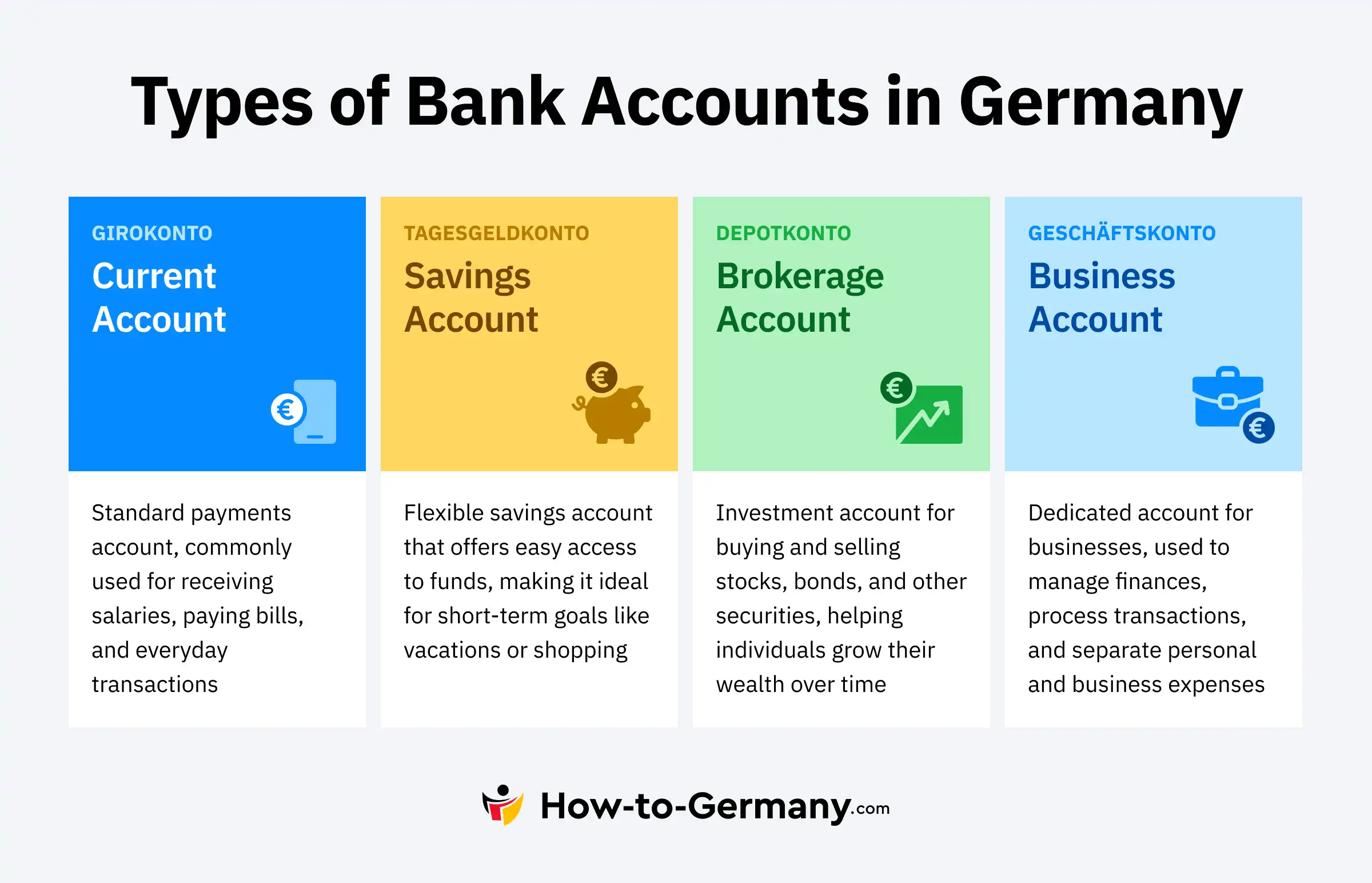
Germany has several types of bank accounts. Some are used for everyday payments, while others are designed for saving, visa proof, business income, investing, shared household expenses, or credit access.
| Account type | German term | Best for | Usually needed by expats? |
|---|---|---|---|
| Current account | Girokonto | Salary, rent, bills, direct debits, and daily spending. | Yes, for most residents. |
| Basic account | Basiskonto | Basic payment access if you cannot open a regular account. | Sometimes, especially if rejected elsewhere. |
| Blocked account | Sperrkonto | Visa applicants proving they can cover living costs. | Yes, for some students, job seekers, and visa applicants. |
| Savings account | Tagesgeldkonto / Sparkonto | Emergency savings and short-term savings. | Useful, but not always essential. |
| Fixed-term deposit | Festgeldkonto | Money you can lock away for a fixed period. | Optional. |
| Business account | Geschäftskonto | Freelancers, self-employed people, and companies. | Useful or required depending on business type. |
| Broker account | Depot | Buying ETFs, stocks, funds, and securities. | Only if investing. |
| Joint account | Gemeinschaftskonto | Shared rent, bills, groceries, utilities, and household costs. | Useful for couples, families, and long-term shared households. |
| Credit card account | Kreditkartenkonto | Travel, deposits, online payments, and credit access. | Optional. |
Current Account / Girokonto
A current account, or Girokonto, is the main bank account used in Germany. It is used for everyday payments and is the first account most expats should open after moving to Germany.
You usually need a current account to:
- Receive your salary.
- Pay rent.
- Set up direct debits for health insurance, utilities, phone contracts, and subscriptions.
- Send and receive SEPA transfers.
- Use a debit card or Girocard.
- Withdraw cash.
For a detailed comparison of providers, see our guide to the best German girokonto accounts.
Basic Account / Basiskonto
A basic account, or Basiskonto, is a simplified payment account. It is designed for people who need access to basic banking services but may not qualify for a standard current account.
Under the German Payment Accounts Act (Zahlungskontengesetz, ZKG), anyone legally residing in the EU has a statutory right to open a Basiskonto. This right can apply even if you do not have a permanent address or have no SCHUFA history. A bank can still require identity verification, but a Basiskonto is legally designed as the fallback option when normal account opening is difficult.
A basic account usually allows you to:
- Receive money.
- Make transfers.
- Set up direct debits.
- Withdraw cash.
- Use a payment card.
However, it may not include overdraft, credit cards, or premium banking services.
Blocked Account / Sperrkonto
A blocked account, or Sperrkonto, is used to prove that you have enough money to support yourself in Germany. It is most common for international students, language students, job seekers, and some visa applicants.
A blocked account is not the same as a normal current account. You deposit a required amount, but only a limited monthly amount can be withdrawn. In 2026, the standard blocked-account requirement for many student visa applicants is €11,904 per year, or €992 per month. For the Opportunity Card (Chancenkarte), the requirement is €13,094.40 per year, or €1,091.20 per month.
Always check the amount required for your exact visa type before opening the account.
Most people who need a blocked account will also need a current account after arriving in Germany, because the blocked account is mainly for visa proof and monthly payouts.
Savings Account / Tagesgeldkonto
A savings account is used to keep money separate from everyday spending. In Germany, a common type is the Tagesgeldkonto, or instant-access savings account.
A Tagesgeld account can be useful for:
- Emergency savings.
- Short-term savings goals.
- Money you do not want to keep in your current account.
- Receiving interest while keeping access to your money.
You usually need a current account as a reference account for transfers in and out.
Fixed-Term Deposit / Festgeldkonto
A fixed-term deposit, or Festgeldkonto, is used for savings that you do not need immediately. You lock your money for a fixed period and usually receive a fixed interest rate.
Festgeld can be useful if you know you will not need the money during the term. It is less flexible than a Tagesgeld account because access before the end of the term may be limited or impossible.
Business Bank Account / Geschäftskonto
A business account, or Geschäftskonto, is used for business income and expenses. It is especially relevant for freelancers, self-employed people, and company owners.
Some business types must use a separate business account. Even when it is not legally required, separating personal and business transactions can make accounting, tax returns, and invoice tracking much easier.
A business account may be useful if you:
- Work as a freelancer in Germany.
- Are self-employed.
- Run a company.
- Send invoices to clients.
- Need to separate business expenses from personal expenses.
Broker Account / Depot
A broker account, called a Depot, is used to buy and hold securities such as ETFs, stocks, funds, and bonds.
A broker account is not used for daily banking. You normally connect it to a current account, transfer money to the broker, and then use it to invest.
If you want to invest in Germany, compare broker fees, ETF savings plan costs, available products, tax handling, English support, and whether you can keep the account if you leave Germany later.
For more details, see our guide to online German broker bank accounts.
Joint Account / Gemeinschaftskonto
A joint account, or Gemeinschaftskonto, is a shared bank account with one IBAN and usually two account holders. It is most useful for couples, married partners, families, and long-term shared households that want one account for common expenses.
A joint account can be useful for:
- Rent and utilities.
- Groceries and household supplies.
- Insurance payments.
- Internet, phone, and streaming subscriptions.
- Shared savings goals or travel costs.
Most everyday joint accounts in Germany are Oder-Konten, meaning either account holder can use the account independently. This is practical, but it also means both account holders should understand the shared responsibility before using an overdraft or keeping large sums in the account.
Application rules can vary significantly by provider. For example, C24 requires both people to already have individual C24 current accounts before opening a C24 joint account in the app. ING may require both joint-account holders to have a shared registered address, which can be a blocker if expat partners move to Germany at different times.
For more details, see our guide to joint bank accounts in Germany.
Credit Cards in Germany
Credit cards are available in Germany, but they are not always used in the same way as in other countries. Many German bank cards are debit cards, not true credit cards.
A credit card can be useful for:
- Travel bookings.
- Hotel deposits.
- Car rentals.
- Online payments.
- Emergency spending.
However, true credit cards and overdraft products often depend on creditworthiness and SCHUFA history.
For card comparisons, see our guide to German credit cards.
Types of Banks in Germany
Germany has many types of banks. Some are fully digital, while others have local branches. Some are designed for everyday residents, while others focus on students, freelancers, investors, or international transfers.
| Bank type | Examples | Best for | Main drawback |
|---|---|---|---|
| Online banks | C24, DKB, ING, comdirect | Low fees, digital banking, established residents. | May require German documents or credit history. |
| Neobanks | N26, Tomorrow, bunq | English support, app-based banking, fast setup. | Limited branch services and cash deposit options. |
| Traditional private banks | Commerzbank, Deutsche Bank, Postbank | Branch access, cash services, and full-service banking. | Higher fees and more paperwork. |
| Savings banks | Sparkasse | Local branches, regional banking, and cash access. | Fees and English support vary by region. |
| Cooperative banks | Volksbank, Raiffeisenbank | Local relationship banking. | Regional differences and limited English support. |
| International providers | Wise, Revolut | Multi-currency use and international transfers. | May not replace a full German current account. |
| Specialized providers | Fintiba, Expatrio, Kontist | Blocked accounts, student packages, and freelancer banking. | Useful for specific needs, not always full everyday banking. |
Online Banks in Germany
Online banks usually offer banking through a website or app instead of a branch network. They often have lower fees than traditional banks and may include current accounts, savings accounts, cards, broker accounts, and loans.
Online banks can be a good fit if you are comfortable managing your finances digitally. However, they may be harder for new arrivals if they require a German address, tax ID, income, or SCHUFA history.
In 2026, common online banking options include C24, DKB, ING, and comdirect. C24 is especially relevant for app-based users because its Smart account is fully digital and can be free without the same monthly incoming-payment requirement used by some direct banks. DKB is free with a monthly incoming payment of at least €700 or if the customer is under 28; otherwise, it costs about €4.50/month. ING is free with a monthly incoming payment of at least €1,000 or if the customer is under 28; otherwise, it costs about €4.90/month.
Neobanks in Germany
Neobanks are digital-first banks or financial providers that focus on app-based banking. They are often popular with expats because they tend to offer modern apps, simple card controls, lower fees, and better English-language interfaces.
Neobanks can be useful for new arrivals, but they may not offer the same branch services, cash deposit options, or long-term credit products as traditional banks.
Traditional Banks in Germany
Traditional banks include large private banks such as Commerzbank, Deutsche Bank, and Postbank. They usually offer current accounts, cards, loans, mortgages, investment products, and branch services.
They may be a better fit if you want in-person support, cash deposits, or a long-term banking relationship. They may be less attractive if you want the cheapest account or a fully English digital experience.
Sparkasse and Savings Banks
Sparkasse is a network of regional savings banks. Each local Sparkasse operates separately, so fees, account models, and customer service can vary by city or region.
Sparkasse can be useful if you want local branches and cash services. However, it may not be the best fit if you want low fees, English-language banking, or an online-first experience.
Volksbank and Raiffeisenbank
Volksbanken and Raiffeisenbanken are cooperative banks. They operate regionally and often focus on local customer relationships.
They can be suitable for people who prefer a local bank and in-person advice. For expats, the main limitations can be German-language service, regional variation, and less flexible digital onboarding.
International Banking Providers
International providers such as Wise and Revolut can be useful for expats who transfer money between countries, hold multiple currencies, travel often, or need an account before they have a full German setup.
These providers can be very helpful as secondary accounts. However, they may not always replace a German current account for salary, rent, direct debits, or long-term financial products.
Specialized Banking Providers
Specialized providers focus on specific needs. For example, blocked account providers help visa applicants prove funds, while freelancer banks help self-employed people manage business income.
These providers can solve a specific problem, but they are not always meant to replace a normal current account.
Bank Account Eligibility in Germany
Eligibility is one of the biggest banking issues for expats in Germany. Two people may apply for the same account and have different results depending on their address, documents, residence status, income, nationality, or credit history.
| Requirement | When it matters | What to do if you do not have it |
|---|---|---|
| German address | Most German banks need an address to send cards and documents. | Use a flexible digital or international provider until you are registered. |
| Anmeldung | Many banks ask for proof of address registration. | Look for providers that accept alternative address proof. |
| Residence permit or visa | Often relevant for non-EU citizens. | Check account requirements before applying. |
| Tax ID | Often needed for full tax reporting and some bank products. | Ask whether the tax ID can be submitted later. |
| SCHUFA history | Important for overdrafts, credit cards, loans, and some accounts. | Start with a debit-based account without credit products. |
| Income or salary | Needed for some free accounts, overdrafts, and credit products. | Choose an account without minimum incoming payment rules. |
| Supported nationality | Some banks and VideoIdent providers only support certain passports. | Check accepted documents before starting the application. |
German Bank Accounts for Non-Residents
A German bank account for non-residents can be difficult to open. Most banks prefer customers who live in Germany and can provide a German address.
If you do not live in Germany, you may have better options with international digital providers or banks in your current country that support euro transfers. If you need the account for a visa, a blocked account provider may be more relevant than a normal bank.
Best Type of Bank Account by Situation
The best bank account in Germany depends on what you need the account to do. Most expats should start with a current account, but some situations require an additional account.
| Situation | Best account type | Why | Next step |
|---|---|---|---|
| You just arrived in Germany | Online current account | Fast setup, simple app, suitable for everyday payments. | Compare the best German current accounts. |
| You do not have Anmeldung yet | International digital account | May be easier before full registration. | Switch to a German Girokonto after Anmeldung. |
| You are an international student | Blocked account + current account | The blocked account supports visa proof; the current account handles daily spending. In 2026, many student applicants need €11,904 per year or €992 per month. | Compare student bank accounts |
| You are applying for an Opportunity Card | Blocked account + current account | The blocked account can support proof of funds. In 2026, the amount is €13,094.40 per year or €1,091.20 per month. | Check the required visa proof amount before applying. |
| You are employed in Germany | German current account | Used for salary, rent, insurance, and direct debits. | Choose based on fees, cards, and English support. |
| You are a freelancer | Current account + business account | Separating personal and business transactions helps with taxes. | Compare freelancer-friendly business accounts. |
| You share expenses with a partner | Current account + joint account | A joint account can handle rent, utilities, groceries, and shared household costs. | Compare joint bank accounts. |
| You want to save money | Current account + Tagesgeld | A savings account keeps emergency money separate. | Comparesavings accounts |
| You want to invest | Current account + broker account | A broker account is needed for ETFs, stocks, and funds. | Compare online brokers in Germany. |
| You need cash deposits | Traditional branch account | Branch banks usually handle cash better than digital banks. | Compare branch banks and fees. |
Best Online Banks in Germany for Expats
Online banks are often attractive for expats because they usually offer digital applications, app-based banking, lower fees, and easier account management.
The best online bank in Germany for you depends on what you need from the account. Instead of choosing only by brand name, compare the features that matter for everyday life.
A good online bank for expats should offer:
- A simple account opening process.
- Clear document requirements.
- English-language app or support, if needed.
- A debit card for everyday payments.
- SEPA transfers and direct debits.
- Fair cash withdrawal rules.
- Transparent fees.
- Support for your passport or nationality during identity verification.
In 2026, C24, DKB, and ING are especially relevant online bank options. C24’s Smart account is a strong app-based free account option. DKB can stay free with at least €700 in monthly incoming payments or if the customer is under 28; otherwise, it costs about €4.50/month. ING can stay free with at least €1,000 in monthly incoming payments or if the customer is under 28; otherwise, it costs about €4.90/month.
Online banks can be ideal if you mostly use card payments and online transfers. They may be less suitable if you often deposit cash, need personal advice, or want a mortgage soon.
Girocard and Visa/Mastercard Debit Cards Work Differently
One German banking detail often surprises expats: a Girocard is not the same as a Visa Debit or Mastercard Debit card.
A Girocard is the domestic German debit card system. It is still useful in some bakeries, small restaurants, pharmacies, local shops, doctor’s offices, public offices, and other places that may not accept international card networks.
A Visa Debit or Mastercard Debit card works well for online payments, travel, hotels, subscriptions, and most modern card terminals. However, some local German businesses may reject it if they only accept Girocard.
Before opening an account, check which card is included:
- C24: Can be attractive for expats who want a free account with strong everyday card features, but always check the current card conditions.
- DKB: Includes a Visa Debit card, while the physical Girocard usually costs extra.
- ING: Includes a Visa Debit card, while the Girocard may cost extra depending on the current account model.
- N26: Works well with Mastercard Debit, but it is not a Girocard-based branch-bank setup.
- Traditional banks: More likely to offer Girocard access, but account and card fees may be higher.
For everyday expat life, the safest setup is usually a bank account with a reliable Visa or Mastercard Debit card plus Girocard access if you often shop at smaller local businesses.
Free Bank Accounts in Germany
Free bank accounts are available in Germany, but “free” does not always mean that every service is included. Some accounts have no monthly fee. Others are free only if you receive a minimum monthly incoming payment.
Before choosing a free account, compare the full fee structure.
| Fee type | What to check |
|---|---|
| Monthly fee | Is the account always free or only free with minimum incoming payments? C24’s Smart account is a notable free option in 2026, while DKB and ING use incoming-payment or age-based conditions. |
| Card fee | Is the debit card, Girocard, or credit card included? |
| ATM fee | How many free withdrawals are included, and from which ATMs? |
| Cash deposit fee | Can you deposit cash, and what does it cost? |
| Foreign currency fee | What happens when you pay or withdraw money outside the eurozone? |
| International transfer fee | How much do non-SEPA transfers and currency conversions cost? |
A free online account may be enough if you mostly use card payments, SEPA transfers, and online banking. A paid branch account may be better if you need regular cash services or in-person help.
German Banking Terms Expats Should Know
German banking vocabulary can be confusing at first. These terms appear often in bank applications, account conditions, cards, transfers, and fee lists.
| German term | English meaning | Why it matters |
|---|---|---|
| Girokonto | Current/checking account | Your main account for salary, rent, bills, and payments. |
| Basiskonto | Basic account | A legally protected basic payment account for people who cannot open a regular account. |
| Sperrkonto | Blocked account | Used by some visa applicants to prove living costs. |
| Tagesgeld | Instant-access savings | A savings account with flexible access. |
| Festgeld | Fixed-term deposit | A savings product where money is locked for a fixed term. |
| Depot | Broker account | Used to hold ETFs, stocks, funds, and securities. |
| Gemeinschaftskonto | Joint account | Used by two account holders for shared household costs. |
| IBAN | International bank account number | Used for transfers, salary, rent, and direct debits. |
| SEPA | Single Euro Payments Area | Used for euro transfers and direct debits across Europe. |
| Lastschrift | Direct debit | Common for insurance, utilities, phone contracts, and subscriptions. |
| Dauerauftrag | Standing order | A recurring transfer you schedule yourself. |
| Girocard | German debit card system | Still useful in some shops, offices, and local businesses. |
| Debitkarte | Debit card | A card that takes money directly from your account. |
| Kreditkarte | Credit card | Can mean a true credit card, charge card, or sometimes card product depending on provider. |
| Dispo | Overdraft | A credit line attached to your current account. |
| Kontoführungsgebühr | Account maintenance fee | The monthly fee for keeping your account open. |
| Geldautomat | ATM | Used for cash withdrawals. |
| Überweisung | Bank transfer | Used to send money from one account to another. |
| Freistellungsauftrag | Exemption order | Used to apply your saver’s allowance to taxable interest or investment income. |
Conclusion
Banking in Germany is easier once you understand the different account types and provider types. Most expats need a current account first, but your full setup may also include a blocked account, savings account, business account, broker account, joint account, or credit card.
If you are new to Germany, focus on eligibility first. Check whether you have the documents the bank requires, such as Anmeldung, a German address, residence permit, tax ID, income, or SCHUFA history. After that, compare fees, English support, cards, cash access, and online banking features. For visa-related accounts, also check the current blocked-account threshold for your exact visa type.
For many expats, the best setup is a German current account for daily life, plus additional accounts only when needed for saving, investing, freelancing, shared household expenses, or visa requirements.
Frequently Asked Questions
The main types of bank accounts in Germany include current accounts, basic accounts, blocked accounts, savings accounts, fixed-term deposits, business accounts, broker accounts, and credit card accounts.
Most expats should start with a current account, or Girokonto. This is the account used for salary, rent, bills, direct debits, and everyday payments. Students, freelancers, investors, and visa applicants may need additional account types.
The best online bank depends on your documents, language needs, fees, card requirements, and whether you need a German IBAN, cash withdrawals, or international transfers. For provider rankings, compare current account offers directly.
Yes, foreigners can usually open a bank account in Germany if they meet the bank’s requirements. These may include a passport, German address, Anmeldung, residence permit, tax ID, income, or SCHUFA history.
You do not always need strong SCHUFA history for a basic or debit-based account. SCHUFA matters more for overdrafts, credit cards, loans, mortgages, and some premium accounts.